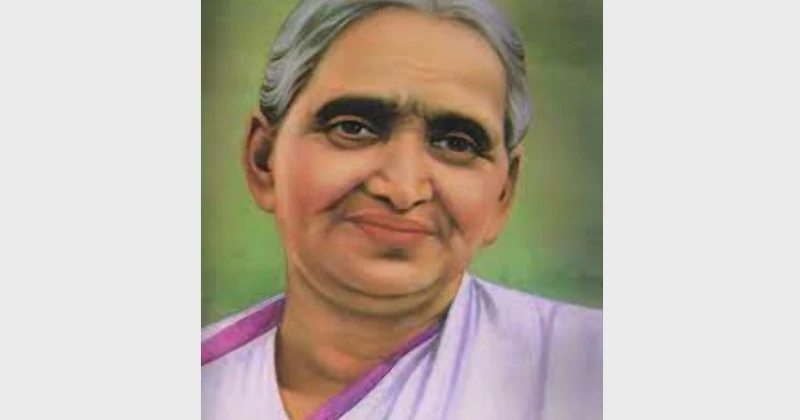
Karachi, August 13, 1947: As the subcontinent stood on the edge of Partition, with communal violence, uncertainty and fear gripping Karachi, most people were trying to escape the coming storm. Lakshmibai Kelkar fondly known as Maushiji chose to move in the opposite direction.
On August 13, 1947, just two days before India’s Independence and one day before Pakistan formally celebrated its independence, the founder and chief organiser of the Rashtra Sevika Samiti boarded a Tata Air Services flight from Bombay’s Juhu Airport bound for Karachi.
She was not travelling for ceremony or politics. She was responding to an urgent appeal from women of the Samiti trapped amid the rapidly deteriorating situation in Sindh. Her decision, taken when Karachi was already engulfed in anxiety and communal tension, has come to represent one of the lesser-known episodes of Partition-era courage.
13 अगस्त 1947
बंबई… जुहू हवाई अड्डा टाटा एयर सर्विसेज के काउंटर पर आठ-दस महिलाएं खड़ी हैं। सभी अनुशासित हैं और उनके चेहरों पर जबरदस्त आत्मविश्वास दिखाई दे रहा है। यह सभी 'राष्ट्र सेविका समिति' की सेविकाएं हैं।प्रमुख संचालिका लक्ष्मीबाई केलकर,अर्थात 'मौसीजी', कराची जाने वाली… pic.twitter.com/ZmTdCg8XaC
— Rashtra Sevika Samiti Delhi Prant (@sevikasamiti) August 11, 2026
The journey began with a letter. Jethi Devani, a Sevika from Hyderabad, Sindh, had written to Kelkar describing the increasingly precarious situation and urging her to come to Karachi. Devani came from an ordinary Sindhi family associated with the Sangh network and had played an important role in developing the Samiti’s work in the region.
Kelkar could have remained in Bombay. Instead, she decided that the organisation’s leadership had to stand beside its workers when they were most vulnerable.
The decision was all the more striking because the Rashtra Sevika Samiti had been founded only in 1936, barely 11 years earlier. Yet its network had already extended beyond Maharashtra into regions including Sindh, Punjab and Bengal. Contemporary accounts of the organisation describe Devani as one of the early figures who helped establish its work in Sindh.
For Kelkar, the existence of a crisis thousands of kilometres away was not a reason to stay back. It was precisely the reason to go. At Juhu Airport, Kelkar was accompanied by her associate Venu Tai Kalmkar.
The flight carried around 40–50 passengers, and according to accounts of the journey, the two women were among very few Hindus aboard. Both travelled wearing nine-yard Maharashtrian sarees, standing out in a passenger group largely composed of Muslims.
As the aircraft travelled towards Karachi, some passengers reportedly raised slogans celebrating Pakistan. Accounts published by sources associated with the Samiti and RSS tradition recall provocative slogans including “Pakistan Zindabad” and “Lad ke liya hai Pakistan, hans ke lenge Hindustan.”
Yet Kelkar did not retreat into fear.
The same accounts describe her remaining composed and visibly resolute as the slogans gradually subsided.
The symbolism was stark. At a time when people were being divided by an impending political boundary, two women were voluntarily crossing that very boundary to stand with those who feared what the next few days might bring. The aircraft left Juhu at around 10:30 in the morning, stopping at Ahmedabad before continuing towards Karachi. It landed at Drigh Road Airport at approximately 3 pm.
Kelkar was met at the airport by her son-in-law, Cholkar, and a group of approximately 15–20 women from the Rashtra Sevika Samiti. RSS Swayamsevaks were also reportedly present for security. The group then travelled through Karachi in cars to reach their destination.
The timing could hardly have been more extraordinary.
The city was preparing for the formal transfer of power and Pakistan’s independence celebrations. The political leadership was arriving, public ceremonies were being organised and the atmosphere was charged with uncertainty.
At the same time, families and communities were confronting the possibility that the political map of the subcontinent would permanently alter their lives. And into this Karachi stepped Kelkar. There was an extraordinary coincidence on the same day.
As Kelkar’s aircraft landed at Drigh Road, another special aircraft was arriving at the Royal Air Force airport at Mauripur, carrying Lord Mountbatten, the last Viceroy of British India and the first Governor-General of independent India.
One aircraft represented the formal transfer of political power at the highest level.
The other carried a woman who had chosen to personally meet members of an organisation she believed needed reassurance at one of the most dangerous moments in the history of the subcontinent.
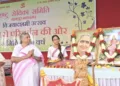
Kelkar’s Karachi visit did not end with her arrival. On August 14, she addressed a large gathering of women associated with the Samiti in Karachi. Accounts published about the meeting describe hundreds of women gathering on the terrace of a residence despite the tense environment. One contemporary retrospective places the gathering at around 700–800 participants, while other accounts give larger figures.
She urged the women to remain calm, protect their dignity and remain steadfast. Those who felt unsafe were advised to consider moving to India, with organisational networks expected to assist them.
In a city preparing to become the capital of a new country, her message was essentially one of psychological resistance: do not surrender to fear.
Lakshmibai Kelkar founded the Rashtra Sevika Samiti on October 25, 1936, establishing an organisation focused on women’s participation, discipline and national service. Historical accounts record that its work subsequently spread to several parts of India, including Sindh.
Her Karachi mission demonstrated one of the core principles associated with her leadership: organisational responsibility did not end when conditions became difficult. The women who had worked to establish the Samiti in Sindh were facing an unprecedented crisis. Kelkar’s answer was to physically be there.
That decision gives the August 13 journey its enduring significance.