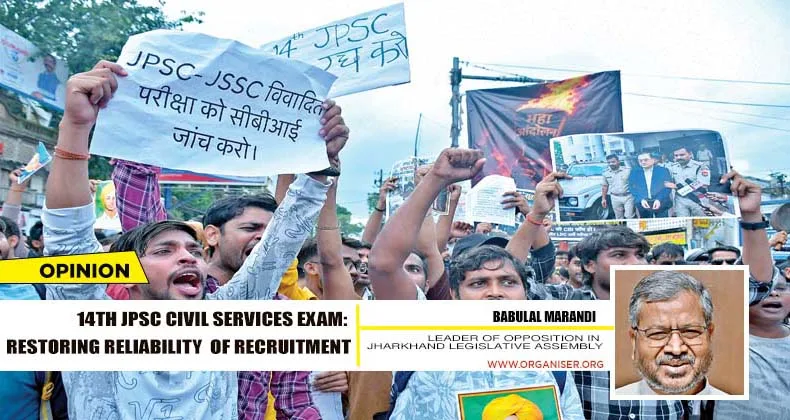
For the past two weeks, thousands of students have occupied the Jaipal Singh Munda Stadium in Ranchi. They are sleeping under open skies, enduring rain, uncertainty and hardship, not because they seek charity from the Government, but because they seek justice from it.
The immediate trigger for the protest was the controversy surrounding the 14th JPSC Civil Services Examination. Students have alleged serious irregularities in preliminary exams, including non-disclosure of category-wise cut-off marks, disputed OMR sheets and a lack of transparency in declaration of results. Their immediate demands include an independent investigation into alleged irregularities, action against those responsible if wrongdoing is established, and structural reforms to restore credibility to future recruitments. What began as a protest against one examination has now become a larger movement against what students see as years of systemic failures in Jharkhand’s recruitment process.
Question Mark on Governance
This is not merely another student’s agitation. It is a referendum on the credibility of governance. The current movement is the culmination of a recruitment crisis that has steadily unfolded over the past six years. Allegations of paper leaks, missing OMR sheets, irregular evaluation, unexplained result patterns, repeated postponements, prolonged litigation and criminal investigations have surfaced across multiple recruitment examinations, severely eroding public faith in the state’s recruitment institutions.
The JSSC-CGL recruitment became perhaps the State’s most controversial recruitment exercise. The examination schedule was revised repeatedly before allegations of paper leaks disrupted the process. After the examination, candidates pointed to an extraordinary anomaly: only 83 candidates qualified from one day’s paper, over 2,000 qualified from the following day’s exam. The controversy led to Statewide protests, CID investigations, arrests linked to alleged paper leak networks, forensic examination of digital evidence and prolonged judicial intervention before the recruitment process could move forward.
The latest controversy surrounding the 14th JPSC Civil Services Examination has reinforced the perception that little has changed. One OMR sheet circulating publicly allegedly showed a candidate qualifying despite attempting substantially fewer questions than would ordinarily be required to clear the examination. These allegations triggered CID investigations, raids at multiple locations, several arrests, the resignation of the JPSC Chairman and the indefinite postponement of the Main Examination along with the Commission’s recruitment calendar.
Recurring Pattern
These are not isolated incidents. The record of Government recruitments between 2019 and 2026 reveals a recurring pattern across JPSC and JSSC examinations. Teacher recruitment, police recruitment, excise constable recruitment and several other examinations have similarly witnessed delays, legal disputes or administrative controversies, leaving lakhs of aspirants trapped in uncertainty.
Behind every recruitment controversy lies a human story. Walking through the protest site, one repeatedly hears stories that are impossible to ignore. Students recount how friends and acquaintances allegedly secured government jobs because they could afford the “going rate” demanded by corrupt intermediaries, while equally deserving candidates who chose the path of merit continue to wait. The striking reality is that these stories are narrated openly, repeatedly and with remarkable consistency across the protest site. For thousands of honest aspirants, the perception that public employment has become a marketplace is itself a devastating indictment of the system.
Parents exhaust their savings to finance coaching. Families postpone important life decisions while their children prepare for examinations. Young men and women dedicate the most productive years of their lives believing that merit will ultimately prevail. When recruitment processes collapse, they do not merely lose an examination; they lose years. Many cross the upper-age limit before fresh recruitments are announced; others abandon their aspirations altogether.
This is why the present movement deserves the support of every citizen. These students are not demanding appointments without examinations. They are demanding examinations that command public confidence. They are asking not for political patronage, but for institutional integrity. The response must therefore go beyond damage control.
Recruitment commissions must be insulated from political influence and subjected to regular independent audits. Appointments to key positions should be based on competence, integrity and transparency.
Every recruitment examination must incorporate the highest standards of technological security. Question papers should be encrypted end-to-end, examination centres digitally audited, and answer sheets securely tracked at every stage. OMR sheets, scanned answer scripts, answer keys and evaluation criteria should be placed in the public domain as a matter of policy.
Time-Bound Investigation
Every allegation of paper leaks, OMR manipulation, evaluation irregularities or organised corruption should automatically trigger a time-bound investigation by an independent agency whose findings are made public.
Accountability must be real. Whenever recruitment processes collapse because of negligence or corruption, responsibility cannot stop with junior officials. Every individual found guilty—whether inside a recruitment commission, an examination agency or the government—must face criminal prosecution, recovery of financial losses and permanent debarment from future recruitment work.
Jharkhand also urgently needs a legally enforceable annual recruitment calendar. Advertisements, examinations, results and appointments must all be completed within fixed timelines so that candidates are not forced to spend years waiting for one recruitment cycle to conclude.
Finally, the State should establish an independent Recruitment Integrity and Examination Standards Authority comprising retired judges, educationists, technology experts and civil society representatives to audit recruitment processes, certify examination security and recommend systemic reforms. Regular consultation with representatives of aspirants should also become an institutional practice rather than an afterthought.
The issue before Jharkhand today is larger than any one recruitment examination or any one Government. The State’s greatest resource is not its minerals but its young people. If they begin to believe that hard work can be defeated by manipulation, influence or corruption, the damage will extend far beyond recruitment—it will erode public faith in governance itself.