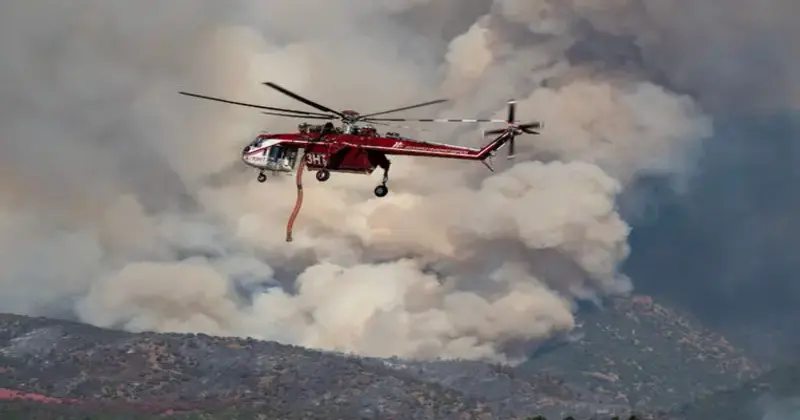
Utah(Western United States): The escalating wildfire and climate catastrophe has been inflicting devastating damage across the United States. Lately, two helicopter pilots died after a Sikorsky Skycrane battling a wildfire crashed in Utah’s Fishlake National Forest. The tragedy of helicopter crash ignited another blaze and further fuelled the wildfire, which was hitherto difficult to contain. The raging fires across the western United States is threatening lives, livelihoods and livestock.
Wildfire crews across the western United States are facing an increasingly dangerous battle as extreme heat and dry conditions fuel fast-moving blazes, which are catastrophic to contain. In Utah, a Sikorsky Skycrane helicopter involved in firefighting operations crashed on August 7, Friday morning in the Fishlake National Forest, killing both people aboard and triggering another fire that later merged with the existing blaze. This further intensified the wildfire, making combating forestfire efforts increasingly impossible.
Officials confirmed the death of firefighting pilots on August 8, Saturday after firefighters were finally able to reach the crash site. The two pilots were employed by Helicopter Transport Services, which had been contracted by the US Forest Service. Their identities have not yet been released. The combined Utah fire has now scorched nearly 174 square miles, or about 451 square kilometres, underscoring the scale of the crisis engulfing the US.
Deadly Utah crash adds new risk & impediments to firefighting effort
The helicopter crash initially created a dangerous situation for rescuers, with the wreckage located inside the fire perimeter. Officials had earlier said they could not safely reach the site because of the flames and chose not to risk additional lives. “The crash site is now inside the fire perimeter itself,” the fire incident management team said as crews waited for dangerous conditions to minimise.
Firefighters eventually accessed the crash site on August 8, Saturday and confirmed that both occupants had died. The National Transportation Safety Board (NTSB) is expected to investigate the crash once its team can examine the wreckage. Officials cautioned against speculation over what caused the accident, noting that determining the cause could take a year or more.
Utah counts the cost of destruction by the wildfire on Farmers
Beyond the immediate threat to firefighters and communities, the fires are inflicting devastating losses on ranchers whose cattles and livestock graze across vast stretches of western rangeland. Utah rancher Trevor Barnson was thousands of miles away attending an American Farm Bureau meeting in New York when the Cottonwood Fire swept through the Fishlake National Forest, where his cattle were grazing.
By the time he could assess the damage, Barnson had lost around 30 pairs of cows and calves, putting his estimated financial loss at roughly $180,000 in a single day. For Barnson, however, the damage goes far beyond the monetary value of the animals. The Straight Arrow Ranch in Piute County has been in his family for three decades, making the loss deeply personal and emotional as well.
Ranchers/Farmers often have only minutes to decide whether to move their herds, cut fences or remain behind to fight the flames. In fast-moving fires, however, there may be little they can do beyond getting themselves and their families to safety.
The damage also continues long after the flames disappear. Ranchers/Farmers lose fencing, barns, wells, corrals, hay and valuable breeding stock. Experts say rebuilding the genetic strength of a herd after losing cattle can take seven to 14 years.
Longer & high-voltage wildfire threaten America
The deadly helicopter crash comes as firefighters battle multiple major wildfires simoultaneously across the western US and Canada.
In Washington state, the National Park Service closed access to the Sunrise and White River areas of Mount Rainier National Park after a new wildfire burned less than a third of a square mile. Larger fires near Spokane have already burned more than 15.63 square miles, or over 40 square kilometres, with firefighters constructing more than 75 miles of containment lines.
Oregon has also been hit hard. Hot and dry conditions helped the Wrights Spring Fire spread beyond 30 square miles, or 77.7 square kilometres. Firefighters are working to establish containment lines while mourning 47-year-old Jason Ensign, who died while operating a bulldozer for a timber company after the rapidly expanding blaze cut off his escape route.
Across the border in British Columbia, more than 20,000 people were evacuated ahead of another fast-moving wildfire.
Meanwhile, the environmental and economic consequences of the wildfire will persist for years. Burned grazing land may require two to three years to recover, while subsequent monsoon rains can trigger flooding and erosion across fire-scarred terrain. Experts warn that these losses ripple through rural communities. Cattle herds often function as a rancher’s retirement security while also supporting local schools, shops and other businesses.
The scale of the wider crisis is stark. Wildfires have burned more than 8,000 square miles across the United States this year, an area roughly the size of New Jersey.
Rising temperatures and worsening drought conditions are also contributing to longer and more intense fire seasons. Hotter weather is drying vegetation and is capable of igniting and spreading more fire rapidly, with some parts of the West experiencing significantly more fire-weather days.