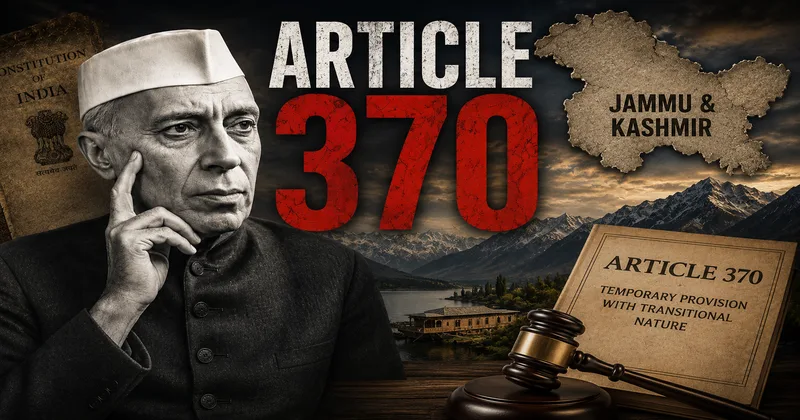
What did Pandit Jawaharlal Nehru, who remained Prime Minister of India till his death in May 1964, say about Article 370 in parliamentary debates? In the Lok Sabha and in the Rajya Sabha. Also in discussions with other ministers of that time, particularly his Home Minister and Minister of State for Home.
Nehru’s statements are available in the public domain and can be assessed if one takes care to find them in the Parliament library. His statements need to be read, re-read and understood, both literally and in terms of political nuances. They are relevant for the National Conference and the Congress. The leaders of these parties will do well to go through his thoughts and articulations.
These are relevant as an intense debate about Article 35-A and Article 370 is now going on these days, and various newspapers are devoting considerable space to who said what on these articles. Article 35-A has died, extinguished from the Indian Constitution, dead since August 2019. Technically, Article 370 still exists in the books, but it can be said that it has been effectively neutered.
Another way of putting what has happened to Article 370 can be perhaps this. It is an article which is in a vegetative state, lost all functional controls over itself. Just as embalmed bodies of Pharaohs of Egypt still exist, as relics of the past, this article also exists in the Constitution. As a (dead) relic of the past.
On August 5 anniversary of the repeal of these articles, National Conference, the ruling party in the Union Territory (UT) of J&K, organised protests. Not to be left behind, its alliance partner Congress and Peoples Democratic Party (PDP) also held demonstrations.
Confusion worse compounded in Congress
Three parties organised protests on an issue, but they could not agree to holding any joint protests, trying to outdo one another. The PDP tried to outdo its rival NC and accused it of not working for restoration of the lost articles but merely restoration of statehood.
Senior Congress leader Pawan Khera added to all the cacophony about the issue, saying he backed the NC demand. The NC demands restoration of statehood to Jammu and Kashmir, besides those going beyond that. Khera said that the people of J&K wanted their rights back. He has been quoted by various news organisations as saying that the rights regarding jobs, land holding, access to opportunities and control over resources must also be restored.
In brief, Khera batted for restoration of status quo ante as it existed prior to August 2019 when Article 35-A was around. Theoretically, any restoration of rights regarding jobs, land holding and others for the people of J&K can happen only through its restoration. Articulating this demand and making noises about it has its implications.
Some very serious implications, in fact, as the Scheduled Tribes (ST) will not be entitled to reservations in the Legislative Assembly of J&K. The West Pakistan Refugees (WPRs) got domicile rights only after Article-35-A was removed. They stand to lose, as also the Valmikis, who were neither here nor there. Virtually stateless citizens like the Gorkhas, who themselves and their ancestors fought in the army for generations.
Khera and his leader, de facto Congress supremo Rahul Gandhi, were both born years after Pandit Jawaharlal Nehru, the Prime Minister who had got Article 370 inserted in the Indian Constitution in October 1949. To placate and promote his friend Sheikh Mohammad Abdullah.
Weakening aimed at systematic, eventual erasure
It is interesting to read about the evolution of Nehru’s ideas about Article 370 and all gradual but systematic changes to erode it. All the constitutional changes that were introduced during Nehru’s lifetime served to weaken it and integrate J&K more closely in the constitutional fabric of India. All movement, so to say, was in the direction of its weakening and erasure.
It may be pointed out that on August 8/9, 1953, Nehru dismissed Sheikh Abdullah, who was then Prime Minister of J&K. For flirting with separatist politics and on grounds of indulging in anti-India activities. By all available indications and conversations in public, Nehru rued and regretted his decisions of empowering Sheikh disproportionately.
Besides, the erosion of Article 370 was a constant process that continued after Nehru’s death during the rule of his daughter Indira Gandhi also. It was in 1975, a full 22 years later, that Sheikh could get back the reins of power in J&K. However, Indira allowed him some leeway only after Sheikh had accepted all constitutional changes that had occurred with respect to the article.
Sheikh was told in no uncertain terms that turning back the clock, which would have meant restoration of what is called pre-1953 status. Reversing all the changes that had happened vis-à-vis this article in 22 years he was out of power were firmly ruled out. It is a different matter that today all the Kashmir-centric parties are talking about restoration of status quo ante of August 2019!
Temporary, transitional, not permanent, asserts Nehru
Participating in a debate on Article 370 in Parliament, Nehru had said: “Article 370 is part of certain transitional provisional arrangements. It is not a permanent part of the Constitution. It is a part as long as it remains so. As a matter of fact, it has been eroded, if I may use the word, and many things have been done in the last few years which have made the relationship of Kashmir with the Union of India very close.”
Mark the words temporary, transitional and permanent as Nehru said categorically that it was not a permanent feature of the Indian Constitution. This statement and some more details are available regarding Nehru’s speech made on November 27, 1963.
Long before August 2019, Nehru had said: It (read Article 370) is a part (of the Indian Constitution) as long as it remains so. From this sentence, it is crystal clear that Nehru never thought (or envisaged) that this article would be a permanent feature of the Constitution.
No impediment for full integration of J&K
“There is no doubt that Kashmir is fully integrated. The fact that there may be some special matters attached to it does not come in the way of integration at all, and I gave as an instance that in Kashmir citizens of India other than those of Kashmir are not allowed to buy land or own property.
“I think it is a very good rule which should continue, because Kashmir is such a delectable place that moneyed people will buy up all the land there to the misfortune of the people who live there,” Nehru added. These constitutional provisions regarding land rights were there to stop potential exploitation of the poorer people of J&K, and for no other reason, according to Nehru.
Three questions for Nehru’s Home Minister
On that day, 19 MPs, including Dr LM Singhvi (father of Congress leader Abhishek Manu Singhvi), Bhagwat Jha Azad (father of Trinamul Congress MP Kirti Azad), Hari Vishnu Kamath, Prakash Vir Shastri, PC Boroah, Mohan Swarup, Vishram Prasad, Raghunath Singh and others had sought the government’s response on the ‘Closer Integration of Jammu & Kashmir with India’. The broad question was divided into three parts.
The Minister of Home Affairs was asked:
-Whether any measures or proposals had been initiated since October 1962 for further integrating the State of Jammu and Kashmir with the rest of the Indian Union?
-If so, what were the details?
-Whether the repeal of Article 370 of the Constitution was under consideration in consultation with the Jammu & Kashmir State Government.
The Minister replied: “Article 370 of the Constitution occurs in Part XXI of the Constitution which deals with temporary and transitional provisions.” He stated: “Since this Article was incorporated in the Constitution, many changes have been made which bring the State of Jammu and Kashmir in line with the rest of India and the State is fully integrated to the Union of India.”
Gradual erosion was meant for ‘The End’
Pandit Nehru was clear that the article was only transitory and had to thus end some day. His understanding was that there should be no impediment to this constant process, though he was not willing to set a time-frame for ending it.
The Government of India, however, at that time was not in favour of its complete repeal in an abrupt manner. “The Government are of opinion that they should not take any initiative now for the complete repeal of Article 370,” the minister said.
“We feel that this process of gradual erosion of Article 370 is going on. Some fresh steps are being taken and in the next month or two they will be completed. We should allow it to go on. That process is continuing,” he added.
However, he also acknowledged that: “Article 370, as the House will remember, is a part of certain transitional provisional arrangements. It is not a permanent part of the Constitution. It is a part as long as it remains so.”
At another place, Nehru wanted the Home Minister to take into account some notes regarding Article 370. These notes acknowledged that Praja Parishad had taken the lead in opposing this provision and this could not be taken lightly.
Praja Parishad demanded repeal of article
Regarding Starred Question Dy. No 1292 in the Rajya Sabha, Nehru wrote: I should like the Home Minister to see these papers. It would, of course, be desirable not to have this question put and answered in the Rajya Sabha. If it is put, there are bound to be supplementaries which will produce some confusion.
If, however, the question is admitted by the Chairman, I would suggest the following answer:
a) The President of the Praja Parishad of Jammu sent to the President a copy of a resolution passed by the Praja Parishad. This resolution was a long one and, among other things, called for a repeal of Article 370 of the Indian Constitution.
b) Article 370 of the Constitution occurs in Part XXI of the Constitution, which deals with temporary and transitional provisions. Since this Article was incorporated in the Constitution, many changes have been made which bring the State of Jammu & Kashmir in line with the rest of India. The State is fully integrated to the Union of India. Government is of the opinion that it should not take any initiative now for the complete repeal of Article 370. This will, no doubt, be brought about by gradual changes. This process has continued in the last few years and may be allowed to continue in the same way.
In 1963, not much life was left in it
In the Lok Sabha, Pandit Nehru said that there was not much life left in Article 370 due to its gradual and constant erosion. He said: The fact of the matter is that there is not much life left in it. About Article 370 and constitutional arrangements regarding this article, he considered it a temporary provision only and said: I do not consider it permanent.
A member named Hari Vishnu Kamath raised a question regarding Article 370, saying: In view of the fact that considerable sections of public and political opinion in Jammu and Kashmir are now in favour of complete integration of that State with the rest of the Indian Union, what are the circumstances, factors and causes which are still stalling such a happy consummation? Is it reluctance on the part of the Union Government or resistance on the part of the Jammu and Kashmir Government and Assembly or something else?
To this, the Minister of Home Affairs (Gulzarilal Nanda) replied: There is no question of either reluctance or resistance. To the extent the public opinion, as the hon. Member points out, favours the movement in that direction, it will certainly be reflected in the attitude of that Government. And no such question as the Honourable Member has in mind arises.