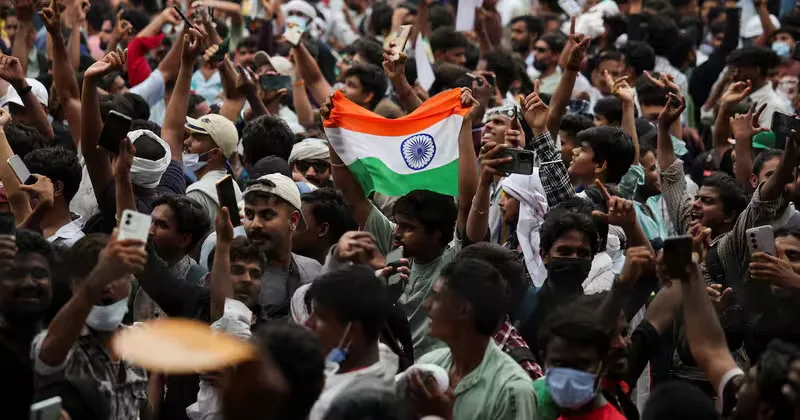
India is one of the youngest nations in the world. According to the United Nations Population Fund (UNFPA), the World Bank, and various demographic studies, nearly 65% of India’s population is below the age of 35. This vast youth population represents India’s greatest demographic dividend and its strongest competitive advantage in the twenty-first century. If this immense human resource is effectively linked with quality education, skill development, innovation, and employment opportunities, India can not only accelerate its journey toward becoming a developed nation but also emerge as a global leader in the knowledge economy.
Ironically, this very youth population is increasingly compelled to take to the streets to demand the fulfillment of their basic aspirations. Public participation by young people on issues such as employment, education, transparency in recruitment, social justice, women’s safety, environmental protection, and policy inconsistencies has steadily increased. This is not merely an expression of dissatisfaction; it also reflects the democratic expectation of accountable, transparent, and responsive governance.
A recent large-scale youth protest at Jantar Mantar in New Delhi was particularly noteworthy because it was not organized by the youth wing of any major political party. Instead, it emerged through the spontaneous cooperation of young people from different states and was led by the Cockroach Party, a relatively new and unregistered political organization. The movement resonated across several states and cities, and the government accepted some of its demands.
The Public Examination (Amendment) Act, 2026, may be regarded as one of the significant outcomes of this movement. More importantly, the protest demonstrated that in the digital age, young people can organize themselves nationally and effectively articulate their concerns without relying on traditional organizational structures. This represents a significant development in democratic politics and deserves serious reflection.
Youth movements are by no means unique to India. Across the world, young people have led major movements on issues such as climate change, unemployment, democratic rights, social inequality, and educational reforms. More recently, youth played a decisive role in political movements in Nepal and Bangladesh. These experiences clearly demonstrate that when governments respond through dialogue, transparency, and timely decision-making, movements tend to find peaceful resolutions. Conversely, when communication breaks down, public dissatisfaction often escalates into confrontation.
At the heart of most youth movements lies the widening gap between aspirations and available opportunities. Today’s youth are more educated, technologically skilled, digitally connected, and aware of their rights than any previous generation. They aspire to quality education, transparent governance, merit-based opportunities, dignified employment, and a respectable standard of living. When these legitimate expectations collide with harsh realities, frustration gradually transforms into organized protest.
One of the most significant causes of this discontent is employment uncertainty. Every year, millions of graduates enter the job market, yet sufficient and quality employment opportunities remain unavailable. The challenge is not merely the shortage of jobs but also their quality. Recruitment in the government sector has slowed considerably, while contractual and outsourced employment has expanded.
Many recruitment processes remain pending for years, and several competitive examinations are cancelled due to paper leaks or administrative failures. Such developments deepen the perception among young people that hard work and merit no longer guarantee success. The private sector too presents new uncertainties arising from limited wage growth, automation, and the changing nature of work driven by artificial intelligence.
The consequences extend beyond economics to social and mental well-being. Years spent preparing for competitive examinations, repeated delays in declaring results, cancellation of examinations, and uncertainty about the future are pushing many young people toward stress, depression, and declining self-confidence. Clearly, the crises of education and employment have evolved into major public mental health concerns.
The increasing commercialization of education is another matter of serious concern. The cost of schooling, higher education, and professional education continues to rise, while the availability of quality public institutions has not increased proportionately. Expensive coaching systems, constantly changing examination patterns, and uncertainty surrounding competitive examinations have imposed substantial financial and psychological burdens on both students and their families. When, after years of preparation, the fairness of the examination system itself comes under question, public confidence in institutions naturally erodes.
Young people today are increasingly encouraged to become job creators rather than merely job seekers. Undoubtedly, India’s thriving startup ecosystem, innovation culture, and entrepreneurial initiatives are significant achievements. However, not every young person can become an entrepreneur. Access to capital, technical guidance, markets, risk-bearing capacity, and financial security is not equally available to all. Therefore, while entrepreneurship should certainly be promoted, governments also bear the responsibility of creating sufficient, quality, and dignified employment opportunities.
The political system must also engage in serious introspection. Most political parties enthusiastically utilize the energy of young people during election campaigns, rallies, and protest movements. Yet, when it comes to policymaking, organizational leadership, and decision-making processes, youth are seldom given adequate representation. Since many policy decisions directly affect the younger generation, their meaningful participation in governance has become an urgent necessity.
The information and communication revolution has fundamentally transformed the nature of public movements. Social media has democratized communication to an unprecedented extent. A local issue can now become a matter of national debate within hours. This transformation strengthens democracy by amplifying public voices. However, it also increases the risks posed by misinformation, rumors, and disinformation. Consequently, digital literacy, fact-checking, and responsible communication have become more essential than ever before.
The Constitution of India guarantees every citizen the right to express their views peacefully and democratically. However, the true strength of any movement lies in its moral legitimacy, discipline, and commitment to non-violence. Violence and damage to public property inevitably weaken the ethical foundation of even the most justified movement. At the same time, governments and administrative authorities should avoid viewing every youth protest merely as a law-and-order issue. Instead, they should respond with dialogue, empathy, and timely resolution.
The real question is not why young people are protesting, but why such situations continue to arise repeatedly. If talented and hardworking youth are compelled time and again to resort to protest simply to secure their rights and protect their future, the issue reflects not only their frustration but also the need for deep institutional introspection. The responsibility for addressing this challenge does not rest solely with governments. Educational institutions, administrative systems, political parties, and society as a whole must collectively seek meaningful solutions.
If recruitment processes are made transparent and corruption-free, the credibility of competitive examinations are safeguarded, quality and affordable education becomes universally accessible, employment opportunities are expanded, skill development is effectively linked with industry and sustained dialogue with young people is institutionalized, then India’s youth can become the strongest pillar in realizing the vision of Developed India-2047.
Ultimately, India’s future will depend not only on its natural resources, technological achievements, or economic growth rates, but also on whether its young citizens perceive themselves as valued participants in the nation’s progress rather than neglected observers. A nation whose youth remains hopeful is a nation that prospers, grows stronger and achieves sustainable development. The need of the hour is not to criticize youth movements, but to eliminate the conditions that compel the nation’s greatest strength(young people) to choose the path of protest. That alone will be the true measure of a mature democracy and a genuinely developed India.