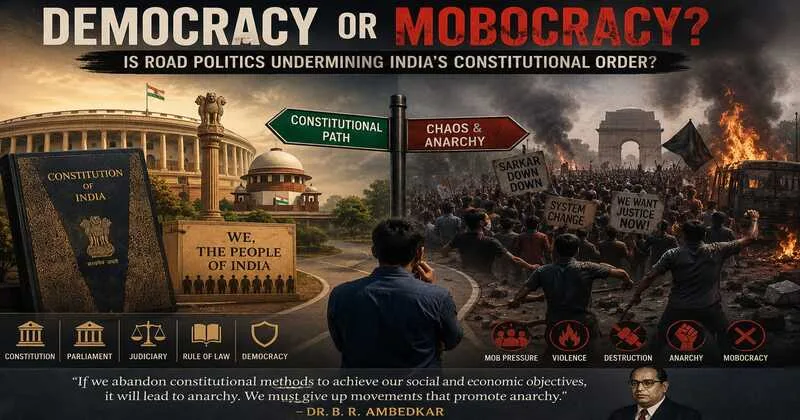
Is road politics and the pressure of crowds, in the name of democracy, gradually becoming a new strategy to weaken constitutional institutions?
Some self-proclaimed political thinkers in this country argue that republics are not built in Parliament, but on the roads. If republics were truly built on the roads, then why was the Constituent Assembly constituted? What did the Constituent Assembly deliberate upon for 2 years, 11 months, and 18 days? Was the Republic really created on the roads?
Does the Preamble to our Constitution begin with “We, the People of India” or with “We, the people gathered on the roads”? If roads alone create a republic, then why does a nation need a Parliament, an independent Judiciary, and a Constitution?
Dr B. R. Ambedkar said:
“If we abandon constitutional methods for achieving our social and economic objectives, it will lead to anarchy. We must give up movements that promote anarchy.”
Has Dr Ambedkar’s statement lost its significance today?
The CJP and the NEET protests are currently the subject of discussion everywhere. In protest against the NEET paper leak and demanding the resignation of Union Education Minister Dharmendra Pradhan, the CJP staged a sit-in for more than a month. Taking responsibility, Union Education Minister Dharmendra Pradhan also tendered his resignation.
On 15 May 2026, while dismissing what it described as an unnecessary petition, the Bench headed by the Chief Justice of India remarked on lawyers who repeatedly waste the Court’s time and file frivolous petitions against the system. Referring to such irresponsible elements, the Bench described them as “cockroaches” and “parasites.”
Immediately after this observation, on 16 May 2026, a person named Abhijeet Deepak, residing in Boston, United States, created a satirical Twitter account titled “Cockroach Janata Party” and described it as “the voice of the lazy and the unemployed.” In other words, only one part of the Court’s remarks against irresponsible elements was circulated and presented as an insult to the unemployed, thereby attempting to create a particular narrative.
Within just five days, the account had, under suspicious circumstances, amassed 5 million followers on Instagram. Thereafter, on 20 July 2026, ahead of the Monsoon Session of Parliament, the CJP’s “Chalo Parliament” march turned Delhi into a violent battlefield.
Was this protest really against the NEET paper leak? In reality, its principal agenda was to generate public resentment against the system.
Had the protest genuinely been about the paper leak, demands would not have been limited to the resignation of Dharmendra Pradhan alone. The resignations of Punjab Education Minister Harjot Singh Bains and Karnataka Education Minister Madhu Bangarappa would also have been demanded, as their names too were allegedly linked to the paper leak.
Perhaps the youth gathered at Jantar Mantar were unaware of these allegations, because the issue was never merely about the paper leak. Rather, it was about pursuing political interests under the guise of representing the youth-an effort that was allegedly amplified by anti-national forces.
If those leading these protests had genuinely been concerned about the future of the youth, why was there no mention of the Chhattisgarh Public Service Commission (PSC) scam, in which the future of countless young aspirants was allegedly compromised, yet no one accepted responsibility?
In reality, the entire protest was aimed at bringing about a road-based change of power, similar to what was witnessed in Nepal and Bangladesh.