The idea of good governance is often associated with modern democratic institutions, constitutional values, and public administration. However, the Indian civilisation has nurtured sophisticated ideas of governance, statecraft, justice, and public welfare for over 5,000 years. From the urban planning of the Indus Valley Civilisation to the participatory institutions of the Vedic period, from the republican traditions of the Mahajanapadas to Kautilya’s comprehensive theory of statecraft, India has consistently demonstrated a rich and evolving political tradition. Far from being a passive recipient of political ideas, ancient India developed governance models that influenced generations of thinkers and continue to inspire discussions on ethical leadership, public administration, and statecraft.
The Indian conception of governance has always been rooted in the principle that the ruler exists for the welfare of the people. Unlike purely authoritarian models, Indian political philosophy emphasised Rajadharma the moral duty of the ruler to ensure justice, prosperity, security, and social harmony. Governance was viewed not merely as the exercise of power but as a sacred responsibility aimed at maintaining Dharma, the moral and social order.
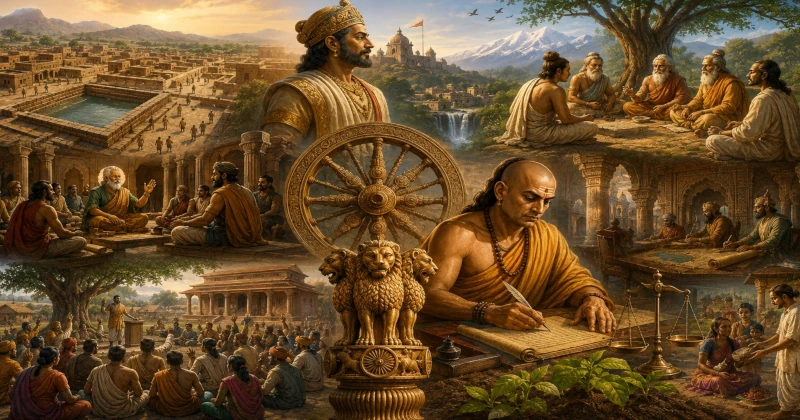
One of the earliest examples of organised governance is found in the Indus Valley Civilisation (IVC), which flourished between approximately 2600 BCE and 1900 BCE. Archaeological discoveries at Harappa, Mohenjo-daro, Dholavira, and Lothal reveal an extraordinary level of urban planning and administrative efficiency. The cities featured well-planned streets laid out in grid patterns, sophisticated drainage systems, standardised bricks, public granaries, reservoirs, and carefully regulated water management systems. Such uniformity across settlements spread over a vast geographical area suggests the existence of an efficient administrative mechanism capable of maintaining standards, organising labour, and managing resources.
Following the decline of the Indus Valley Civilisation, the Vedic period witnessed the emergence of participatory political institutions that laid the foundations of collective decision-making. The Sabha and the Samiti were among the earliest representative institutions known in world history. References in the Rigveda describe these bodies as important forums where political, administrative, and social matters were deliberated.
The Sabha functioned as a council of respected elders, scholars, nobles, and experienced members of society. It advised the ruler, deliberated on judicial matters, and discussed issues concerning governance and public welfare. The Samiti, on the other hand, represented a broader popular assembly involving larger sections of the community. It participated in the selection or approval of rulers, discussed important public issues, and reflected the voice of the people. These institutions illustrate that governance in ancient India was not entirely centralised but involved consultation, debate, and consensus. The presence of these assemblies highlights the Indian tradition of participatory governance long before similar representative institutions emerged in many other parts of the world.
The evolution of political organisation reached a new phase with the rise of the Mahajanapadas between the sixth and fourth centuries BCE. Sixteen major kingdoms and republics emerged across northern India, representing diverse political systems. While several Mahajanapadas were monarchies, others, such as the Vajji Confederacy, followed republican forms of governance. These republics were governed through assemblies where representatives debated policies, elected leaders, and collectively administered the state. Decisions were often reached through discussion and voting, indicating institutionalised political participation.
The republican traditions of the Mahajanapadas demonstrate that democratic practices were neither foreign to India nor recent imports. Instead, they evolved organically within Indian society. These republics balanced authority with consultation and established procedures that emphasised collective responsibility. Historians have often regarded these republican systems as remarkable examples of early constitutional governance. They reveal that ancient India experimented with multiple political models while maintaining the central objective of public welfare and social stability.
No discussion of Indian political thought is complete without examining the contributions of Kautilya, also known as Chanakya or Vishnugupta, whose Arthashastra remains one of the world’s greatest treatises on governance and statecraft. Written around the fourth century BCE during the Mauryan period, the Arthashastra presents a comprehensive framework for administration, diplomacy, economics, law, taxation, intelligence, defence, and public policy.
Kautilya viewed the state as an institution existing for the welfare of its people. His famous principle, “In the happiness of the subjects lies the happiness of the king; in their welfare lies his welfare,” reflects a remarkably modern understanding of public service. According to him, the legitimacy of a ruler depended not on personal power but on the prosperity and security of the people.
Kautilya’s theory of governance was systematic and pragmatic. He described the Saptanga Theory, according to which a successful state consists of seven essential elements: the king, ministers, territory, fortified cities, treasury, army, and allies. These components were interdependent and collectively ensured the stability of the kingdom. Modern scholars often compare this framework with contemporary concepts of state institutions and governance structures.
The Mauryan Empire under Chandragupta Maurya, guided by Kautilya’s principles, became one of the largest and best-administered empires of the ancient world. Later, Emperor Ashoka expanded the ethical dimension of governance by emphasising compassion, justice, religious tolerance, environmental protection, and welfare measures after the Kalinga War. His inscriptions across the Indian subcontinent reveal an administration committed to moral governance and the well-being of all citizens. Ashoka’s model demonstrated that political power could be tempered by ethical responsibility, making governance not merely efficient but humane.
Ancient Indian political thought also emphasised decentralisation. Villages functioned as self-governing units with local councils managing resources, resolving disputes, and administering community affairs. This tradition of local self-governance laid the foundation for institutions that continue to influence India’s Panchayati Raj system. The principle that governance should operate as close to the people as possible reflects a remarkably enduring feature of Indian political philosophy.
The significance of India’s political heritage extends beyond its own history. Many governance principles that are celebrated today, such as public accountability, participatory decision-making, welfare-oriented administration, strategic diplomacy, decentralised governance, and institutional responsibility, find early expression in ancient Indian traditions. Although these systems emerged in different historical contexts and should not be equated directly with modern democratic institutions, they demonstrate the remarkable sophistication of Indian political thinking.
In the contemporary world, where governments face challenges related to transparency, corruption, sustainability, and citizen participation, India’s ancient political wisdom continues to offer valuable insights. The emphasis on ethical leadership, institutional accountability, public welfare, and consultative governance remains relevant across nations and cultures. Ancient India’s contributions remind us that effective governance is not measured solely by the concentration of power but by the ability of institutions to serve society with justice, wisdom, and integrity.
The Indian idea of good governance is therefore not merely a historical legacy but a living intellectual tradition. Over five millennia, India has developed governance models that combined ethics with administration, participation with authority, and prosperity with social responsibility. From the civic organisation of the Indus Valley Civilisation to the deliberative institutions of the Sabha and Samiti, from the republican experiments of the Mahajanapadas to Kautilya’s timeless principles of statecraft, India’s political thought has consistently offered profound lessons in governance. This enduring heritage stands as one of India’s greatest contributions to world civilisation, demonstrating that the pursuit of good governance has long been central to its civilizational identity.