

In Indian politics today, the true measure of credibility has shifted from the number of schemes launched to the quality of services delivered. Prime Minister Narendra Modi has articulated this as “service-based politics”, a governance approach that prioritises continuous, functional service to citizens over one-time announcements. In his words, “quality in governance is not determined by the mere launch of schemes but by how deeply these schemes reach the people and their real impact”. This citizen-centric philosophy echoes across the nation, including in Assam, where Chief Minister Himanta Biswa Sarma emphasises taking government services “to citizens’ fingertips” for maximum reach and transparency.
From Promises to Performance: The Era of Service-Based Politics
Politics once revolved around big scheme launches and grand promises. Today, people judge governance in a far simpler way, like does the LPG refill arrive, is the bank account actually usable, does water flow from the tap, does the health card settle hospital bills, and does the pension come on time? In short, citizens now measure leaders not by how many schemes are announced, but by how well those schemes work in daily life. Prime Minister Modi has repeatedly stressed this shift, urging officials to follow “Naagrik Devo Bhava” put the citizen first and noting in his 2025 Civil Services Day address that India must move from “incremental change to impactful transformation” through last-mile delivery so that no village, no family, and no citizen is left behind. Assam Chief Minister Himanta Biswa Sarma echoes the same outcome-driven approach, calling it a “revolution” in public service delivery through digitisation and faster disposal, and saying services must reach citizens “at their fingertips” because efficiency and transparency are no longer optional, and announcements mean little unless benefits are felt on the ground.
Citizens’ New Metrics: Access, Usage, Grievance Redressal and Continuity
The modern voter’s scrutiny involves four key metrics:
1. Access: How many eligible people have access to the service or scheme? (e.g. having a bank account, an LPG connection, a health insurance card, etc.)
2. Usage: Are those with access actually using the service? (e.g. account is active, gas connection is used for refills, health card is used for hospital treatment)
3. Grievance Redressal: How effectively and quickly are problems resolved? (e.g. fixing payment issues, supply outages, or other complaints)
4. Continuity of Benefit: Is the service provided reliably and on schedule? (e.g. benefits every month/quarter without gaps, water or power supply without long outages)
Increasingly, governments are being evaluated on these outcome metrics. For example, simply declaring millions “eligible” for a scheme no longer wins applause; the public watches how many actually received the benefit and whether it solved their problem. If a scheme falters in execution or if entitlements exist only on paper, citizens are quick to flag it. On the other hand, leaders who deliver tangible results, a road built, a school functional, a subsidy reaching the bank account on time, earn trust. This shift is driving what PM Modi calls “new benchmarks in governance”, rooted in transparency, innovation, and saturation coverage.
Scheme Outcomes: Access vs. Usage
To illustrate service-based politics in action, consider the following scheme-wise snapshots of access and usage:
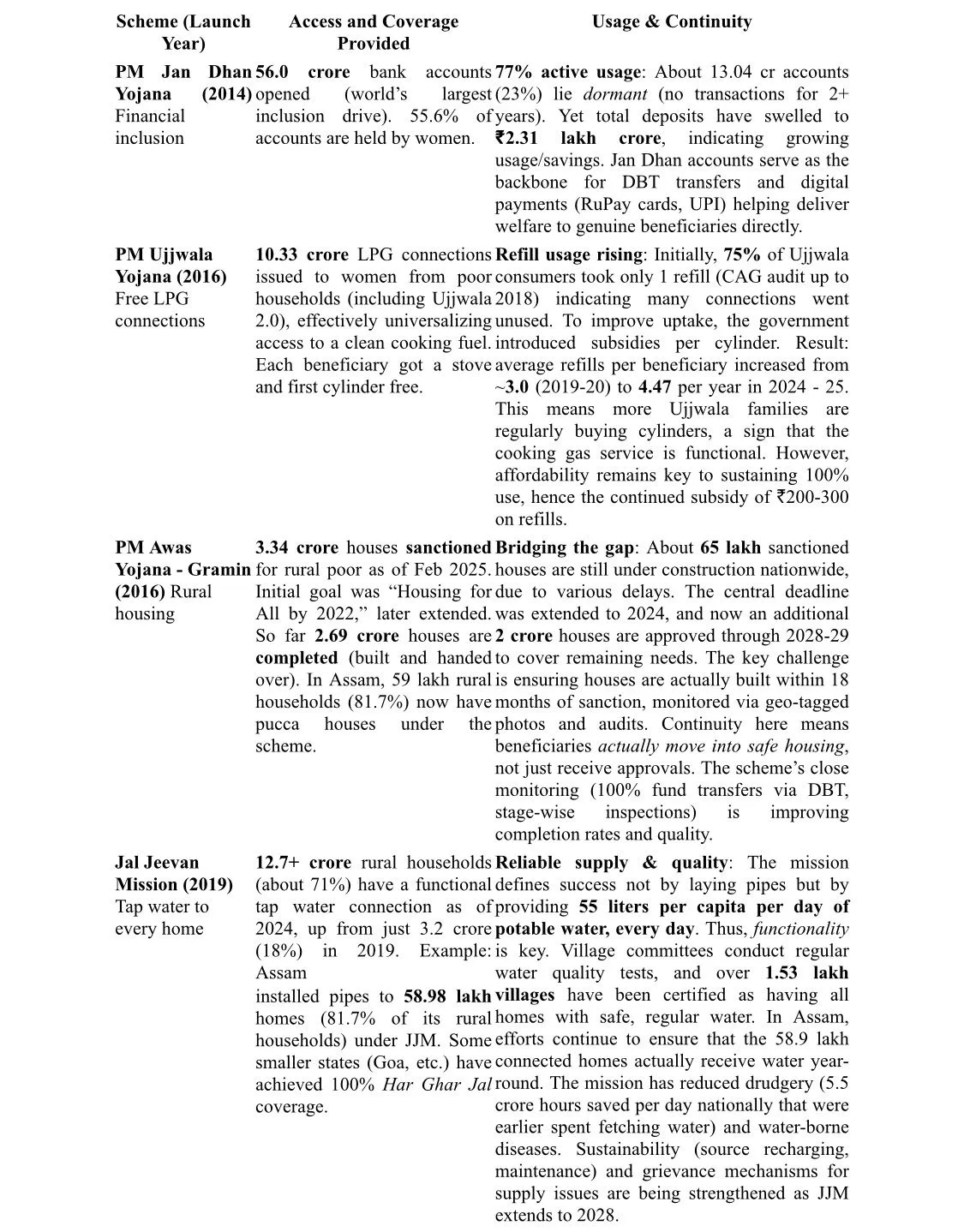

Continuous service delivery is now the yardstick for success. Gaps highlight areas for improvement in ensuring every entitled person not only has the benefit but can use it fully. Such responsiveness to service data is a hallmark of service-based politics. It also reflects a maturation of India’s welfare system, increasingly data-driven, transparent, and accountable.
The Assam Example: Citizen-First Governance in Practice
Assam provides a microcosm of this shift toward outcome-oriented governance. Under CM Himanta Biswa Sarma, the state has placed citizens at the centre of service-delivery reforms. A flagship initiative, the Assam Governance and Public Service Delivery Transformation, has digitised over 400 public services. In the past couple of years, more than 75 lakh applications were submitted online for various services, with an impressive 88% disposal rate. The government proudly reports a 78 per cent on-time delivery of these services and a 95% satisfaction rate in feedback surveys, unheard of in earlier eras of bureaucratic delays.
“In Assam, we are taking government services to citizens’ fingertips,” CM Himanta Biswa Sarma remarked, underscoring that people can now apply for certificates, benefits, and permits from home and get them within stipulated timelines. Crucially, an online monitoring system for appeals and grievance redressal ensures that if a service is delayed or denied, it is swiftly corrected, reinforcing public trust. This end-to-end digitisation and monitoring exemplifies treating citizens as valued clients of the state, not as petitioners.
The outcomes in central schemes also reflect Assam’s focus on delivery. For instance, Assam has achieved 81.65% tap water coverage in rural households, up from almost zero functional taps in 2019 making it one of the better performers in the Northeast. In rural housing, the state has constructed over 21 lakhs PMAY-G houses (as of 2025). Assam’s implementation of PM-KISAN initially faced hurdles (a 2022 probe found over 10 lakh bogus entries which were pruned), but by 2024 the scheme is back on track with nearly 19 lakh farmers receiving funds regularly. The government also rolled out a supplemental scheme, Orunodoi, which now supports nearly 40 lakh (4 million) women across Assam, providing monthly DBT of rupees 1250 per month with rigorous tracking to ensure continuity of those payments. CM Sarma’s philosophy, much like PM Modi’s, is “outcome over optics.”
Outcome-Oriented Governance
What gives service delivery its real political weight is how top leaders frame it in human terms. Prime Minister Modi has reminded officials that the goal is not just to launch schemes but to achieve “100 per cent coverage and 100 per cent impact,” noting that 25 crore people were lifted out of poverty when basic services were delivered to the last mile. He often puts it in outcomes that ordinary families can feel 4 crore pucca homes, 12 crore households with tap water, 11 crore toilets, and millions receiving free medical treatment to show that governance must be measured by what changes in a person’s daily life. In Assam, Chief Minister Himanta Biswa Sarma makes the same point in his own way, saying that people’s “blessings are earned by serving them well,” and urging officials to remember that citizens don’t forget the officer who solved their problem or delivered on a promise. And both leaders understand that today’s citizens are far more connected: if a payment is delayed due to a technical glitch, or if a village still struggles for reliable water, it doesn’t remain a local complaint for long it travels through WhatsApp, Facebook, and news platforms. That is why the push for higher benchmarks and faster grievance resolution is not only good governance; it is also the new reality of politics where trust is built through continuous, everyday service, not just big announcements.
Politics as Public Service, Not Power
The service-based politics reflects a more mature democracy because people now ask a simple question: “I have the scheme but is it actually working for me?” That question is pushing leaders to solve everyday problems and pushing officials to become facilitators, not gatekeepers, just as PM Modi urged civil servants to move beyond rulebooks and focus on results. When DBT cuts leakage and money reaches the right person, or when an Ayushman card truly delivers cashless treatment, citizens feel the system working in real time and trust grows. Yes, gaps still remain, from irregular water supply to sustaining Ujjwala usage, but the difference today is that shortcomings are being tracked, discussed, and corrected so welfare becomes a dependable service, not a one-time announcement.
Ultimately, when politics is treated as public service, everyone benefits, people experience development in their everyday lives, and leaders earn trust that naturally converts into support. Su-raaj becomes the real vote-getter, because citizens don’t remember ribbon-cuttings as much as they remember results. If schemes deliver reliably such as benefits on time, grievances resolved, and services that actually work success will be judged not on day one, but on what people experience months and years later: water running from taps, money landing in accounts, and a quiet sense that the system is finally working for them.