For nearly two centuries, colonial rule sought to conquer not merely India’s territory but also its consciousness. Political domination was accompanied by intellectual domination, where history was rewritten, educational systems were redesigned, and cultural confidence was systematically undermined. While India achieved political independence in 1947, the task of liberating the national mind from inherited colonial assumptions has remained a far more enduring challenge. Decolonising the mind, therefore, is not about rejecting the world or romanticising the past. It is about reclaiming intellectual agency, restoring historical balance, and enabling future generations to engage with their civilisation from a position of confidence rather than inherited inferiority.
Colonial education was never intended to nurture an independent civilizational consciousness. Thomas Babington Macaulay’s famous Minute on Education in 1835 openly argued for creating a class of Indians who would be “Indian in blood and colour, but English in taste, in opinions, in morals, and in intellect.” The purpose was administrative convenience rather than national development. Indigenous systems of learning, ranging from gurukulas and pathshalas to centres of advanced scholarship, were increasingly marginalised in favour of a curriculum that privileged European knowledge while portraying India as static, irrational and dependent upon colonial intervention for progress.
The consequences extended beyond classrooms. Historical narratives often reduced India’s civilisational journey to a sequence of invasions, defeats and foreign rule, overlooking the remarkable continuity of its philosophical traditions, scientific innovations, artistic achievements and democratic practices. Ancient universities such as Takshashila and Nalanda, India’s contributions to mathematics, metallurgy, astronomy and medicine, and the sophistication of regional knowledge systems received comparatively little attention. Such selective storytelling gradually shaped public consciousness, leaving many generations disconnected from the depth and diversity of their own heritage.
Decolonisation of the mind begins with questioning these inherited frameworks rather than replacing one rigid narrative with another. A mature nation neither denies historical complexities nor accepts distortions as permanent truths. Instead, it strives for a fuller understanding of its past by incorporating multiple sources, archaeological evidence, indigenous texts, regional histories and recent scholarly research. The objective is not ideological conformity but intellectual completeness.
In recent years, India has witnessed a noticeable shift towards this broader understanding of history. Museums, archives, academic institutions and cultural organisations have increasingly focused on recovering neglected chapters of India’s civilisational experience. Unsung freedom fighters, tribal resistance movements, women leaders, local kingdoms and indigenous knowledge traditions are receiving greater scholarly attention. This widening of historical memory enriches national identity by recognising that India’s freedom struggle and cultural evolution were far more diverse than earlier narratives suggested.
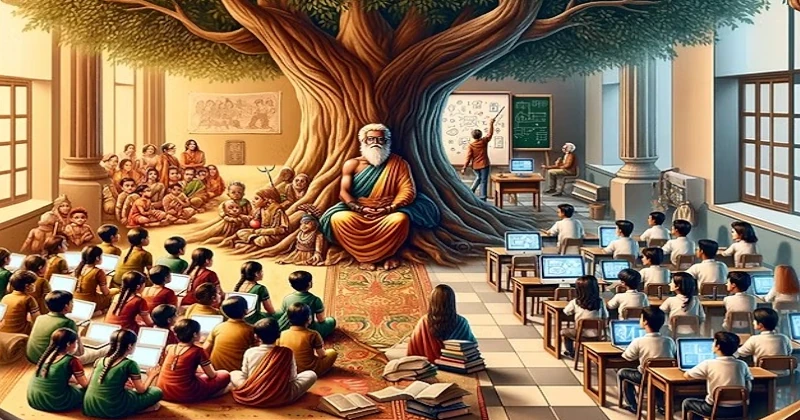
Education has emerged as one of the most significant arenas of this transformation. The National Education Policy 2020 represents an important attempt to reconnect learning with India’s intellectual traditions while maintaining global standards. Greater emphasis on multidisciplinary education, Indian languages, experiential learning and knowledge systems reflects an understanding that educational excellence need not come at the cost of cultural rootedness. Students are increasingly encouraged to appreciate classical literature, philosophical schools, environmental ethics and scientific contributions originating within the Indian knowledge tradition alongside contemporary global scholarship.
Language occupies a central place in this process. Colonial hierarchies often equated English with intelligence and social mobility while diminishing the status of Indian languages. Yet every language carries unique ways of thinking, remembering and interpreting the world. India’s renewed emphasis on multilingual education acknowledges that linguistic diversity is not a barrier to modernisation but one of the country’s greatest intellectual assets. The revival of Sanskrit studies, the promotion of regional languages and the increasing availability of higher education resources in Indian languages contribute to making knowledge more accessible and culturally meaningful.
Decolonising the mind also involves recovering confidence in indigenous systems of knowledge. Traditional practices in agriculture, architecture, water conservation, medicine, ecology and governance evolved over centuries through close engagement with local environments and communities. Modern scientific evaluation should certainly guide their contemporary application, but dismissing them solely because of colonial-era prejudices would be intellectually limiting. Increasing research on Ayurveda, traditional agriculture, yoga, sustainable architecture and environmental conservation demonstrates that dialogue between tradition and modern science can generate innovative solutions for present-day challenges.
Technology has further accelerated this intellectual transformation. Digital archives, online libraries, language technologies and virtual museums have made historical sources accessible to millions. Young Indians are exploring manuscripts, archaeological discoveries, oral traditions and regional histories through podcasts, documentaries, academic platforms and independent research initiatives. Social media, despite its limitations, has democratised historical discussion by allowing wider participation beyond traditional academic institutions. This growing public engagement has created a vibrant ecosystem where questions about history and identity are increasingly examined with curiosity and confidence.
The process of decolonisation is equally relevant to India’s global identity. For decades, international understanding of India was often filtered through colonial interpretations or external academic frameworks. Today, India’s expanding diplomatic presence, technological achievements, cultural outreach and economic growth are enabling it to articulate its own civilisational narrative. Initiatives highlighting yoga, Ayurveda, classical arts, traditional crafts, Buddhist heritage and democratic values present India as a civilisation with enduring contributions to humanity rather than merely a post-colonial nation navigating modernity.
Importantly, decolonisation should never become isolation. India’s civilisational ethos has historically embraced dialogue, adaptation and exchange. From absorbing diverse cultural influences to contributing knowledge across continents, India has flourished through openness rather than insularity. Reclaiming indigenous confidence does not require rejecting Western scholarship or global cooperation. Instead, it demands intellectual equality where Indian perspectives participate in global conversations as contributors rather than passive recipients.
The journey is far from complete. Academic debates will continue, historical interpretations will evolve, and educational reforms will require constant refinement. Some concerns regarding balance, methodology and inclusivity deserve careful consideration. Yet these debates themselves signify a healthy democracy willing to re-examine inherited assumptions instead of accepting them unquestioningly. A confident civilisation is not afraid of asking difficult questions about its past because it recognises that truth ultimately strengthens rather than weakens national identity.
For the younger generation, decolonising the mind is perhaps the most significant aspect of nation-building. It encourages students to approach India’s history with both pride and critical inquiry, recognising achievements without ignoring shortcomings. It inspires innovation rooted in cultural confidence, enabling them to solve contemporary problems while drawing from a rich civilisational reservoir of ideas. Such intellectual self-assurance is essential in a rapidly changing world where nations increasingly compete not only through economic or military power but also through the strength of their narratives.
India’s ongoing journey demonstrates that political independence reaches its fullest meaning only when accompanied by intellectual independence. Reclaiming historical memory, reforming education, revitalising languages and recognising indigenous knowledge are not backward-looking exercises; they are investments in a more confident future. Decolonising the mind is ultimately about restoring the ability of a civilisation to define itself on its own terms. As India continues to emerge as a leading voice of the Global South and an influential participant in shaping the twenty-first-century world order, this intellectual renaissance may prove to be one of the most consequential transformations of independent India, reaffirming that a nation secure in its identity is best equipped to engage the world with confidence, creativity and purpose.