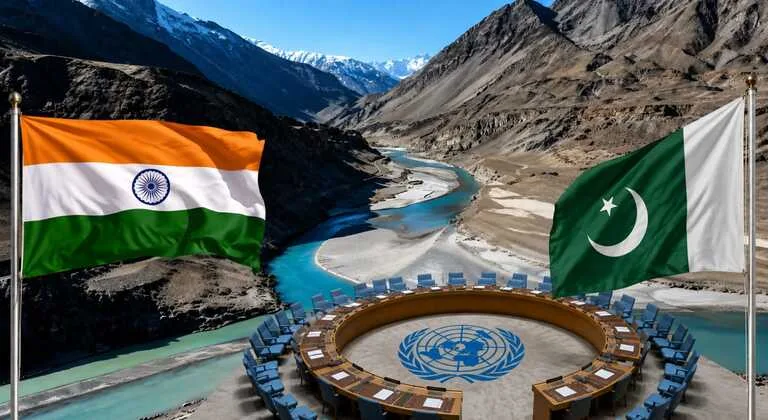
New Delhi: Pakistan has once again sought to draw international attention to its concerns over the Indus Waters Treaty (IWT) by raising the matter before the United Nations Security Council (UNSC), arguing that India’s actions under the agreement have implications for regional peace and security. However, despite Islamabad’s repeated diplomatic outreach, legal experts and international observers believe the effort is unlikely to result in any meaningful or binding intervention by the Security Council.
They argue that the treaty itself provides a comprehensive dispute resolution framework and that the UNSC has historically refrained from intervening in transboundary water disputes where established legal mechanisms already exist.
The Indus Waters Treaty, signed in 1960 between India and Pakistan, remains one of the world’s most enduring water-sharing agreements. The treaty, with the World Bank serving as a signatory to certain procedural aspects, established a detailed framework governing the allocation and management of the waters of the Indus river system between the two neighbouring countries.
Rather than relying on international political institutions, the agreement incorporates a multi-layered dispute resolution mechanism specifically negotiated by both parties to resolve disagreements arising from its implementation.
Pakistan has periodically written to the President of the United Nations Security Council, expressing concerns over India’s approach to the treaty and alleging that certain Indian decisions amount to violations of the agreement. By framing the dispute as one affecting regional stability and international peace, Islamabad has sought to bring the matter within the Security Council’s mandate under the United Nations Charter.
Analysts note that these diplomatic efforts are also intended to create an official international record of Pakistan’s objections, strengthening its legal and diplomatic narrative even if no immediate action follows from the UN body.
Treaty mechanism remains the primary legal avenue
Legal experts argue that the principal obstacle to Pakistan’s campaign lies within the treaty itself. The Indus Waters Treaty already establishes a detailed institutional framework for addressing disagreements, making external political intervention unnecessary in the eyes of many international observers. At the centre of this framework is the Permanent Indus Commission (PIC), which serves as the first platform for bilateral engagement and routine dispute resolution between India and Pakistan.
Under the treaty, technical disagreements that cannot be settled through the commission may be referred to a Neutral Expert, while disputes involving more complex legal interpretations can be taken before a Court of Arbitration, depending on the nature of the issue.
Since both countries voluntarily negotiated and accepted these procedures under the 1960 agreement, legal scholars maintain that these mechanisms remain the appropriate and primary avenues for resolving treaty-related disputes.
This institutional structure significantly limits the scope for intervention by political bodies such as the United Nations Security Council. Observers argue that replacing or bypassing the treaty’s established procedures would undermine the legal framework that both countries accepted more than six decades ago.
As a result, the prevailing legal opinion is that disagreements concerning the treaty should continue to be addressed through the mechanisms specifically created for that purpose rather than through international political forums.
India rejects internationalisation of the dispute
India has consistently maintained that all matters arising under the Indus Waters Treaty are strictly bilateral issues governed exclusively by the provisions of the agreement. New Delhi has repeatedly opposed attempts to internationalise the dispute, arguing that the treaty already contains adequate legal procedures for addressing differences between the two countries.
India’s position is also consistent with its broader foreign policy approach, which generally resists third-party involvement in bilateral disputes. According to this view, the existing treaty framework is sufficient to resolve disagreements, making external political involvement both unnecessary and inconsistent with the agreement signed in 1960.
Delhi: Vikas Swarup, former Secretary, Ministry of External Affairs, Government of India, says, "The Indus Waters Treaty has been in existence since 1960. It has survived a number of wars between India and Pakistan. But this time, after what happened in Pahalgam, where 26… pic.twitter.com/s5fSFNpU0A
— IANS (@ians_india) August 2, 2026
International legal observers note that India’s stance is reinforced by the treaty’s carefully designed dispute resolution provisions. Since the agreement itself prescribes a sequence of bilateral consultations, technical review and arbitration where necessary, there is little legal basis for transferring treaty-related disputes to the Security Council or other political institutions. This has further strengthened the argument that the Indus Waters Treaty should remain the sole governing framework for resolving disagreements between the two countries.
UNSC practice and political constraints limit intervention
Another major factor working against Pakistan’s efforts is the Security Council’s own institutional practice regarding international water disputes. Historically, the UNSC has exercised considerable restraint when dealing with transboundary river disagreements, particularly in cases where comprehensive legal mechanisms are already available.
Observers point to the Council’s approach in discussions surrounding the Grand Ethiopian Renaissance Dam (GERD) as an example. Even in that case, the Security Council largely encouraged the parties involved to pursue solutions through existing legal, technical and regional mechanisms rather than assuming a direct adjudicatory role. This longstanding practice suggests that the Council is unlikely to transform itself into an arbitration forum for disputes already governed by detailed international agreements.
The Security Council’s primary responsibility under the United Nations Charter is the maintenance of international peace and security. Although water disputes can contribute to regional tensions, experts note that the Council has generally avoided intervening directly in highly technical treaty disagreements that already provide their own dispute settlement procedures.
Political realities within the Council also reduce the possibility of any substantive action. Any binding resolution would require broad support among Council members and would remain subject to the veto powers exercised by the five permanent members. In disputes arising from bilateral treaties, achieving such consensus is often difficult, making the adoption of any meaningful Security Council resolution highly unlikely.
Shocking video viral claiming to have been released by Pakistan-based terror group Lashkar-e-Taiba (LeT) purportedly showing its operatives conducting swimming and water-based training at Mangla Dam, PoK.
After clearing these trainings, terrorists will be sent by Pakistan on…
— Megh Updates 🚨™ (@MeghUpdates) July 14, 2026
Consequently, analysts believe Pakistan’s engagement with the UNSC is primarily a diplomatic and political exercise rather than a realistic pathway to obtaining binding legal relief. By repeatedly raising the issue before international institutions, Islamabad seeks to highlight its concerns before the global community and potentially secure diplomatic support, even if formal Security Council intervention remains improbable.
Similarly, legal experts see little prospect of the Security Council referring the dispute to the International Court of Justice (ICJ). The ICJ ordinarily exercises jurisdiction only with the consent of the states concerned, while the Indus Waters Treaty already provides alternative and mutually accepted mechanisms for dispute resolution.
In light of these legal and institutional constraints, the treaty’s own framework continues to be regarded as the principal mechanism for addressing disagreements between India and Pakistan. While Pakistan remains free to present its concerns before the United Nations and other international forums, the prevailing legal and diplomatic assessment is that the United Nations Security Council is unlikely to replace, override or supersede the dispute resolution procedures negotiated by the two countries under the 1960 Indus Waters Treaty.