In the age of social media, misinformation often spreads faster than scientific truth. A recent target has been Bharat’s E20 petrol programme. Viral videos circulating across social media claim to expose a “scam” by pouring water into E20 petrol, shaking the bottle and then triumphantly displaying two distinct layers. The accompanying claim is dramatic: “Look! Ethanol has separated from petrol. This proves E20 is adulterated and dangerous.”
The demonstration appears convincing. It is also scientifically misleading. These videos are not exposing a flaw in E20 petrol. They are recreating a well-known chemical reaction by deliberately contaminating the fuel with water. Unfortunately, millions of viewers are left believing that Bharat’s ethanol blending programme is fundamentally defective, when in reality the experiment itself creates the result. As Bharat moves towards greater energy security through biofuels under the ethanol blending programme championed by the Narendra Modi Government, it is important to distinguish science from sensationalism. It is equally important to present an honest picture of both the benefits and the practical considerations associated with the programme. A balanced understanding strengthens public confidence far more than exaggerated claims made either for or against E20.
Understanding E20
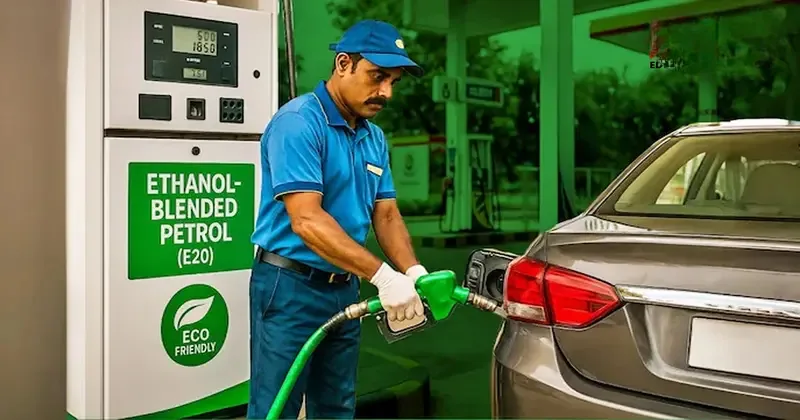
E20 refers to petrol blended with 20 per cent anhydrous ethanol and 80 per cent petrol. The word anhydrous is crucial. It means the ethanol used for blending has been dehydrated to remove virtually all water before it is mixed with petrol. The ethanol blended into fuel is not raw sugarcane juice or ordinary alcohol. It is produced through fermentation of agricultural feedstock such as sugarcane, molasses or grain. The alcohol produced is then distilled and further dehydrated to remove almost all remaining water. Before it reaches fuel depots, it must comply with stringent quality specifications prescribed by the Bureau of Indian Standards.
Once blended according to these standards, E20 forms a homogeneous mixture. Ethanol does not float on petrol nor settle beneath it under normal conditions. If it naturally separated into layers, storage tanks at refineries, fuel depots and petrol pumps across Bharat would experience constant operational failures, and millions of vehicles would face immediate problems. That simply does not happen because properly manufactured E20 remains stable during normal storage, transportation and everyday use.
The truth behind the viral bottle videos
The viral demonstrations follow almost the same script. Someone pours E20 petrol into a transparent bottle, adds water, shakes the bottle vigorously, waits a few minutes and then points to two distinct layers as proof that ethanol and petrol cannot remain mixed together. The crucial step is usually ignored. Water has been deliberately added.
Ethanol is hygroscopic, meaning it has a strong attraction to water molecules. When a significant quantity of water enters E20 petrol, ethanol naturally combines with the water instead of remaining dissolved in petrol. This process is known as phase separation.
The upper layer becomes petrol containing much less ethanol. The lower layer becomes a denser mixture of ethanol and water. Far from exposing adulteration, this is exactly what chemistry predicts. The demonstration is no different from adding lemon juice to milk and then claiming the milk was defective because it curdled. The outcome is created by the experiment itself. This is why the viral videos do not demonstrate poor fuel quality. They demonstrate what happens when water is intentionally introduced into ethanol blended petrol.
Does moisture inside a fuel tank cause separation?
Another claim frequently repeated on social media is that ordinary atmospheric moisture inside a vehicle’s fuel tank will gradually cause E20 petrol to separate into layers. This is incorrect. Modern vehicle fuel systems are designed as largely closed systems that minimise water entering the tank. Although ethanol can absorb small quantities of moisture, the tiny amount of water vapour normally present inside a properly functioning fuel tank is far below the level required to trigger phase separation.
Phase separation occurs only when a substantial quantity of liquid water enters the fuel. This may happen because of flooding, contaminated storage tanks, damaged fuel caps or grossly improper handling of fuel. If ordinary atmospheric humidity were sufficient to separate ethanol from petrol, countries that have successfully used ethanol blended fuel for decades would have experienced widespread engine failures and storage problems. No such pattern exists. The chemistry is therefore straightforward. Ordinary moisture is not enough to separate E20. Significant water contamination is required.
Why Bharat adopted ethanol blending
The E20 programme is not simply an environmental initiative. It forms an important part of Bharat’s long-term strategy to strengthen energy security, reduce dependence on imported crude oil and create new opportunities for the agricultural economy. Bharat imports a substantial portion of its crude oil requirements. Every rise in international crude oil prices places pressure on transport costs, inflation and the national economy. Replacing part of imported petrol with domestically produced ethanol reduces this dependence while strengthening the country’s energy resilience.
Recent geopolitical conflicts have demonstrated that dependence on imported energy can become a strategic vulnerability. Nations that rely heavily on imported crude remain exposed to supply disruptions, shipping bottlenecks and sudden price shocks arising from wars and international tensions. Every litre of ethanol produced within Bharat and blended into petrol marginally reduces that dependence. Viewed from this perspective, ethanol blending is not merely an agricultural or environmental policy. It is also an important component of Bharat’s national security and long-term energy strategy.
According to official government data, ethanol blending has saved more than ₹1.97 lakh crore in foreign exchange by reducing crude oil imports. It has substituted nearly 316 lakh metric tonnes of crude oil, reduced approximately 952 lakh metric tonnes of carbon dioxide emissions and transferred more than ₹1.66 lakh crore to Bharatiya farmers through ethanol procurement. These figures illustrate the scale of the programme’s economic, environmental and agricultural impact.
A boon for Bharatiya farmers
One of the greatest beneficiaries of ethanol blending has been the agricultural sector. For many years, sugar mills struggled with surplus sugar production, often leading to delayed payments to sugarcane farmers. Ethanol production has created an additional market for sugarcane and grain, enabling mills to diversify their output while improving their financial stability. The programme has also increased demand for maize and other suitable feedstocks, creating new income opportunities for farmers across several states.
Instead of sending billions of dollars abroad to purchase imported crude oil, a larger share of economic value now circulates within Bharat’s own rural economy. This supports agricultural production, strengthens rural industries and improves the financial position of farming communities.
Environmental benefits
Although ethanol is not a complete replacement for fossil fuels, it represents an important step towards cleaner transportation. Because ethanol is produced from renewable agricultural feedstock, its overall carbon footprint is lower than that of conventional petrol. It also promotes cleaner combustion and can reduce certain harmful exhaust emissions. No serious scientist suggests that ethanol blending alone will solve climate change. However, increasing the share of renewable fuel within conventional petrol provides a practical and achievable method of lowering transport-related emissions while making use of existing vehicle infrastructure.
Vehicle performance and mileage
Perhaps the most common criticism of E20 petrol concerns mileage and vehicle compatibility. These concerns deserve an honest scientific response. Ethanol contains less energy per litre than conventional petrol. Under controlled laboratory conditions, this can translate into a modest reduction in fuel economy, often estimated at around five to seven per cent. However, actual mileage depends on many factors, including engine design, vehicle calibration, driving habits, traffic conditions, tyre pressure, vehicle maintenance and road quality.
This is where Bharat’s remarkable expansion of road infrastructure becomes relevant. During the past decade, the Narendra Modi Government has overseen one of the largest expansions of national highways and expressways in the country’s history. Through Bharatmala Pariyojana, modern expressways and upgraded highways, vehicles are increasingly able to travel on smoother roads with fewer interruptions and reduced congestion. Every motorist recognises this difference. The same vehicle that struggles to deliver good mileage while moving through congested urban traffic often achieves much better fuel economy while travelling at a steady speed on a well-built expressway.
Modern internal combustion engines perform most efficiently when operating under stable driving conditions. Frequent braking, idling at traffic signals, potholes, uneven roads and heavy congestion increase fuel consumption regardless of whether the vehicle uses E20 or conventional petrol. For this reason, judging E20 only by laboratory energy values presents an incomplete picture. Better roads, improved traffic flow, shorter travel times and modern highway infrastructure naturally improve real world fuel efficiency and can offset part of the modest reduction associated with ethanol’s lower energy density.
The second issue concerns older vehicles. Ethanol is a stronger solvent than conventional petrol. Vehicles manufactured before higher ethanol blends became common, particularly those fitted with older rubber seals, gaskets and fuel lines, may experience greater wear if they were not designed for E20. Owners of such vehicles should consult the manufacturer’s recommendations and replace incompatible components where necessary. Most petrol vehicles manufactured in recent years have been designed or adapted for E20 compatibility following consultations between the Government and automobile manufacturers.
It is important not to confuse genuine compatibility issues affecting certain older vehicles with the misleading chemistry demonstrations circulating on social media. They are entirely different subjects. One concerns engineering compatibility in specific vehicles. The other concerns a deliberately staged experiment that misrepresents the chemistry of ethanol-blended petrol.
Myth versus Fact
The debate surrounding E20 petrol has become clouded by misinformation, half truths and genuine technical concerns that are often mixed together. Separating myths from facts is essential for an informed public discussion.
Myth: Ethanol naturally separates from petrol
Fact: Properly manufactured E20 is a stable and homogeneous blend. Ethanol remains uniformly mixed with petrol under normal storage and operating conditions. Separation occurs only when a significant quantity of water contaminates the fuel.
Myth: The viral bottle demonstrations prove that E20 petrol is adulterated.
Fact: The demonstrations deliberately add water before shaking the bottle. The resulting separation is a predictable chemical reaction known as phase separation. It is caused by the added water, not by defective fuel.
Myth: Ordinary moisture inside a vehicle fuel tank causes E20 to separate.
Fact: Modern fuel tanks are designed to minimise the entry of water. The tiny amount of atmospheric moisture normally present inside a properly maintained fuel tank is far below the level required to trigger phase separation. Significant liquid water contamination is necessary before separation occurs.
Myth: Water is mixed into E20 during production.
Fact: Fuel grade ethanol used for blending is anhydrous ethanol that complies with Bureau of Indian Standards specifications. The production process removes virtually all water before blending takes place.
Myth: E20 causes massive mileage loss in every vehicle.
Fact: Ethanol contains less energy per litre than petrol, and laboratory testing indicates a modest reduction in fuel economy. However, actual mileage depends on numerous factors including driving habits, vehicle condition, tyre pressure, traffic and road quality. For many motorists travelling on modern highways, smoother roads and steady cruising speeds can compensate for part of the reduction experienced under laboratory conditions.
Myth: E20 destroys engines.
Fact: Most modern petrol vehicles manufactured in recent years have been designed or adapted for E20 compatibility. Certain older vehicles that were not designed for higher ethanol blends may require replacement of specific fuel system components. This is a recognised engineering issue affecting some older vehicles, not evidence that E20 is inherently unsafe.
Learning from the world
Bharat is not experimenting with an untested fuel. Several countries have used ethanol-blended petrol successfully for decades. Brazil is widely regarded as the global leader in ethanol blending. Many vehicles there routinely operate on fuels containing much higher proportions of ethanol than E20, supported by appropriate vehicle technology and fuel standards. The United States also blends ethanol extensively into petrol as part of its renewable fuel policy. These programmes have demonstrated that ethanol blending is both technically feasible and commercially viable when supported by proper fuel quality standards, compatible vehicles and sound distribution infrastructure. Bharat’s programme builds upon this international experience while adapting it to the country’s unique agricultural economy and energy requirements.
Beyond Fuel: Building energy independence
The significance of ethanol blending extends far beyond what happens inside an engine. Energy security has become one of the defining strategic challenges of the twenty-first century. Wars, geopolitical tensions and disruptions in global supply chains have repeatedly demonstrated how vulnerable nations can become when they depend heavily on imported energy. For Bharat, reducing dependence on imported crude oil is therefore not simply an economic objective. It is a strategic necessity. Every litre of ethanol produced from Bharatiya agriculture and blended into petrol reduces the demand for imported fossil fuel, however modestly. When multiplied across billions of litres consumed every year, the cumulative impact becomes substantial.
This approach also keeps more wealth within the national economy. Money that would otherwise leave the country to pay for imported crude instead supports Bharatiya farmers, rural industries, ethanol distilleries, transport networks and associated employment. The programme therefore strengthens multiple sectors simultaneously. It supports agriculture, improves energy resilience, encourages investment in renewable fuels and contributes to a stronger domestic biofuel ecosystem.
Answering criticism with science
No major public policy should be treated as beyond criticism, and the E20 programme is no exception. Questions regarding feedstock availability, long-term sustainability, water use, vehicle compatibility and infrastructure deserve continued scientific research and informed public debate. Constructive criticism often strengthens policy by identifying areas that require improvement. What should be rejected, however, is the replacement of scientific evidence with carefully staged demonstrations designed to create misleading impressions.
The viral bottle videos circulating online do not expose a hidden conspiracy. They exploit a genuine chemical phenomenon by first introducing water into ethanol-blended petrol and then presenting the predictable result as proof of fraud. Such demonstrations may generate millions of online views, but they do not change the underlying chemistry. Public understanding of science cannot be built on visual spectacle alone. It must rest upon reproducible evidence, established principles and honest explanation.
The road ahead
The success of Bharat’s ethanol blending programme will ultimately depend on maintaining high fuel quality standards, expanding sustainable feedstock production, improving vehicle compatibility and continuing investment in modern fuel infrastructure. As technology advances, second-generation ethanol produced from agricultural residues and other non-food biomass offers the potential to expand renewable fuel production without placing additional pressure on food supplies. Research into advanced biofuels, flexible fuel vehicles and cleaner transport technologies will further strengthen Bharat’s long-term energy transition. E20 should therefore be viewed as one step within a much broader strategy rather than the final destination.
Science must guide public debate
The debate over E20 petrol illustrates a larger challenge facing modern society. In the digital age, a short video can often shape public opinion more quickly than years of scientific research. Yet chemistry does not change because a claim becomes viral. When water is deliberately mixed with ethanol-blended petrol, phase separation occurs exactly as every chemist expects. That outcome does not expose adulteration. It confirms the known properties of ethanol. At the same time, acknowledging genuine engineering considerations such as compatibility in certain older vehicles makes the defence of E20 stronger, not weaker. Honest public discussion requires recognising both the benefits and the practical limitations of any policy.
Bharat’s ethanol blending programme strengthens energy security, reduces dependence on imported crude oil, supports millions of farmers, saves valuable foreign exchange, lowers emissions and encourages the growth of a domestic biofuel economy. Like every major national initiative, it will continue to evolve through scientific research, technological innovation and practical experience. The conversation surrounding E20 should therefore be guided by facts rather than fear, evidence rather than spectacle and chemistry rather than conjecture. When misinformation collides with science, science ultimately prevails.