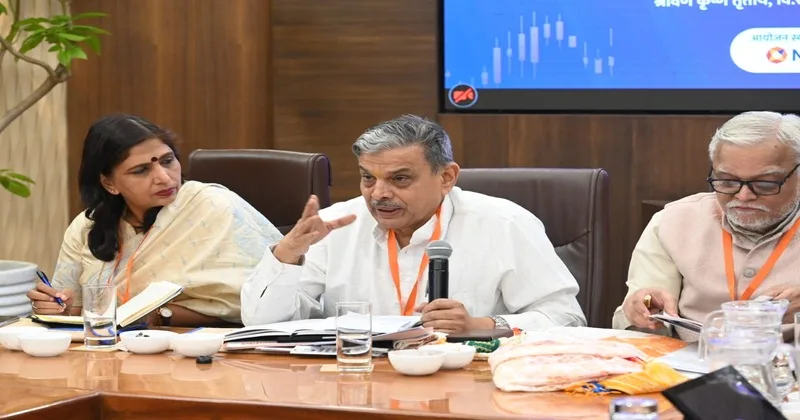
Mumbai: Building a Viksit Bharat requires an education system that nurtures not only knowledge and skills but also character and values, said Shri Dattatreya Hosabale, Sarkaryavah of the Rashtriya Swayamsevak Sangh (RSS), while addressing the National Symposium on Education for Viksit Bharat on August 1, jointly organised by Shiksha Sanskriti Utthan Nyas and the University of Mumbai at the National Stock Exchange (NSE), Mumbai.
Addressing an audience comprising eminent educationists, industry leaders, policymakers, vice-chancellors, and ministers from across the country, Hosabale emphasised that education should prepare students for the holistic development of life, balancing material progress with ethical, cultural, and spiritual values.
He observed that educational institutions must continuously evolve their teaching methodologies to meet the aspirations of a changing generation while remaining rooted in Bharat’s civilizational wisdom. Referring to the vision of Viksit Bharat 2047, he described it as an important milestone in Bharat’s developmental journey rather than its final destination, stressing that progress must always remain connected to the nation’s cultural foundations.
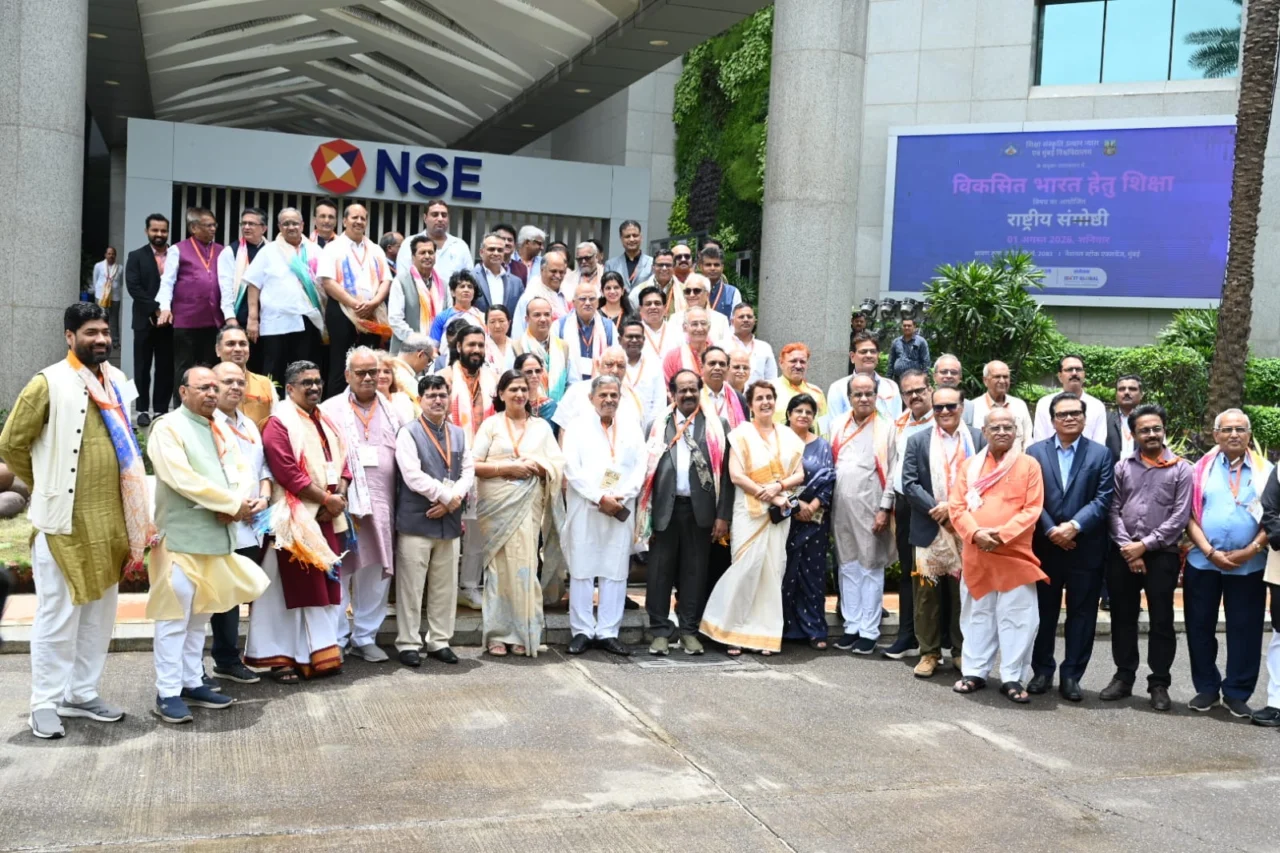
The symposium served as a national platform for dialogue on the role of education in shaping the future of Bharat. Participants explored ways to strengthen collaboration between academia, industry, government, and society to create an education ecosystem capable of supporting the country’s long-term development goals.
Welcoming the delegates, Dr Pankaj Mittal, President of Shiksha Sanskriti Utthan Nyas and President of the Association of Indian Universities (AIU), highlighted the transformative potential of the National Education Policy (NEP) 2020, describing it as a roadmap for positioning Bharat as a global knowledge leader through collaborative implementation.
Setting the context for the discussions, Dr Atul Kothari, National Secretary of Shiksha Sanskriti Utthan Nyas, said that the vision of a developed Bharat cannot be measured solely through economic indicators. True development, he said, must combine economic growth with ethical values, environmental responsibility, civic consciousness, cultural confidence, and skill-oriented education. He underlined the importance of partnership between government and society in achieving this vision.
The symposium built upon the national dialogue initiated during the Gyan Sabha held in Kochi last year under the guidance of RSS Sarsanghchalak Dr Mohan Bhagwat. That initiative has since inspired similar deliberations across several states. The Mumbai symposium expanded this conversation by bringing together leaders from education, industry, and the financial sector on a common platform.
During the first session, selected institutions from across Bharat presented innovative educational models that demonstrate how higher education can contribute to the vision of Viksit Bharat. Presentations were made by Guru Ghasidas Central University, Gondwana University, the Higher Education Department of the Government of Madhya Pradesh, Nalanda University, Sharda Group, Jhabua, Sarv Hitkari Vidya Mandir, Swami Vivekananda University, Sagar, SVKM Shirpur, the Central University of Tamil Nadu, and Ganpat University.
The session was chaired by Shri Ashish Chauhan, MD & CEO of the National Stock Exchange. The second session focused on “Viksit Bharat @2047: The Role of Education, Research, Industry and Society. Distinguished speakers included Shri Goverdhan Das Agrawal, Member, NITI Aayog; Shri Madan Dilawar, Minister of School Education, Rajasthan; Shri Yogendra Upadhyay, Minister of Higher Education, Uttar Pradesh; Shri Mangal Prabhat Lodha, Minister of Skill Development, Maharashtra; Shri Guru Khushwant Saheb, Minister of Technical Education, Chhattisgarh; Shri Yantrik, Chairman of DEXIT Global; representatives from IIT Bombay, IIT Bhilai, Tata Institute of Social Sciences (TISS) and Prof. Deepak Shrivastava, former UGC Secretary. The discussions emphasized that meaningful collaboration between education, research, industry, and society will be critical in realizing the vision of Viksit Bharat.
The symposium also witnessed the participation of several distinguished personalities, including Dr. Joram Beda Tana, Member, NITI Aayog; Prof. Ravindra Kulkarni, Vice-Chancellor, University of Mumbai; Dr. Vinita Sahay, Director, IIM Bodh Gaya; Shri Santosh Choubey, Chancellor, Rabindranath Tagore University; Milind Kamble, Founder, DICCI; Monica Garg, former IAS officer and Education Secretary; and numerous vice-chancellors, academicians, industry leaders, administrators, and institutional heads from across Bharat.
The symposium concluded with a renewed commitment to strengthen collaboration among educational institutions, policymakers, industry, and society in shaping an education system that is rooted in Bharatiya values while preparing future generations to contribute meaningfully to the vision of Viksit Bharat 2047.