सर्वे वर्णा यथा पूजां प्राप्नुवन्ति सुसत्कृताः।।14।।
Sarve varṇā yathā pūjāṃ prāpnuvanti susatkṛtāḥ ।।14।। (VR Balkanda Canto 13, Page 56)
The very architecture of society, through its institutions and social constructs, ensures that honour and respect are bestowed upon every individual and group.
जात्यन्ताच्छ बन्धुनि 5.4.9
jātyantāccha bandhuni 5.4.9 (Panini Ashthadhyayi)
Communities are formed to foster a sense of brotherhood. Hindu society was historically structured and organised around essential commonalities—shared attributes, professions, and vocations—that collectively defined the identity and cohesive character of the Samaj. These Samajs have long been observed diligently fulfilling their specialised duties and responsibilities in accordance with their respective professions, while also upholding important social obligations within their communities and contributing to the broader welfare of Hindu society.
Within Hindu society, there exists a rich diversity of communities such as the Maheshwari Samaj, Agarwal Samaj, Lohana Samaj, Patidar Samaj, Arya Vaishya Samaj, Kshatriya Samaj, Modh Bania Samaj, Reddy Samaj, Kamma Samaj, Maratha Samaj, Kunbi Samaj, Kurmi Samaj, and Yadav Samaj. These are but a few examples; in reality, the number of such Samajs is far greater.
Traditionally, Hindu society was organised through these Samajs (community bodies). Any message of importance—whether concerning a specific Samaj or the wider Hindu society—was communicated through this structured network. When required, the message would be conveyed to the head of the Samaj, who would ensure its dissemination to every member of the community. This well-established system functioned effectively for centuries, significantly contributing to the development, protection, and defence of Hindu society.
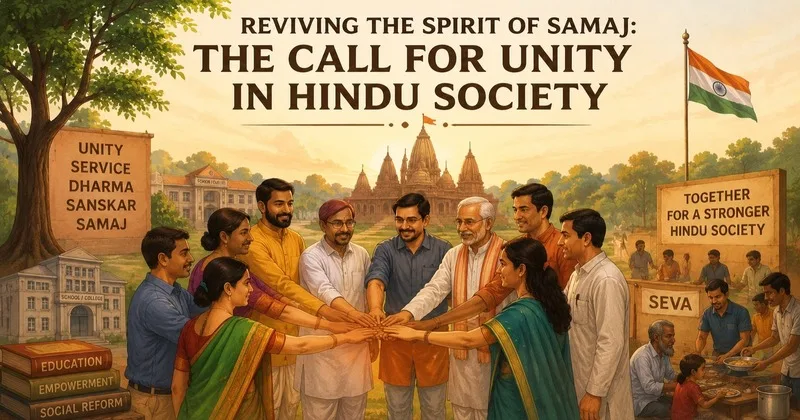
In addition to their professional responsibilities, these Samajs undertook essential social duties such as promoting education, supporting marriages, advancing economic upliftment, and initiating social and structural reforms—while safeguarding the overarching interests of Hindu society.
For instance, the Bisa Agarwal Samaj diligently oversees the renowned Nigam Bodh Ghat cremation ground, ensuring its dignified upkeep and exemplary management.
Many Samajs have established schools, hostels, colleges, and institutions across the country—not solely for the benefit of their own communities, but also in service of the wider Hindu society. Notable examples include Hindu College in Delhi, Hindu College in Sonepat (Haryana), and the RV College group of institutions in Bengaluru. These are just a few examples that come to mind; such examples can be found throughout the country.
In times of crisis—such as foreign invasions—various Samajs and communities have historically stood united in defence of Hindu society. One of the most devastating invasions occurred in 1398, when Tamerlane (Timur), the formidable Turco-Mongol invader from Central Asia, invaded Bharat. On 17th December 1398, Timur’s forces inflicted a crushing defeat on the Delhi Sultan, Mahmud Shah Tughluq.
Following the decisive battle, Delhi was besieged for three days. What followed was a massacre of unimaginable brutality: contemporary accounts estimate that over 100,000 civilians were slaughtered, with countless others taken as slaves. While Timur spared the Muslim population, Hindus were exterminated en masse.
After pillaging, plundering, and devastating Delhi and Loni, Timur advanced towards Baghpat, Meerut, Saharanpur, and Haridwar. Recognising the gravity of the situation, the respected Devpal Rana, a village panchayat head, convened a Sarvajati Mahapanchayat at Doghat (in present-day Meerut district). In response, a united Sarvajati Sena (People’s Army) was formed.
Mahabali Yograj Gurjar was appointed Commander-in-Chief of this force. His principal lieutenants included Harbir Singh Guliya Jat, Dhula Valmiki, Gaje Singh Jat Gathwala, Tuhiram Rajput, Saryu Pandit, Umra Tyagi, Durjan Pal Ahir, Kundan Jat, Dhari Gadaria, Bhalla Nai, Bhana Bunkar, Aman Singh Pundir Rajput, Natthu Padhar Rajput, Manchand Gurjar, and Bhalwa Kahar. This united force comprised 80,000 soldiers, with every Samaj and community contributing. In the final confrontation with Timur, he was gravely wounded and ultimately forced to retreat to Central Asia.
These Samajs and communities have also acted as steadfast bulwarks against the religious conversion of their members to Islam and Christianity. When the time was right, their leaders and members wholeheartedly welcomed those returning to the Hindu fold, accepting them back into the Samaj — their spiritual and cultural home, where they have always truly belonged.
In recent times, self-serving politicians have sought to exploit Samaj organisations, community leaders, and influential individuals to further their personal and political ambitions. In doing so, they have not only betrayed the trust of the community and weakened its internal cohesion, but have also contributed to the fragmentation of the wider Hindu society. It is imperative that Samaj leaders, community elders, and discerning members recognise these divisive agendas and liberate themselves from such influence and control.
In the 21st century, Hindu society is confronted with numerous assaults and formidable challenges. In such times, it is imperative that various Hindu communities and samaj organisations come together in unity—just as our ancestors, samaj leaders, and elders did in centuries past, serving Hindu society with unwavering dedication through even the most testing periods of history. By nurturing a united Hindu Samaj, we can rise above present adversities and move forward with dignity, honour, and self-respect.