The war in West Asia is engulfing like a wildfire across the geopolitical latitude with no sign of de-escalation, permanent truce and peace. The recently drawn ceasefire, apparently brokered by Pakistan, was vociferously broken. The quick stint of halt in conflict is only seen as a buffer period or a brief pause by the warring parties, to replenish militarily, re-escalate and facilitate the attack. The conflict is rigorously flaming with regional ramifications, as countries including Egypt, Kuwait, Azerbaijan are being drawn into the war., beyond the UAE, Saudi Arabia, Qatar, Jordan and others.
One among the most dreadful global impacts of the war in West Asia is not just confined to energy and trade. The West Asian landscape does not just act as the critical global trade route and energy chokepoint. But, beneath the vast oceans, they also hold the arteries & veins of the digital world, which are subsea internet cables. West Asia is also imperative as the global digital corridor, fuelling significant internet traffic. The spiralling geopolitical confrontation, thus threatening the very soul of 21st century industrial revolution, which is defined by the digital networks.
The escalating war with regional ramifications
In the latest catastrophe, the US and Saudi Arabia have launched a coordinated attack on the Iran-supported shia-militia positions in eastern Iraq, symbolising the expanding fabric of the US-Israel and Iran war, as a larger regional conflict. The US-Saudi attack on Iraq, is claimed as a response to Tehran’s attack on the US military bases in Jordan. Similarly, on July 27, Saudi Arabia reiterated that it shot down the drones fired by the IRGC on the petroleum facilities in Riyadh.
The Houthis of Yemen, who are a strong proxy of Iran, also blocked the Saudi ships in Bab al-Mandab, which is critical to Saudi’s oil trade. As a reaction Riyadh shot down Houthi drones. This opened yet another facet of the escalating West Asia conflict with regional repercussions. As a part of the fresh attacks in West Asia, Iranian drones have hit Kuwait on July 30. This came hours after the US declared that it conducted a “heavy wave of strikes against Iran”, in response to an Iranian attack on the US bases in Jordan. As per the reports, fires were witnessed in two natural gas vessels at Egypt’s Damietta port after suspected drone strikes.
The US also stated that “dozens” of missiles, drones and even military command centres belonging to the IRGC have been struck by the CENTCOM. Meanwhile, President Trump vowed to hit “Iran very hard”, as the latter attacked the US base in Jordan. The US has also struck Qeshm island in Iran, leading to the death of three people. Meanwhile, the oil tankers and commercial vessels being unequivocally hit in the Strait of Hormuz are a recurring phenomenon, as an impact of the hard-nosed rivalry between the US-Israel axis and Iran.
Submarine internet cables as strategic tools of the conflict
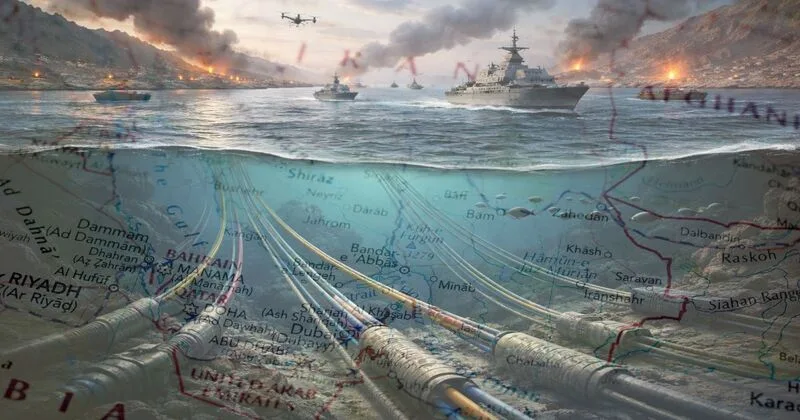
Beyond oil tankers and massive commercial vessels, West Asia, particularly the Strait of Hormuz also acts as a key corridor to transit global internet traffic. West Asia is not just vital for energy security and supply chain resilience, but also for digital security. But, the escalating war has been exposing the vulnerabilities of the submarine internet cables. The subsea cables are the potential strategic tools that the warring parties can exploit to seek hegemonic primacy.
A few months ago, as the war soared, there were reports claiming that Iran was exploring ways to exert control over the subsea internet cables, passing through the Strait of Hormuz, as Tehran predominantly controls the sensitive maritime corridor, since the war broke out. Reports claimed that IRGC is aiming to impose levy & fees on the tech giants who are running subsea optic fibres across the Strait of Hormuz and compel them to follow Iranian law, licensing & regulatory norms, while passing through the region. This includes, Google, Microsoft, Meta, Amazon.
On the other hand, the US can weave a counter strategy to Iran’s agenda of controlling the subsea cables, as the tech giants who operate and control the arteries of the internet are US-based. Moreover, the larger international sanctions channelised by Washington DC on Tehran, makes it difficult for Iran to completely control the submarine optic fibres. However, if these internet cables running across West Asia, unfortunately emerge at the epicentre of the US-Iran conflict, the global repercussions will be disruptive & beyond comprehension.
The optic fibres in West Asia & potential global disruption
If the subsea cables emerge as the strategic chokepoint and if the digital traffic is disrupted, the ramifications are beyond control. Every digital activity will be foiled that depends on the internet system. This includes, net banking, online payment models, banking transactions, education & health sector, agriculture, GPS & location tracking, agriculture and the vast social media network. It will also fracture complex categoricals dependent on internet such as Artificial Intelligence, quantum computing, space research, cloud computing etc.
In reality, every single aspect of the global economy will be disrupted, if the subsea cables are weaponised in the West Asia war. This will inflict serious strain on the global economy as predominantly, every single activity is digital-dependent in the contemporary world. To be more specific, the modern economy cannot sustain and survive if the digital arteries in West Asia are weaponized. Nearly 17 subsea cables pass through West Asia, carrying significant internet to Asia, Europe and Africa.
The impact on India
If the subsea cables are used as strategic tools in the West Asia war, it poses a significant threat to digital connectivity in India. The region around the Red Sea has emerged as a critical and strategic digital hub, as they cater the internet to entire Asia. Several major international cable systems also pass through the Strait of Hormuz. As per the sources, nearly 60 per cent of India’s internet traffic comes from these western routes. The subsea cables carrying internet to India, via these western routes include, AAE-1, Falcon Network, Tata TGN Gulf, SEA-ME-WE 4 and IMEWE. If these internet infrastructure are disrupted, it causes massive digital disruption in India, affecting the dependent services and a significant burden on the economy.
Is blocking global internet traffic virtually possible?
Weaponising subsea cables in the West Asia war is deemed as an extreme measure and a near impossible task. However, the vulnerability of the optic fibres is not completely hypothetical. For example, in the previous year, as an impact of the brief conflict in West Asia, three undersea cables linking India to global telecom networks were ruptured. As an impact, 25 per cent of the global internet traffic was disrupted, which was also further linked to Europe.
Meanwhile, Iran claims that it has the right to levy charges and control subsea cables as per the clause mentioned in the UNCLOS, which allows coastal states to impose certain conditions on internet cable operators while it passes through the sovereign territory.
On the other hand, experts assert that complete shut down of the global internet services is virtually not possible, though it is weaponised, as the operators deroute the internet traffic via other pipelines or cables. The Internet does not depend on a single route and it is a complex network. If one route is vulnerable, the digital network is channelised via the other. However, due to infrastructure limitations and other bottlenecks the derouting is also a herculean task and can lead to significant slowdown in the internet traffic.
Moreover, if the subsea cables are manipulated as a strategic chokepoint, any adverse impact of the war can cause severe damage to the optical infrastructure, beneath the oceans. The repairing takes a prolonged period and it is impossible to repair amidst a war. This will also visibly slow down the internet speed across the globe. Repairing a cable during normal times, is itself a herculean task, as the operators have to find out & assess the problems beneath deep oceans, send repair ships, park it in the same spot for a long duration and undertake the repair process.
Such a task amidst a war is impossible, due to continuous bombardment & explosions. For example, Meta has paused its subsea cable expansion task to Africa via West Asia, since the conflict broke out, as the process of capitalising the infrastructure is vulnerable to missile and drone attacks.
The geopolitical wildfire of West Asia engulfing the global energy & trade apparatus also can stretch to the digital domain thus causing additional pressure on every country’s economy. This also exposes the multi-vector repercussions of a geopolitical escalation. As India always advocates, dialogue, diplomacy and peace seems to be the only tangible solution. However, the escalating animosity & kinetic posture in a breakneck speed illustrates no strategic prudence, as the basket of risks soar and the truce mediated by Pakistan seems only as a paper over fissure, with no credible strategic propositions.