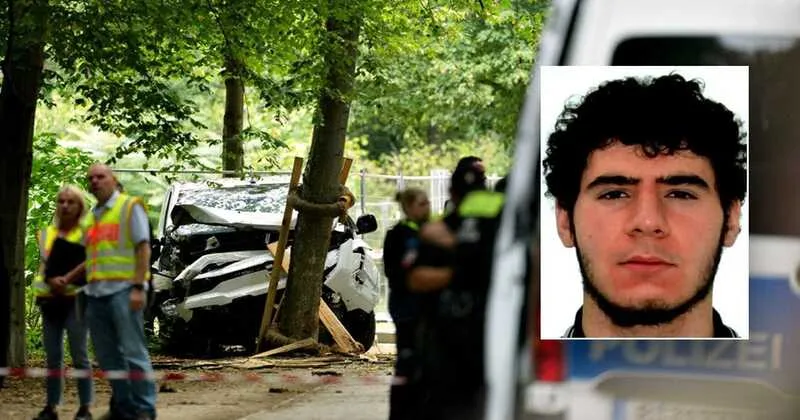
New Delhi: The deadly attack near Berlin’s Christopher Street Day (CSD) Pride celebrations has reignited a fierce debate over Islamist terrorism, radicalisation, immigration, and security failures across Europe. What began as a festive gathering in the German capital on the night of July 25, 2026, ended in bloodshed after 21-year-old Abdul Ballout, a German citizen of Lebanese descent with a documented extremist background, drove a van into a crowd before launching a knife attack.
The assault left one woman dead and 29 people injured, several of them seriously, before Ballout was tracked down and shot dead by German police the following day after he charged at officers with a bladed weapon. German authorities have formally described the incident as an Islamist terror attack.
A known extremist who was back on the streets
According to German investigators, Abdul Ballout was born in Berlin in 2005 and had long been on the radar of law enforcement. Police records linked him to offences including grievous bodily harm, aggravated extortion, assault and robbery, while intelligence agencies had also associated him with Islamist circles operating in Berlin.
Officials further stated that Andul had attempted to join the Islamic State (ISIS) and had previously travelled towards the West Asia in an unsuccessful bid to reach territory controlled by the terror organisation. He was eventually convicted under Germany’s juvenile justice system for terrorism-related offences but received a sentence of one year and ten months, remaining free pending appeal under supervision.
❗️A car plowed into a crowd at an LGBTQ+ Pride parade in Berlin, killing one person and injuring at least 16 others
According to police, one or more suspects fled the vehicle after the attack. Several people were also reportedly stabbed.
Police are searching for 21-year-old… pic.twitter.com/4u1ZCpgZAx
— NEXTA (@nexta_tv) July 26, 2026
Earlier reports indicated that Ballout had been released from juvenile detention only in May 2026, despite his extremist history. German media reported that he was regarded as a supporter of ISIS and remained known to police for radicalisation. During the initial manhunt, Berlin police warned the public not to approach him under any circumstances, describing him as armed and dangerous.
The nationwide search ended on July 26 in Berlin’s Spandau district. Police said officers located Ballout in an allotment garden complex where he rushed towards them carrying a bladed weapon. Special police units opened fire, fatally shooting him despite emergency resuscitation attempts.
Attack revives debate over vehicular terrorism
The Berlin attack has renewed attention to vehicle-ramming attacks, a tactic repeatedly employed by Islamist terrorists over the past decade. Counter-terrorism analysts have long identified vehicle attacks as a preferred method because they require little preparation while maximising casualties in crowded public spaces.
The Islamic State itself openly encouraged such methods in a propaganda message released in September 2014, urging supporters unable to obtain firearms or explosives to attack civilians using whatever means were available, including vehicles, knives, rocks or poison. That message specifically encouraged followers to target citizens of countries participating in military operations against ISIS.
German investigators have not publicly stated whether Ballout acted under direct operational instructions or independently after ideological radicalisation. However, Interior Minister Alexander Dobrindt said that “everything we see here indicates that this was an Islamist terror attack.”
The incident has once again highlighted concerns over lone-actor attacks inspired by extremist propaganda rather than centrally directed terrorist plots. Security experts note that such attacks are often difficult to detect because perpetrators require minimal logistical support while drawing ideological inspiration from online extremist material.
Political shockwaves across Germany and Europe
The attack unfolded near Tiergarten Park, only a short distance from Berlin’s annual Christopher Street Day celebrations, one of Europe’s largest LGBTQ+ events attracting hundreds of thousands of participants.
During the immediate aftermath, Berlin police spokesman Florian Nath confirmed that the suspect was already known to authorities and had links to Islamic circles in Berlin. Investigators also revealed that the suspect’s criminal and extremist background had already attracted the attention of security agencies before the attack.
Berlin Mayor Kai Wegner condemned the violence, describing it as “an attack on our free and cosmopolitan society.” He said that what had begun as a peaceful celebration of diversity had been transformed into an act of terror and expressed confidence that police and security services would thoroughly investigate the case. German Chancellor Friedrich Merz similarly declared that Germany would “not allow this poison of terrorism to spread further in our society,” while calling for a determined response against extremist violence.
The attack has simultaneously intensified political scrutiny of Germany’s criminal justice system. Questions are being raised over why an individual with previous terrorism-related convictions, documented extremist associations and multiple criminal offences remained at liberty only weeks before carrying out one of Germany’s deadliest attacks of the year.
I am in Berlin now and it is heartbreaking to watch driving a car into innocent people become a repeated act of Islamist terrorism.
The Islamist terror attack at CSD must be a wake-up call. Federal and state governments must stop funding Islamic centers that promote Islamism or… pic.twitter.com/FiI9WsKO3h
— Masih Alinejad (@AlinejadMasih) July 27, 2026
Counter-extremism specialists involved in Ballout’s earlier case reportedly questioned whether he had genuinely abandoned radical ideology, despite his claims of disengagement. Critics now argue that Germany’s handling of high-risk extremist offenders, particularly under juvenile sentencing provisions, requires urgent review.
Beyond Germany, the incident has renewed wider European concerns over Islamist-inspired terrorism targeting public gatherings. Major events across several European cities have already announced heightened security measures following the Berlin attack, while intelligence agencies continue monitoring online extremist networks capable of inspiring similar acts without direct organisational control.
For many observers, the Berlin Pride attack has become more than an isolated act of violence. It has reopened longstanding debates over radicalisation, immigration, judicial leniency, counter-terrorism policy and the ability of European security institutions to identify and neutralise individuals already known to law enforcement before they turn to mass violence.
German authorities continue investigating Ballout’s contacts, digital footprint and possible links to broader extremist networks as they seek to determine whether the attack was entirely self-directed or influenced by wider Islamist circles.