Tucked in the folds of the Aravalli hills, around 20 kilometres from Faridabad city and barely 55 kilometres from Delhi, lies Dhauj, a nondescript village that has once again exploded into the national headlines. Once infamous as the home of the perpetrators of the 2010 Dhaula Kuan gangrape, the Muslim-majority village in Haryana’s Mewat region is now under the scanner for hosting a Kashmiri Islamist terror operative with an arsenal of 350 kilograms of explosives, an AK-47 rifle, and a large cache of ammunition.
What was once dismissed as a backwater village of cattle traders and stone transporters has now been revealed as a safe haven for radical operatives and criminal syndicatesa chilling reminder of how lawlessness and Islamist terrorism have merged seamlessly in Mewat’s underbelly, right next to the national capital.
In late October, a joint operation by the J&K Police, Haryana Police, and the Intelligence Bureau (IB) blew the lid off a potential terror plot that could have devastated northern India.
Acting on intelligence derived from interrogations of two arrested suspects in Kashmir Dr Muzammil Shakil and Dr. Adil Ahmad Rather, both medical professionals the agencies raided a rented accommodation in Faridabad’s Dhauj village.
Inside, they discovered what Police Commissioner Satender Kumar Gupta described as “a stockpile of destruction”:
- 360 kg of ammonium nitrate, a highly explosive material
- An AK-47 rifle with three magazines and 83 live rounds
- A pistol with eight live rounds
- 20 electronic timers and batteries
- Wiring, switches, and detonators
The cache, police believe, was meant to be used in a series of coordinated attacks in the Delhi-NCR region. Gupta clarified that the substance was ammonium nitrate and not RDX, as initially reported, but warned that “the quantity was sufficient to trigger multiple large-scale blasts.”
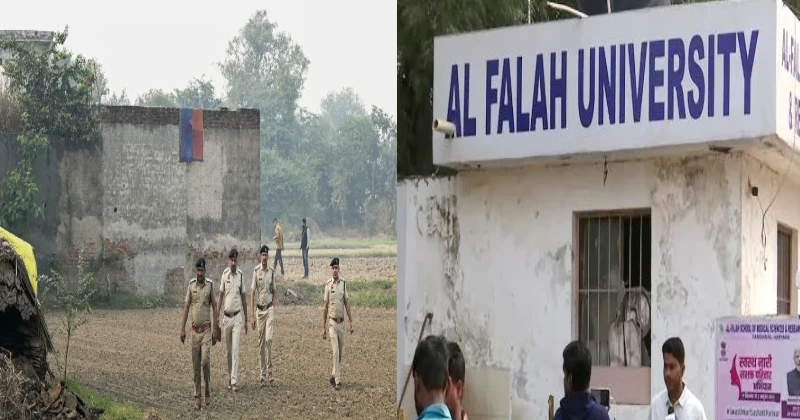
The primary accused, Dr. Muzammil Shakil, had rented the Dhauj accommodation three months prior to his arrest. According to police sources, Shakil was a lecturer at Al-Falah University, an institution situated in the same village. The discovery has sparked deep suspicion over how a university-educated doctor managed to operate a terror safehouse undetected in a small, tightly-knit village.
Who is Dr. Muzammil Shakil?
Dr. Muzammil Shakil, a native of Kashmir, is an MBBS degree holder who appeared to lead a quiet academic life. His professional background and role at Al-Falah University, a private institution with a 76-acre campus, allowed him to blend seamlessly into Dhauj’s semi-rural environment.
However, intelligence inputs suggest that Shakil and his associate Dr. Adil Ahmad Rather were in contact with handlers across the border, and that their role was not limited to planning attacks but also included recruitment and logistics for an Islamist terrorism.
During the investigation, it emerged that a Swift Dzire car belonging to a woman doctor at Al-Falah University was used to store one of the assault rifles linked to the case. While police have not charged her, her involvement remains under investigation.
“The possibility of other associates within the university cannot be ruled out,” an official source said. “The module’s sophistication doctors, academics, explosives suggests a white-collar terror network.”
Al-Falah University, located within Dhauj, has long been touted as an institution aimed at “uplifting the educationally backward Mewat region.” However, the terror-linked arrests have turned the spotlight on the university’s internal culture, affiliations, and oversight mechanisms. Security officials are probing whether radical elements exploited the campus environment to build recruitment channels or hide operatives under the cover of academia.
“Institutions like these, located in sensitive zones with porous oversight, are soft targets for infiltration,” said a senior officer from the Haryana Police’s Intelligence Wing. “When ideology seeps into education, it creates an ecosystem that can hide extremism in plain sight.”
The investigation has now expanded to examine digital communications, financial flows, and student networks linked to the suspects. Authorities have also sought UGC and MHRD assistance to conduct background checks on faculty appointments and foreign funding associated with the university.
The terror recovery might have shocked many, but for those familiar with Dhauj’s history, it fits a grim pattern. The village has been synonymous with criminal activity for over a decade, its name first entering the national lexicon after the infamous 2010 Dhaula Kuan gangrape case.
In that case, five men from Dhauj Mohd Kamru, Mohd Usman, Mohd Shamshad, Mohd Shahid, and Mohd Iqbal Shamshad—were arrested for the brutal gangrape of a Mizo woman working in a Delhi BPO. The men had reportedly set out to steal cows for slaughter that night when they spotted their victim returning home from work. They kidnapped her at gunpoint, assaulted her inside their mini-truck, and dumped her on the road hours later.
The case exposed the gruesome criminal tendencies and complete breakdown of law and order in Dhauj and its surroundings. Police later said the accused were part of a network of cattle smugglers and vehicle thieves, operating freely under a veil of rural anonymity.
Even today, Dhauj remains a portrait of neglect a village caught between poverty, religious identity, and criminal enterprise. Many villagers depend on cattle trading, beef sales, or running dumpers and trucks that ferry crushed stones from nearby quarries. Illegal slaughter and cattle theft continue despite Haryana’s cow protection laws, with local police often accused of looking the other way.
“After 5 PM, the entire village turns dark. There is no power, no security, no government presence,” said Sirajuddin, a 25-year-old daily wager from Dhauj. “Most boys drop out after primary school. Some work as conductors or truck drivers; others get involved in stealing vehicles or cattle. It’s easy money.”
The lack of educational infrastructure ironically in a village that houses a university has created a generation of uneducated and idle youth, vulnerable to both criminal gangs and radical preachers.
Old-timers like Abdul Sattar, a lifelong resident, express despair, “There is no discipline here. Every few years, something terrible happens—rape, murder, now terrorism. We fear what will come next.” Dhauj’s decay cannot be seen in isolation. It is a microcosm of the larger Mewat region, which spans southern Haryana, parts of Rajasthan, and western Uttar Pradesh. The region’s population is predominantly Meo Muslim descendants of Rajput converts who have retained some Hindu customs but remain socially and economically isolated.
Over the years, Mewat has gained notoriety as one of North India’s most lawless belts. The region is a known hub for cow smuggling, carjacking, land grabbing, and cross-border trafficking.
Law enforcement officials privately admit that radical Islamist organisations have found fertile ground in Mewat, where poverty and alienation are exploited to push extremist ideologies. Foreign-funded NGOs and religious networks often operate under the pretext of “education” or “social upliftment,” creating what one intelligence officer described as “a perfect petri dish for radicalisation.”
“Dhauj’s geography makes it ideal for such operations,” the officer explained. “It’s close to Delhi, connected by rural backroads to Gurugram and Alwar, and sits on the edge of a region with weak policing and strong communal bonds. It’s a shadow corridor.”
The transformation of Dhauj from a village of cattle smugglers to a terror hideout is not as abrupt as it appears. Over the years, police have noticed a disturbing continuum: networks engaged in illegal trade, especially beef smuggling and vehicle theft, have developed links with Islamist handlers and hawala networks.
“Many of these gangs already have routes, vehicles, and logistics ready,” said a senior Haryana Police officer. “It doesn’t take much for an external group to tap into them for movement of arms or explosives.”
This logistical overlap has been observed in several investigations involving Mewat-based operatives linked to cross-border terror groups. In some cases, smuggling channels used for cow transport have doubled as routes for weapons or illegal cash. What distinguishes the Dhauj case from previous Mewat incidents is the profile of the accused. Unlike the illiterate cattle thieves of old, Dr. Muzammil Shakil and Dr. Adil Rather are educated professionals symbols of modern respectability.
This shift, officials say, points to a “white-collar jihad” emerging in India’s urban peripheries. “We are seeing educated individuals doctors, engineers, students being indoctrinated into ideological extremism,” said an IB source. “They are not fringe criminals but ideologically motivated actors who use their professional cover to hide their activities.”
This pattern mirrors global trends, from ISIS recruiters using universities in Europe to Pakistan-backed sleeper cells infiltrating academic institutions in South Asia.
The Faridabad recovery has rattled security agencies because of its proximity to Delhi. Dhauj lies barely an hour’s drive from the Parliament complex and major defence installations. “The volume of explosives recovered is alarming,” said a former IB officer. “This wasn’t an experiment it was preparation. If not intercepted in time, the impact could have been catastrophic for the NCR.”
He added that the presence of ammonium nitrate and multiple detonators indicates industrial-level planning, possibly with foreign support or training. While authorities scramble to trace the larger network, locals in Dhauj continue to live in denial. Some blame the media for “defaming” the village; others insist that crime stems from “poverty and discrimination.”
But the ground reality tells another story. The village’s pattern of recurring criminality, coupled with the emergence of a terror module, points not to poverty alone but to an entrenched culture of impunity sustained by religious cohesion and political appeasement.