“Motherhood began with the very creation of the universe. It is the most eternal and the innate instinct of nature. While creation has continued to expand since its origin, the process of creation itself cannot move forward without motherhood,” said RSS Sarsanghchalak Dr Mohan Bhagwat. Describing motherhood as the fundamental basis for creation, nourishment and the continuation of human existence, he emphasised that it remains the foundation of civilisation.
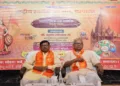
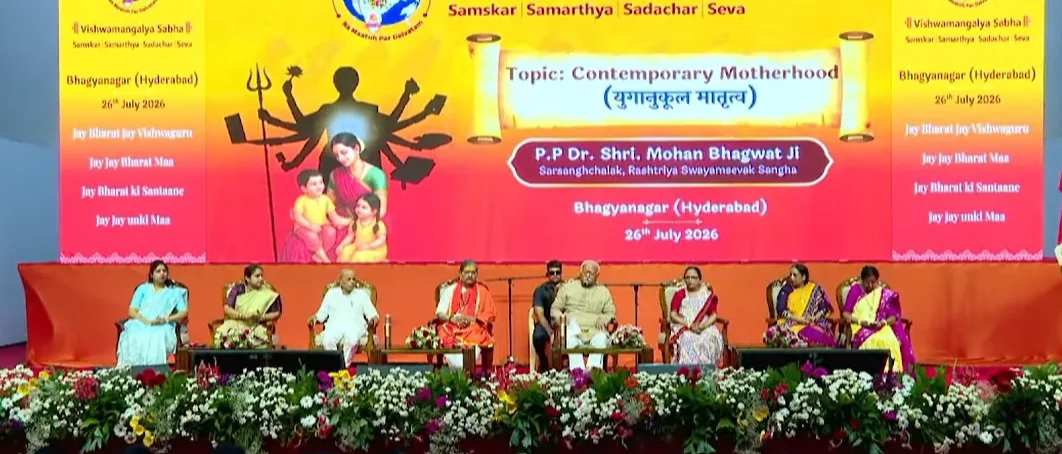
Dr Bhagwat made these remarks while delivering the valedictory address at the two-day Dakshin Bharat Prabodhan Baithak, organised by Vishwamangalya Sabha, in Bhagyanagar (Hyderabad) on 26 July. The concluding session was held at Sevalal Banjara Bhavan, where he addressed women representatives, mothers and delegates from across Southern India.
He remarked humorously that there is no greater strength than experience when speaking on any subject. Since ours is one of the world’s most ancient civilisations, motherhood in our country is equally ancient. Therefore, asking him to speak about mothers who possess such immense experience was, he joked, nothing less than putting him to the test.
However, he said that for the past several centuries, our country remained under the domination of foreign rulers. The influence of foreign cultures brought many changes not only to our culture but also to our daily way of life. Under such circumstances, he said, all of us have the opportunity to discuss “Yuganukool Matrutva” (Contemporary Motherhood).
He said that mothers possess the experience of many ages with regard to motherhood. Therefore, there is not much that needs to be taught to them about motherhood, though there is certainly a need for discussion. He said that circumstances and the environment have changed, and such change is a natural and continuous process. Despite all these changes, mothers have continued to nurture and raise their children based on our eternal values.
He said that everyone is now discussing motherhood, but there is a need to analyse why this question has arisen. He said that society as a whole is responsible. He stated that Bharat is the most ancient nation and that it is equally ancient in the concept of motherhood.
However, because society forgot the inspiration and message of motherhood, it declined, enabling foreign powers to plunder and dominate the country. He added that the last foreign rulers, the British, further strengthened this loss of self-awareness before leaving. Moreover, they conditioned our minds to believe that all the ancient traditions and concepts of our country were worthless.
He explained that many people believe we have been forgetting our practices and traditions only over the past two thousand years, but in reality, this forgetfulness began as early as the period of the Mahabharata. Since then, he said, we have gradually forgotten our customs, practices and traditions.
Thereafter, invasions began, and from that point onwards, foreigners shaped our minds in such a way that we ourselves developed hatred towards our own traditions. They gradually instilled the belief that foreign customs and practices were correct, while our own traditions and ways of life were wrong. As a result, we even lost awareness of our genuine traditions and practices.
He said that false notions arising from this incomplete outlook prevail in Western countries, leading to numerous problems there. We adopted some of those ideas from them, yet they have no solutions to those problems, nor have we found any. Nevertheless, some people here continue to treat those narratives and standards as the benchmark.
He further said that foreigners created narratives that never existed in India and propagated them here. For example, they introduced the debate over whether men are superior or women are superior. Those favouring men argue that men are superior, while those supporting women claim that women are superior. Thus, society has become occupied with arguments over who is greater and who is lesser.
From there arise questions such as: If women are superior, why do they remain slaves within the family? Why do they accept the institution of marriage, which keeps them in bondage? Some argue that women can do anything. He said that the claim that women can do everything is merely an illusion, and the claim that men can do everything is equally an illusion.
He further said that the term “women’s liberation” was also brought into public discourse. While the phrase sounds appealing, he clarified that if the concept of slavery truly exists, then women must certainly be liberated from it. However, he observed that everyone lives within some form of bondage. Breaking all bonds is impossible. Every liberation inevitably leads to another form of bondage. Merely declaring, “I am free from all bonds; I am no longer bound,” is not enough. What we perceive as the bondage that binds us is, in reality, another form of bondage called liberation.
He said that the women’s liberation movement began in the country and that some people accepted it. He also said that Gen Z has come, and that the term sounds good to hear. He said that it is emotional in nature and is likewise easy to imitate, but that it does not think with maturity.
In the same context, a Gen Z woman wrote a book in the name of “women’s liberation”, planting poisonous ideas, and that because of it, two generations were disrupted. A few days later she realised her mistake and wrote another book as a counter to it, in which she admitted her mistake.
He said that she went on to write several more books so that, at the very least, the coming generations would not go down the wrong path. Finally, she acknowledged that motherhood is the greatest thing for a woman.
However, we too have blindly followed that Western approach, thinking that it is progressive, and that we too follow it blindly. Therefore, he stressed that at the present time there is a need to discuss “motherhood.”
All situations have an underlying perspective, and that perspective must be properly understood, he said.
He said that Bharat has possessed a complete and holistic perspective since ancient times because our ancestors thoroughly studied the truth relating to creation, accepted it and passed it on to future generations. He added that the same heritage is still with us and teaches us that all of us are one.
He said that men, women, living beings, human beings, inertness and consciousness are all illusions. However, we cannot go beyond them. Although all these are maya (illusion), they can be transcended through tapas (penance). However, it is only through the cooperation and permission of nature that this illusion can be overcome.
But the reality everyone is one, and this is our heritage. He further pointed out that this consciousness is not confined to a limited extent but is universal, and that science too says the same.
Dr Mohan Bhagwat said that in our society, for anything to happen, it is possible only when men and women come together. In fact, this is the very characteristic of our tradition. However, it is being propagated as though it functioned on the basis of domination, and some people have accepted this blindly.
He said that Bharat has possessed a complete and holistic perspective since ancient times because our ancestors thoroughly studied the truth relating to creation, accepted it, passed it on to future generations, and left us with a heritage that teaches us that all of us are one.
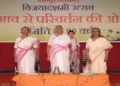
The programme was attended by Vishwamangalya Sabha founder Pujya Shri Jitendranath Maharaj, National Organising Secretary Dr Vrushali Joshi, Akhil Bharatiya Vishwamangalya Sabha Guide Prashant Ji Holkar, Vishwamangalya Sabha National President Nalini Hawade, National Organising Secretary Dr Vrushali Joshi, Vishwamangalya Sabha National Vice-President Suraj Ji Damor, Reception Committee President Bhagwati Ji Baldwa, and Joint Secretary Shruti Boddupalli, who participated as chief guests and guided the programme.
Around 150 Vishwamangalya Sabha workers from the South Indian states of Telangana, Andhra Pradesh, Goa, Maharashtra, Karnataka, Tamil Nadu and Kerala, among others, participated in the programme.
Women representatives, eminent personalities and mothers from across Southern India participated in large numbers in these Dakshin Bharat Prabodhan Baithak meetings and made the programme a success.