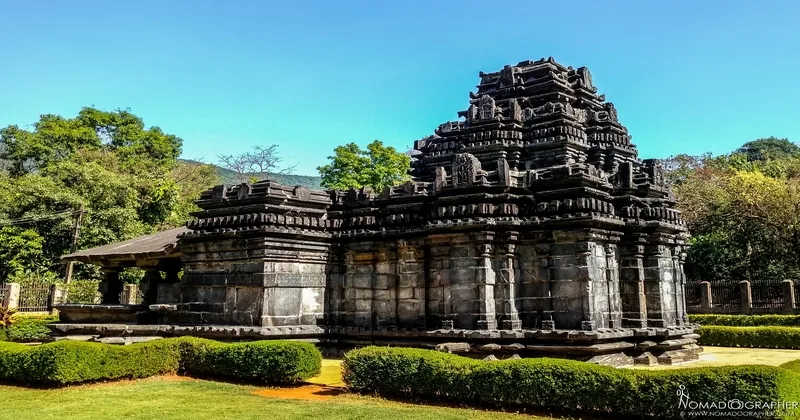
South Goa: Nestled deep inside the lush forests of Goa’s Bhagwan Mahavir Wildlife Sanctuary, the Tambdi Mahadeva Mandir stands as the state’s oldest surviving Hindu Mandir. Built over 900 years ago, this remarkable monument has withstood invasions, changing dynasties and the test of time, preserving a rare example of Kadamba-era architecture in Goa.
Located around 60 km from Panaji in South Goa, the Mandir sits on the banks of a mountain stream within the Bhagwan Mahavir Wildlife Sanctuary. Surrounded by thick evergreen forests and the foothills of the Western Ghats, the shrine offers visitors a rare combination of spirituality, history and natural beauty. Dedicated to Bhagwan Shiva, Tambdi Mahadeva is the only surviving Mandir in Goa built in the distinctive Kadamba architectural style.
Historical Background
The Mandir is believed to have been constructed in the 12th century, during the reign of the Kadamba dynasty, which ruled Goa between the 10th and 14th centuries. Historians believe the Mandir may have originally stood elsewhere and was later relocated to its present remote location to protect it from destruction during periods of political upheaval. Others suggest that its isolated forest setting itself helped shield it from invasions that destroyed many other Mandirs across Goa.
Unlike numerous Mandirs that were demolished or converted during Portuguese rule, Tambdi Mahadeva survived largely because of its secluded location in dense forests far from coastal settlements. Today, it remains one of the finest surviving monuments of pre-Portuguese Goa.
Unique Architecture
The Tambdi Mahadeva Mandir is celebrated for its exquisite Kadamba style of architecture, displaying remarkable craftsmanship despite its modest size.
Some of its notable architectural features include:
-Constructed entirely from black basalt stone, which was transported from the Deccan plateau since basalt is not naturally available in Goa.
-Built without the use of modern cement, with stones interlocked through precise engineering.
-Features an intricately carved mandapa (assembly hall) and garbhagriha (sanctum sanctorum).
-Supported by beautifully sculpted pillars decorated with floral motifs, miniature figures and geometric patterns.
-The entrance is adorned with finely carved images of Shaivite deities.
-A beautifully carved Nandi, Bhagwan Shiva’s sacred bull, faces the sanctum.
-The Mandir’s pyramidal roof, stepped design and elegant proportions reflect the advanced Mandir-building traditions of medieval peninsular India.
At the heart of the Mandir lies a Shiva Linga, which continues to be worshipped by devotees throughout the year. Unlike many archaeological monuments that function solely as heritage sites, Tambdi Mahadeva remains an active place of worship. Daily rituals continue, maintaining an unbroken spiritual tradition spanning centuries. The Mandir exudes an atmosphere of serenity, enhanced by the sound of flowing streams and birdsong from the surrounding forest.
Engineering Excellence
One of the Mandirs most fascinating aspects is its construction. Despite standing in a region receiving some of India’s heaviest monsoon rainfall, the structure has remained remarkably intact for over eight centuries.
The carefully cut basalt blocks fit together with extraordinary precision, allowing the monument to withstand: Heavy rainfall, Humidity and Natural weathering. The craftsmanship reflects the engineering expertise of medieval Indian Mandir builders.
Tambdi Mahadeva remains an important pilgrimage centre for Shaivite devotees. The Mandir witnesses large gatherings during:
-Mahashivaratri
-Shravan month
-Kartik festivals
-Mondays dedicated to Bhagwan Shiva
Devotees from Goa, Karnataka and Maharashtra regularly visit the shrine.
The Archaeological Survey of India (ASI) has designated Tambdi Mahadeva as a protected monument. In recent years, the Mandir has also gained international attention after being included in India’s Tentative List for UNESCO World Heritage status as part of the Sacred Ensembles of the Hoysalas and related Mandir traditions, highlighting its exceptional historical and architectural value.
The Archaeological Survey of India periodically undertakes conservation work to preserve the Mandir’s stone carvings and structural integrity. Given its location within a protected forest, environmental conservation and heritage preservation go hand in hand. Authorities regulate construction activities nearby to maintain the site’s ecological and archaeological significance.
Tambdi Mahadeva is far more than an ancient shrine. It represents a living link to Goa’s pre-Portuguese history, showcasing the region’s indigenous cultural and architectural traditions. As one of the few surviving monuments from the Kadamba era, it offers invaluable insights into medieval temple architecture, engineering and religious life in western India.
For historians, architects, pilgrims and nature enthusiasts alike, the Mandir stands as a testament to India’s enduring civilisational heritage. Hidden within the forests of the Western Ghats, Tambdi Mahadeva continues to inspire awe, not only for its artistic excellence but also for its extraordinary survival through centuries of political change and natural challenges.