By the middle of 1986, Punjab was struggling under the growing threat of Khalistani extremism. The state, which had already witnessed several years of violence, was entering a phase where radical groups increasingly targeted ordinary civilians.
After Operation Blue Star in June 1984 and the subsequent political and security developments, extremist organisations intensified their activities. While security forces conducted operations against radicals, extremist groups attempted to spread fear by carrying out attacks on soft targets, particularly Hindu civilians.
Earlier, many attacks were directed against police personnel, political workers and government officials. However, over time, ordinary citizens travelling on roads, buses and trains became targets. Public transport became a preferred method for radicals to spread fear among civilians.
The attack at Muktsar on July 25, 1986, was one such incident that exposed the brutality of Khalistani radicalism against innocent civilians.
The Muktsar Bus Massacre
On the morning of July 25, 1986, a Chandigarh-bound passenger bus was travelling through the Muktsar area of Punjab. The passengers were ordinary people travelling for work and daily activities. At around 5:30 am, the bus was intercepted by a group of armed Khalistani radicals.
The attackers stopped the vehicle and took control of the bus. Carrying automatic weapons, including Sten guns and pistols, the radicals entered the bus and began questioning passengers. They then separated passengers on the basis of their religious identity.
According to contemporary reports, Sikh passengers, women and children were allowed to leave, while Hindu passengers were singled out. The attack was not a random act of violence; the victims were targeted because of their religious identity.
After identifying their targets, the radicals opened fire on the passengers. Around 24 Hindu passengers and one Sikh passenger were killed in the massacre, while several others were injured. The attackers fled after carrying out the violence, leaving behind a trail of death and fear.
The Muktsar massacre was not merely an attack on a bus. It was part of a larger pattern of violence in which Khalistani radicals targeted innocent civilians to create fear. The choice of public transport as a target was deliberate, and such attacks created insecurity among families across Punjab.
Innocent civilians were not targeted because of any political role or involvement with the government; they were targeted because they were Hindus. The incident came at a time when the Punjab government and security agencies were already facing criticism over their inability to prevent terrorist violence. The massacre further increased fear among Hindu families in Punjab, many of whom felt vulnerable due to repeated attacks.
The attack triggered anger and concern across Punjab and neighbouring states. Questions were raised over how armed Khalistani radicals were able to carry out such attacks despite the presence of security forces.
Security agencies increased vigilance across Punjab, Haryana, Jammu & Kashmir and Delhi amid fears that extremists could carry out similar attacks in other parts of North India.
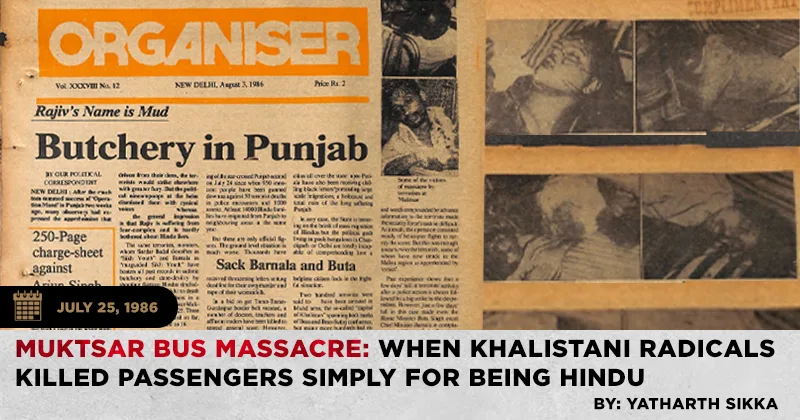
The August 3, 1986 edition of Organiser highlighted the wider security situation following the Muktsar massacre. The report noted that the attack came soon after Operation Mand, a major security operation launched against terrorists hiding in the Muktsar and Gidderbaha areas.
According to the report, security forces had conducted operations against terrorists in the region, but the subsequent bus massacre demonstrated that radical groups were still capable of retaliatory strikes. The attack was seen as an attempt by terrorists to show that they could continue targeting innocent civilians despite security operations.
The Muktsar massacre was among the first of many such incidents in a series where Hindus were singled out and killed on buses, representing a disturbing pattern during the insurgency.
The forgotten side of Punjab’s history
The has been a long talks and debates on the suffering of Sikhs during that period, which is necessary. However, there has been no discussion about the violence carried out by Khalistani radicals against innocent Hindus in which more than 34000 Hindus were killed.
During the insurgency period, extremist groups openly issued threats and calls against Hindus. Many Hindus were killed in buses, trains and on roads simply because of their religious identity. Yet, there remains a lack of comprehensive documentation and public remembrance of many such victims.
Despite the scale of violence during the insurgency, several attacks, including the Muktsar massacre, remain absent from wider public memory. The Muktsar massacre was one among several attacks during the 1980s and early 1990s in which Hindu civilians became targets of Khalistani terrorists.
Nearly four decades later, the victims of July 25, 1986, deserve to be remembered not merely as numbers in an account of violence, but as individuals whose lives were cut short by terrorism.
Documenting their stories remains essential to ensure that this chapter of violence against Hindus in Punjab is neither forgotten nor lost with time.