Post the phase of intense diplomatic face-off and severe strain in the bilateral relations over the Khalistan issue, India and Canada are espousing on the path of major diplomatic reconfiguration. National Security Advisor(NSA) Ajit Doval visited Ottawa where a series of discussions were held and agreements were sealed to consolidate security cooperation. India’s outreach to Canada is thus a pivotal pillar to counter extremist activities and defend the national security architecture against anti-national elements.
In 2023, diplomatic relations between India and Canada hit an all-time low as the former Prime Minister of Canada Justin Trudeau accused India of being linked to the killing of Hardeep Singh Nijjar, a Khalistani activist. These irrational and evidenceless accusations, led to the explosion of a row where there were diplomatic/High Commissioner expulsions and any form of bilateral relations were halted. However, under the leadership of Prime Minister Mark Carney, New Delhi-Ottawa ties are reviving with strategic clarity and diplomatic maturity, where security cooperation is a key dimension in the strategic relations.
Law enforcement liaison officers to leverage transnational security
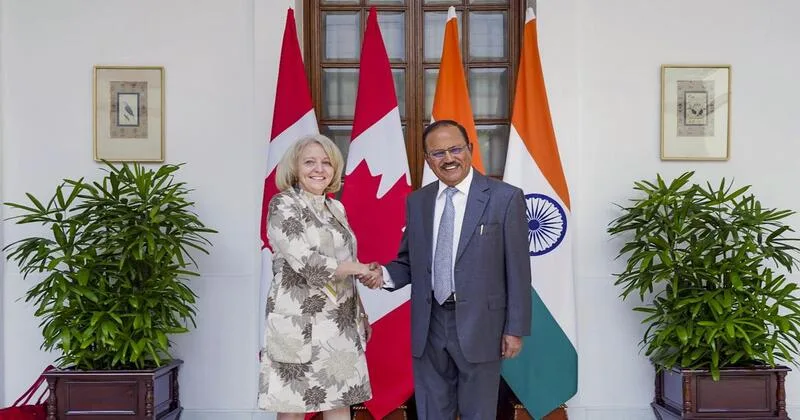
NSA Ajit Doval met his Canadian counterpart Deputy Clerk and National Security and Intelligence Advisor to the Prime Minister of Canada Nathalie Drouin. Both officials agreed to strengthen coordination to counter extremist movements and other transnational crimes. In this direction, it was announced that a security and law enforcement liaison officer would be appointed to handle mutual security concerns and eradicate other transnational organised crimes such as drug trafficking, money laundering for anti-national activities etc. The liaison officials will also ensure stronger enforcement of immigration vigilance norms to thwart the transnational movement of anti-national and extremist elements.
The liaison officers posted in each other’s country would exclusively work towards strengthening the security cooperation between India and Canada. The officers would facilitate the security coordination on priority basis. The liaison and law enforcement wing will help swift information exchange, intelligence sharing and will streamline other vital elements that are critical to ensure transnational security by eradicating illegal and fraudulent networks.
Sharp message to Khalistan outfits
During the meeting between NSA Ajit Doval and his Canadian counterpart deliberated upon countering the Khalistani threat which is a strategic bottleneck for the cordial ties between New Delhi and Ottawa. Khalistani extremists pose a security challenge to both India and Canada with their illicit separatist motives. Talks between the security officials focused on cutting the sources of extremist funding which aims at intimidation and fake propaganda building targeting India. An agreement and mutual consent to counter the Khalistan threat, gives a major strategic boost to reset the India-Canada ties as that was the dominant spine in the bilateral relations.
Infact, Canada acknowledged the violent extremism prevailing in its soil that is deliberately targeted against India. Thus, Ottawa reiterated its support in India’s fight against Khalistan extremism. It asserted that the extremism aspect is not just a diplomatic thorn but a deep security crisis and the larger public safety is embedded in the issue which is adversely impacting the sovereignty, national security and territorial integrity of India. This acknowledgement from Ottawa reflects a comprehensive shift in Canada’s diplomatic and strategic book towards India, a drift from the approach of the Trudeau government in Canada with respect to the Khalistan issue.
Cybersecurity cooperation
NSA Ajit Doval and his Canadian counterpart also curated a path to funnel cyber security cooperation between India and Canada. By formalising the cyber security cooperation, India and Canada agreed for information sharing, accelerated practical steps to rebuild trust that was derailed over the Khalistan issue and aimed to harness capacity building to ensure cyber security. The cyber security cooperation aims to carve an institutionalised framework to channelise collaboration to counter transnational organised crimes by crafting a solid and safe cyber domain.
Prime Minister Mark Carney to visit India
The visit of NSA Doval to Canada has stimulated a major pathway to reset New Delhi-Ottawa ties. In yet another big momentum to propel the bilateral relations, Prime Minister Mark Carney is set to visit India in early March, as per the official sources. During the visit deals are expected to be signed in the domain of uranium and other critical mineral cooperation, energy security, Artificial Intelligence, digital ecosystem, quantum computing, education, cultural cooperation and will unlock vast potential to fuel bilateral cooperation, said Dinesh Patnaik, Indian High Commissioner to Canada.
During the visit of the Canadian PM to India, the formal negotiations are also expected to commence for a Comprehensive Economic Partnership Agreement(CEPA). This will be yet another Free Trade Agreement etched by India in line with the United Kingdom, European Union and the USA. As mentioned, Canada is willing to sell its vast pool of Uranium to India under the bilateral nuclear cooperation agreement. The Canadian Prime Minister visit to India, thus reflects strategic pragmatism and a diplomatic push to reset the ties which is vigilant in an unpredictable geopolitical landscape.
Recently, Canada is aiming to diversify its bilateral affiliations away from the United States to shield the country from the irrational policies of the Trump administration. Prime Minister Mark Carney lately exclaimed that diversifying away from the dependence on the US and collaborating with countries like India is crucial to carve a resilient, fair and multilateral world order which is currently entangled in tariff war and trade weaponisation. Thus, Canada deems India as a credible partner to protect its national interests against the geopolitical volatilities. On the other hand, India’s approach towards Canada is rooted in strategic pragmatism to secure national interest and carve a rule-based balanced world order, which is secure from the extremist threats.