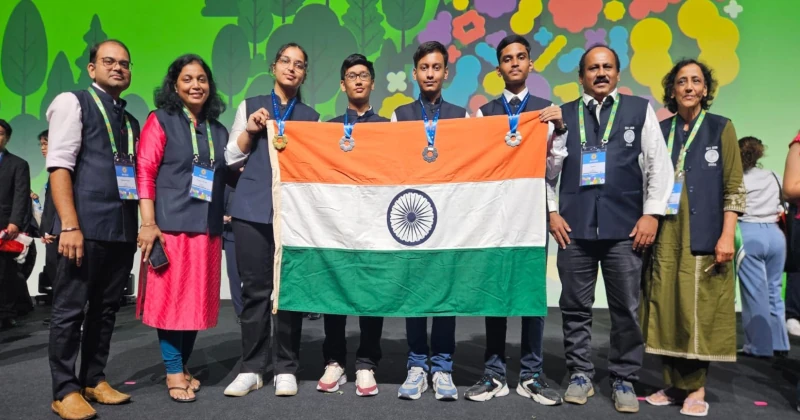
NEW DELHI: India scripted another remarkable success on the global academic stage as all four members of the Indian contingent won medals at the 37th International Biology Olympiad (IBO) 2026 held in Vilnius, Lithuania, from July 12 to 19. The team returned with one gold medal and three silver medals, reaffirming India’s growing excellence in international science competitions.
Prime Minister Narendra Modi congratulated the young achievers, describing their accomplishment as a matter of “immense happiness” and expressing confidence that their success would inspire countless students across the country.
Taking to X, the Prime Minister wrote, “It is a matter of immense happiness that in the 37th International Biology Olympiad held in Vilnius, Lithuania, all four Indian team members secured medals, including one Gold.”
Congratulating the students individually, he added, “Proud of Bhavyaa Gunwal, Soumil Maity, Nishit Kalani and Anmol Kumar for their success at the Olympiad. They have shown immense knowledge of subjects like Molecular Biology and Biochemistry, Animal Physiology, Animal Morphology and Systematics as well as Plant Computational Biology. I am certain that this success will encourage several more youngsters.”
It is a matter of immense happiness that in the 37th International Biology Olympiad held in Vilnius, Lithuania, all four Indian team members secured medals, including one Gold.
Proud of Bhavyaa Gunwal, Soumil Maity, Nishit Kalani and Anmol Kumar for their success at the… pic.twitter.com/8KNqqhgFbM
— Narendra Modi (@narendramodi) July 19, 2026
Leading India’s stellar performance was Bhavyaa Gunwal from Mahendragarh, Haryana, who secured the gold medal. The three silver medals were won by Soumil Maity from Howrah, West Bengal, Nishit Kalani from Pali, Rajasthan, and Anmol Kumar from Mansa, Punjab.
The 2026 edition of the Olympiad witnessed participation from 307 students representing 78 countries, making it one of the world’s most competitive school-level biology competitions. This year, 31 gold, 61 silver and 91 bronze medals were awarded.
The International Biology Olympiad is widely regarded as one of the most demanding global competitions for school students, designed to evaluate advanced biological knowledge, experimental skills and scientific reasoning.
Hosted by the Vilnius University Life Sciences Centre, the Olympiad featured two six-hour examinations—one practical and one theoretical. The practical examination required participants to conduct sophisticated experiments across four specialised disciplines:
- Molecular Biology and Biochemistry, including plasmid analysis and enzyme assays.
- Animal Physiology, involving aspirin pharmacokinetics using specialised digital tools.
- Animal Morphology and Systematics, featuring insect classification and detailed dissections.
- Plant Computational Biology, where students performed image-based plant trait analysis and transcriptome studies using computational tools.
The six-hour theoretical examination consisted of 100 research-oriented questions covering cell biology, molecular biology, genetics, evolution, ecology, plant sciences, animal sciences, ethology and biosystematics. The questions focused heavily on analytical thinking and scientific problem-solving rather than memorisation.
The Indian team was led by Prof Rekha Vartak, former faculty member at the Homi Bhabha Centre for Science Education (HBCSE-TIFR), Mumbai, along with Dr Anupama Ronad of HBCSE-TIFR.
The delegation also included Scientific Observers Dr Ranjithsinh Devkar of The Maharaja Sayajirao University of Baroda and Dr. Siddhesh Ghag of the UM-DAE Centre of Excellence in Basic Sciences, Mumbai.
According to HBCSE, the students underwent intensive orientation and pre-departure training camps conducted by the Biology Olympiad Cell, with guidance from experienced teachers and mentors from across the country.
This year’s achievement further strengthens India’s impressive record at the International Biology Olympiad. The 2026 competition marked India’s 26th participation in the prestigious event.
Since making its debut, 104 Indian students have represented the country, winning an outstanding 17 gold medals, 69 silver medals, 17 bronze medals and one honourable mention.
Over the past decade, Indian students have consistently delivered exceptional performances, with 25 per cent of the country’s medals being gold and 68 per cent silver, reflecting the strength of India’s science education ecosystem and Olympiad training programme.
The organisers also acknowledged the continued support of the National Steering Committee, teacher organisations and the Government of India’s funding agencies for nurturing young scientific talent and enabling Indian students to compete successfully on the world stage.