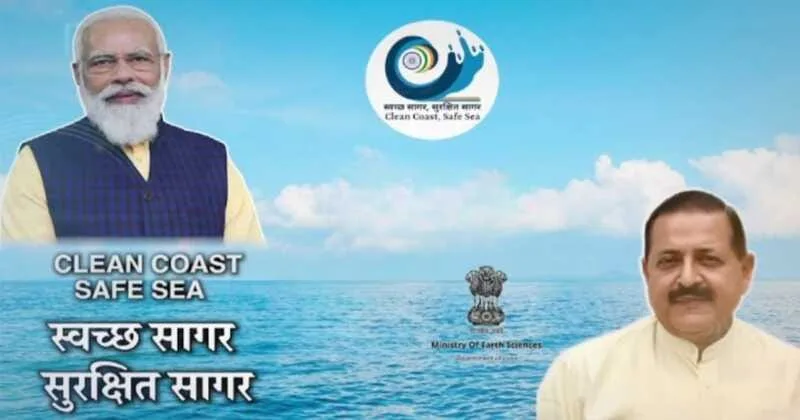
India’s 7,500-kilometre coastline is at once an economic artery, an ecological treasure and a growing casualty of the plastic age. Along its beaches wash up the residues of modern consumption, such as polythene bags, discarded fishing nets, bottle caps, sachets, rubber and metal carried by rivers and tides from far inland. It was against this backdrop that the Government of India launched Swachh Sagar, Surakshit Sagar (Clean Coast, Safe Sea), a citizen-led coastal cleanliness campaign that has since grown into one of the world’s largest public participation drives for ocean health. Now with the fresh edition scheduled from 10 to 19 September 2026, the campaign is being scaled up with the full weight of India’s scientific establishment behind it. Union Minister of State (Independent Charge) for Science & Technology and Earth Sciences, Dr Jitendra Singh, has called for scientific departments to function as an integrated ecosystem rather than as isolated silos, signalling a shift from a symbolic cleanliness ritual to a technology-backed, evidence-driven national mission.
From 75 Beaches to a National Movement
The campaign was launched in 2022 by the Ministry of Earth Sciences (MoES) as a 75-day citizen-led initiative to improve ocean health through collective action. The Ministry launched a Coastal Clean Up Drive under the Swachh Sagar, Surakshit Sagar campaign to clean 75 beaches across the country in 75 days, Described at the time as the first of its kind and longest-running coastal cleanup campaign in the world, with the highest number of people participating in it. The number 75 was not incidental it was chosen to resonate with the Azadi ka Amrit Mahotsav commemorations marking 75 years of Indian independence, tying environmental stewardship to the language of national renewal.
The inaugural campaign culminated on International Coastal Clean-up Day, observed on 17 September 2022, a day intended to increase public awareness about the accumulation and negative impacts of litter in oceans, on coastlines and on beaches. Globally, International Coastal Clean-Up Day is observed on the third Saturday of September every year.
The campaign was never conceived as a government-executed exercise. The cleanliness initiative was carried out along the whole coastline of India in collaboration with charitable groups and local communities, drawing in the Ministry of Earth Sciences, the Ministry of Environment, Forest and Climate Change (MoEFCC), the National Service Scheme (NSS), the Indian Coast Guard and the National Disaster Management Authority (NDMA), alongside numerous central and state government departments, non-governmental organisations and educational institutions. The intent was explicit to increase public awareness of the harm plastic causes to the environment and the threat that declining ocean health poses to ecological balance.
To operationalise mass participation, a mobile app called “Eco Mitram” was launched to spread awareness about the campaign and to allow ordinary citizens to voluntarily register for beach cleaning activity. This was a small but significant innovation it converted goodwill into logged, trackable volunteer hours and gave the campaign a digital spine.
The Numbers That Matter for Validity
By its third edition, the campaign had settled into a measurable rhythm. The Ministry of Earth Sciences concluded Swachh Sagar, Surakshit Sagar 3.0 on 21 September 2024, facilitating beach cleanup drives at more than 80 locations across the country’s coasts and removing more than 60 tons of waste, including plastic, metal, cloth, rubber and paper and wood debris.
The campaign, launched in 2022 with successful editions in 2022 and 2023, is a flagship initiative of MoES aimed at raising awareness about marine pollution, conserving coastal areas, and promoting cleanliness and sustainable practices to protect oceans and preserve marine ecosystems. Dr M Ravichandran, Secretary, MoES, led the 3.0 campaign, joined at Thiruvanmiyur beach in Chennai by Ms May-Elin Steiner, Norwegian Ambassador to India, along with senior officials, students, NGOs and members of the public. The presence of a foreign envoy was itself telling that marine litter is a transboundary problem, and India’s coastal diplomacy increasingly runs through the vocabulary of ocean governance.
The campaign is aligned with the Government of India’s ongoing Swachhata Hi Seva initiative under the Swachh Bharat Mission, envisioned by Prime Minister Narendra Modi, positioning the sea as the logical extension of a cleanliness movement that began on land.
The 2026 Edition: Science Enters the Frame
The forthcoming edition marks a qualitative departure. Union Minister Dr Jitendra Singh chaired a high-level review meeting of Secretaries and senior officials of the Science Ministries and central departments on 12 July 2026, calling for seamless coordination among scientific institutions to accelerate the delivery of national priorities. With preparations underway for the campaign from 10 to 19 September 2026, the Minister stressed that scientific institutions must work in close partnership to combine technological innovation, public participation and inter-departmental collaboration for maximum national impact.
The meeting was held at the CSIR-Science Centre, New Delhi and was attended by the Principal Scientific Adviser to the Government of India, Prof Ajay Kumar Sood, along with the Secretary of the Department of Science and Technology and other senior functionaries.
Reviewing the Action Taken Reports from the previous coordination meeting, Dr Jitendra Singh emphasised that scientific departments must function as an integrated ecosystem rather than as isolated institutions, arguing that regular interaction among Ministries, knowledge sharing, joint initiatives and coordinated implementation would help accelerate innovation, improve governance and ensure that scientific achievements directly benefit citizens.
The 2026 campaign is expected to bring together scientific institutions, government agencies, volunteers, educational institutions and local communities in one of the country’s largest coastal cleanliness drives. The nationwide initiative seeks to combine environmental conservation with public participation and awareness, the operative phrase in official communication being the translation of scientific initiatives into a people’s movement or jan andolan.
Departments shared plans to strengthen digital outreach through videos, documentaries, thematic campaigns, infographics, success stories and public engagement initiatives showcasing India’s growing scientific capabilities. The Department of Science and Technology presented its outreach plan covering flagship initiatives such as the Anusandhan National Research Foundation (ANRF), the National Quantum Mission, the National Mission on Interdisciplinary Cyber-Physical Systems and the Research, Development and Innovation Scheme. The Department of Biotechnology reported launching thematic publications covering public health, bioeconomy, genomics, agricultural biotechnology, research infrastructure, biotechnology start-ups and sustainable development, alongside a nationwide #DBTQuest public engagement campaign. CSIR, meanwhile, is preparing a comprehensive publication documenting its achievements over the past twelve years for release during CSIR Foundation Day.
Why This Initiative Matters
Because plastic is a land problem that ends in the sea. The overwhelming majority of marine debris does not originate on boats, it originates in cities, drains and rivers hundreds of kilometres inland. A campaign that cleans beaches without changing upstream behaviour treats the symptom. This is precisely why the initiative’s stated objective is behavioural: a mass behavioural change is intended by raising awareness about how plastic usage is destroying marine life. The beach is the classroom; the real target is the household.
Because it is anchored in binding international commitment. These initiatives form a broad approach to preventing pollution from both land-based and offshore activities, in line with Sustainable Development Goal 14 and its target 14.1, which seeks to prevent and significantly reduce marine pollution of all kinds, particularly from land-based activities, including marine debris and nutrient pollution. India’s performance here is not merely a domestic housekeeping matter; it is reported, compared and scrutinised globally.
Because it complements hard regulation. Awareness campaigns work best when paired with enforceable rules. India implemented a nationwide ban on single-use plastic beginning 1 July 2022, precisely because of the risks posed by plastic trash. The campaign gives the ban a constituency; citizens who have physically handled the waste are more likely to accept the inconvenience of the prohibition.
Because the coastal economy is a livelihood economy. India’s coastline sustains fishing communities, tourism circuits, ports and aquaculture. Degraded beaches depress tourist footfall; microplastics enter the food chain and, eventually, fish markets. The economics of a clean coast are not abstract environmentalism; they are income protection for some of the country’s most weather-exposed and least insured workers.
Because it converts science into citizenship. The 2026 edition’s distinguishing feature is the deliberate coupling of the country’s research establishment with a mass volunteer drive. Departments including DST, CSIR and DBT presented outreach plans and progress on flagship initiatives, with the campaign aiming to combine environmental conservation with public participation across India’s coastline. If waste characterisation data, remote sensing, coastal modelling and materials research can be folded into what has so far been a manual cleanup, the campaign stops being an annual photograph and becomes a longitudinal dataset.
Because ownership is the only sustainable enforcement. The event inspires the community to adopt eco-friendly habits and become marine conservation advocates by engaging citizens across all age groups. No coastal police force can patrol 7,500 kilometres. Only a coastline whose residents regard litter as personally offensive stays clean.
The challenge before Swachh Sagar, Surakshit Sagar 2026 is the challenge before every recurring campaign: avoiding ritualisation. Sixty tons of waste removed across eighty locations is a genuine achievement, but it is also a rounding error against the volume India’s coasts receive annually. The campaign’s real value lies in its multiplier effect, where every volunteer who spends a morning pulling sachets out of sand is a permanent, unpaid ambassador against careless disposal.
The 2026 edition’s scientific turn suggests the government has recognised this. The stated call is for greater synergy to translate scientific initiatives into a people’s movement. If source-tracking, waste analytics and materials innovation are married to the raw energy of student volunteers, coast guard personnel and fishing communities then the ten days of September 2026 will have bought India something more durable than clean sand.