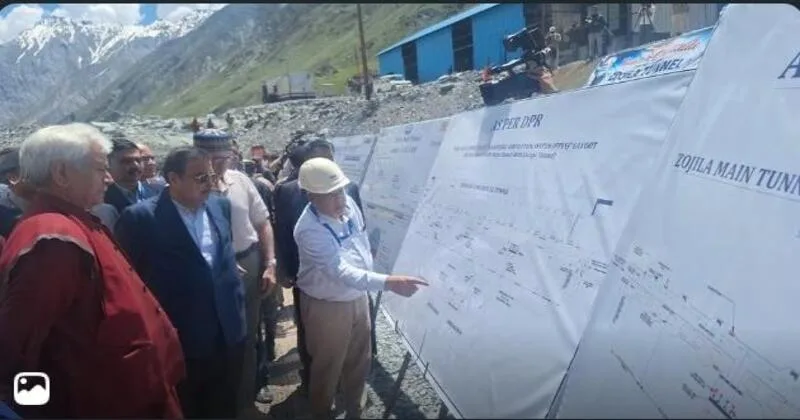
Ladakh: Union Minister for Road Transport and Highways Nitin Gadkari on June 9, Tuesday triggered a controlled blast which led to the breakthrough of the main Zojila Tunnel. This means that the tunnel is clear throughout and the two opposite ends have met. Gadkari described the moment as “historic” which will ensure all-weather connectivity between Kashmir and Ladakh.
On the Kashmir side, the tunnel is located at the picturesque tourist spot of Sonamarg in Ganderbal district and on Ladakh side at Minamarg in newly created Drass district. Presently, Minamarg is just a holding area with no hotels, restrooms or tourist infrastructure of any kind. However, this may change once the tunnel starts functioning in another two years.
For people of Ladakh, who remained cut off from the other parts of the country through winter months, this is going to be a major change as they will remain connected 365x24x7 through surface link to Srinagar and beyond. The connectivity through this tunnel is going to be a major catalyst for cheaper transport. Those who have spent winter months in Ladakh rue the fact that fresh vegetables are not available during winter months.
Major boost for military & defence logistics
For military personnel stationed in Ladakh, some vegetables are flown in via logistical behemoths, large IL-76 aircraft. All this is set to change and a new era of far reaching changes in lifestyle is likely to be observed. Local livelihoods are going to get a major boost as more footfalls of tourists become a new reality.
Jammu and Kashmir Lieutenant Governor Manoj Sinha, Chief Minister Omar Abdullah, Ladakh MP Mohammad Haneefa, Chairman and Chief Executive Councillor of LAHDC Kargil Dr Mohammad Jaffer Akhoon, Chief Secretary of Ladakh Ashish Kundra, DGP Ladakh, senior officials of NHIDCL, BRO and representatives of Megha Engineering & Infrastructures Ltd (MEIL) were present on the occasion.
The breakthrough ceremony marks the completion of more than 13 kilometres of excavation on the strategically significant tunnel, which is regarded as Asia’s longest bi-directional road tunnel project. Being constructed at an estimated cost of Rs 6,800 crore, the project is expected to revolutionise travel and logistics by ensuring uninterrupted connectivity through the challenging Zojila Pass.
Round the year connectivity guaranteed
Once operational, the tunnel is expected to significantly reduce travel disruptions caused by heavy snowfall and adverse weather conditions. It is also anticipated to improve mobility, promote tourism, strengthen defence logistics and support economic growth in the Union Territories of Jammu and Kashmir and Ladakh. A dangerous journey of over three hours is likely to be completed in a matter of 15 minutes.
The breakthrough is being hailed as a major engineering accomplishment and a significant step towards achieving seamless all-weather connectivity across the Himalayan region. Long considered a strategic and developmental necessity, the project is expected to provide dependable road access between Kashmir and Ladakh throughout the year.
Stretching 13.153 kilometres, the Zojila Tunnel is designed to be the world’s longest single-tube, bi-directional road tunnel at such a high altitude, located approximately 11,578 feet above sea level. The tunnel is being constructed by Megha Engineering and Infrastructures Limited (MEIL) using the New Austrian Tunnelling Method (NATM).
During the past few years, MEIL has been involved in some major infrastructure projects in these parts. It is also involved these days in the construction of 850 MW Ratle hydropower project on Chenab at Drabshala in Kishtwar district. The Ratle project was earlier being developed by another private company but it was abandoned midway. It took a lot of effort on the part of the Central government to revive it.
Bypassing difficult snow bound terrain
The project will bypass the avalanche-prone Zojila Pass on National Highway-1, which remains closed for several months each year due to heavy snowfall. The final structural excavation breakthrough on June 9, 2026, marks a historic stage in the project’s development.
Zojila pass on Srinagar-Kargil highway is the highest point which comes under several metres of snow during winters. Till some years ago, this stretch of road remained closed to all vehicular traffic for six months of the year, usually from November to May every year. The Border Roads Organisation (BRO) has changed that as its men keep the highway open for a lot more time during winters.
Those who have travelled by road from Srinagar to Kargil and Leh vouch for the fact that the Zojila pass is the most treacherous stretch of road. Despite annual repairs and deployment of heavy snow clearing machinery, keeping the road open is a significant challenge. Also, the steep gradient and massive potholes in some parts make it a test of one’s driving skills. However, all that will change on completion of the tunnel.
“Construction teams worked in temperatures ranging between minus 20 and minus 30 degrees Celsius for nearly 100 days every year”, an official said. The project site also faced multiple avalanche incidents over the past five years, including a major avalanche in January 2023 that left more than 170 workers stranded before they were rescued by the Army.
“Despite these challenges, excavation progressed steadily, supported by a workforce of over 1200 personnel, nearly 80 percent of whom are local residents”, the official said. A visitor from Leh said the tunnel would significantly ease the hardships faced by residents during winter months when the highway remains closed due to snowfall.
“Earlier, we had to store essential supplies for months as our area remained cut off from the rest of the country. Even during recent years, we had to stock ration for at least two months,” he said. “Once the tunnel becomes operational, our lives will become easier and Ladakh will remain connected with the rest of the world throughout the year”.
Tourism stakeholders in Sonamarg also expressed optimism, saying the project would open new economic opportunities and extend the tourism season. A local tourist guide said year-round road access to Ladakh through Sonamarg would attract visitors in all seasons and provide a major boost to local livelihoods.
Upon completion, travel time through the sector is expected to be reduced from more than three hours to around 15 minutes. The tunnel is also expected to ensure reliable supply lines, boost tourism, improve regional connectivity and provide enhanced logistical support to the Indian Armed Forces in strategically important border areas.
The project began in October 2020 and has since witnessed numerous engineering accomplishments, including the completion of the Nilgrar twin tunnels, approach roads, bridges, snow galleries and cut-and-cover structures.