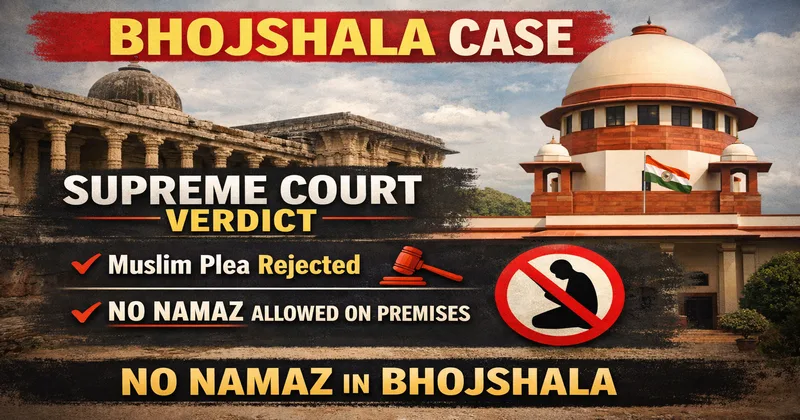
New Delhi/Dhar. In the ongoing dispute regarding the historic “Bhojshala complex” in Dhar, Madhya Pradesh, the Supreme Court issued a significant interim order on Tuesday, explicitly refusing to stay the Madhya Pradesh High Court’s decision. The Court stated that, for the time being, Friday prayers would not be permitted inside the Bhojshala complex itself. This decision is being viewed as a major setback for the Muslim side.
However, balancing religious rights, the Court directed the Madhya Pradesh government to provide a separate open space near the complex where the Muslim community could offer prayers every Friday between 1:00 PM and 3:00 PM, pending a final verdict.
The Supreme Court also issued clear instructions to the Archaeological Survey of India (ASI) not to carry out any structural or internal alterations to the Bhojshala complex without the Court’s permission. The Court indicated that it would conduct a detailed hearing on the entire dispute and deliver a final judgment after considering the arguments of all parties.
Key observations by the Supreme Court
During the hearing, Chief Justice Surya Kant asked Solicitor General (SG) Tushar Mehta whether an open space could be made available for worshippers near the Bhojshala complex. CJI Surya Kant also asked the Muslim side, “Can we order arrangements for prayers in the surrounding area? Such an interim arrangement could be made until a final verdict is reached in this matter.”
The Chief Justice further remarked, “We had previously made an interim arrangement for Basant Panchami as well, allowing both sides to offer prayers. We issued that order while the matter was sub judice, but now the High Court has delivered its final verdict.” Meanwhile, a remark by Justice Joymalya Bagchi, a member of the bench, has also drawn attention; she expressed surprise at the Madhya Pradesh High Court’s order regarding the repatriation of the Vagdevi (Saraswati) idol from a London museum. Taking a stern view of the matter, Justice Bagchi asked, “How can a constitutional court issue such an order?”
No immediate relief against the High Court’s verdict
The Muslim side had urged the Supreme Court to restore the arrangement for Friday prayers, which had been in place for nearly 40 years, and to immediately stay the Madhya Pradesh High Court’s decision. Senior Advocate Huzefa Ahmadi argued that the Muslim community has now been completely barred from the premises, and a long-standing practice spanning decades has been abruptly terminated. After considering these arguments, the Supreme Court refused to stay the High Court’s decision for the time being. The Court stated that a detailed hearing would take place, but there was no justification for intervention at this stage.
Strict instructions to ASI: No tampering with the structure
The Supreme Court directed the Archaeological Survey of India (ASI) not to carry out any structural or internal alterations to the Bhojshala complex without the Court’s permission. Simultaneously, the Court issued notices seeking responses from the Hindu side, the Madhya Pradesh government, the district administration and the ASI regarding the petitions filed by the Muslim side. The Court also clarified that all pending petitions would be heard together and scheduled the next hearing for the third week of July.
What was the Madhya Pradesh High Court’s historic verdict?
In its detailed judgment, the Indore Bench of the Madhya Pradesh High Court reached several significant conclusions:
• It recognized the disputed premises as “Bhojshala, including the Mata Vagdevi (Saraswati) temple.”
• It affirmed the status of the complex as a protected monument since March 18, 1904.
• It set aside the portion of the 2003 ASI order that had granted permission to the Muslim community to offer prayers.
• Directed the Government of India and the ASI to determine arrangements for the conservation, management and Sanskrit education at the Bhojshala.
• Granted the ASI supreme supervisory authority regarding religious activities and conservation.
• Stated that if the Muslim community seeks land for an alternative mosque or ‘Namaz’ site, the state government may consider the request in accordance with the law.
• Asked the Government of India to consider a representation regarding bringing the Vagdevi idol back to India from the London museum.
FACT BOX | 8 Key Points from the Supreme Court Order
• Refused to stay the High Court’s verdict.
• No permission for Friday ‘amaz’ within the Bhojshala complex.
• Arrangements to be made for ‘Namaz’ at an alternative open space near the complex.
• Restrained the ASI from making any structural alterations.
• Notices issued to all parties.
• Next hearing scheduled for the third week of July.
• Emphasis on a balanced interim arrangement for this sensitive matter.
• Questions raised regarding the High Court’s observations on the Vagdevi idol.
TIMELINE | Bhojshala Dispute
18 March 1904 – Bhojshala complex declared a protected monument.
7 April 2003 – ASI determined arrangements regarding worship and ‘Namaz’.
2024 – ASI conducted a scientific survey following court directives.
2026 – Madhya Pradesh High Court recognized the Bhojshala-including the Mata Vagdevi temple, as a protected complex and set aside the disputed portion of the 2003 order.
The Broader Message of the Verdict
Three clear messages have emerged from the Supreme Court’s interim order. First, the High Court’s decision has been upheld for the time being, and there will be no immediate interference with it. Second, in an effort to strike a balance between religious rights and law and order, the provision of an alternative site for prayers for the Muslim community has been suggested. Third, the Archaeological Survey of India (ASI) has been restrained from making any structural alterations to preserve the current state of the protected archaeological heritage. Now, following responses from all parties and detailed arguments, the Supreme Court will determine the final constitutional and legal course for this high-profile and sensitive dispute.