New Delhi: China’s economy showed fresh signs of broad-based weakness in July as the country’s official purchasing managers’ indices (PMIs) for manufacturing, services, and construction all slipped into contraction, underscoring mounting pressure from shrinking orders, weak domestic demand, job insecurity, and cautious consumer spending.
Data released on July 31 by China’s National Bureau of Statistics (NBS) and the China Federation of Logistics and Purchasing (CFLP) revealed that the official manufacturing Purchasing Managers’ Index (PMI) fell to 49.2 in July from 50.3 in June, marking the first contraction since February.
At the same time, the non-manufacturing PMI, covering both services and construction, declined to 49.0, while the composite output index, which measures overall business activity, dropped to 49.3. Since PMI readings below 50 indicate that more surveyed firms experienced declining activity than improving conditions compared to the previous month, the latest figures suggest that weakness has spread across multiple sectors of the Chinese economy.
The deterioration extended well beyond manufacturing. The July survey showed that factory production slowed, new orders weakened more rapidly than output, and businesses of all sizes reported contraction. Construction activity also slipped below the expansion threshold, while the services sector recorded similar weakness, highlighting that the slowdown is no longer confined to a single segment of the economy.
Manufacturing weakness deepens despite high-tech resilience
Although the overall manufacturing sector contracted, the July survey revealed a widening divergence between industries supported by state industrial policy and traditional sectors facing declining demand. High-technology manufacturing and equipment manufacturing continued to register expansion, while consumer-goods manufacturing, energy-intensive industries, and smaller enterprises all remained in contraction.
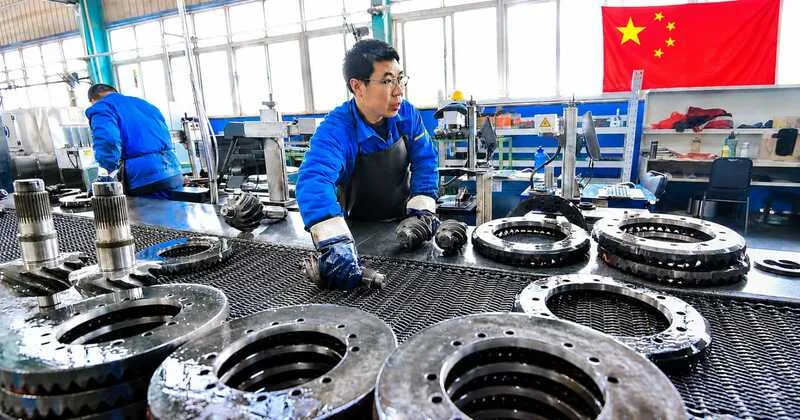
The official data reflected worsening demand conditions. The new orders index declined to 48.5, falling more sharply than the production index, which eased to 49.9. This indicates that incoming demand is weakening faster than factories are reducing production, increasing the likelihood of rising inventories and additional production adjustments in the coming months. The difficulties reflected in the official survey mirror conditions reported by business owners and workers across China’s manufacturing hubs.
Many smaller manufacturers have been squeezed by a combination of declining orders, intense price competition, and rising labour and raw material costs. During earlier years of stronger economic growth, numerous firms borrowed heavily to expand factories and invest in new equipment. However, as demand weakened, the additional production capacity turned into a financial burden, leaving many private manufacturers struggling with mounting debt despite a sharp decline in business orders.
The deteriorating business environment has already resulted in factory closures. During June, Dongguan Wuzhu Electronics and an affiliated new-energy company announced that they would cease operations and terminate all employee contracts. In their closure notice, the companies cited changing market conditions and an unsuccessful investment strategy as the primary reasons for shutting down.
Employment, consumer spending and domestic demand under pressure
Weak factory activity is increasingly affecting China’s labour market, raising concerns that falling employment opportunities may further reduce household consumption.
Reports from Hangzhou in April indicated that many privately owned manufacturers had begun reducing their workforce after failing to secure sufficient orders, leaving numerous production lines and machines idle as industrial activity slowed.
A Nordic-owned factory manufacturing feed equipment reportedly reduced its workforce from 80 employees to 29, with further layoffs expected. The deteriorating labour market was also reflected in the growing difficulty of securing even temporary factory jobs paying 13 yuan per hour (about $1.80), underscoring weakening employment opportunities for industrial workers.
By June, the slowdown had intensified, with factories in Hangzhou reportedly shutting down, relocating, or scaling back operations, prompting many migrant workers to leave the city in search of employment elsewhere. The weakening job market has also weighed heavily on household consumption, as reduced incomes and rising employment uncertainty have curbed discretionary spending. Consequently, shopping centres and physical retail stores have experienced declining customer footfall, reflecting the broader impact of industrial weakness on domestic demand and consumer confidence.
International institutions have also pointed to similar structural challenges facing China’s economy. In its July China Economic Update, the World Bank said that investment in high-technology industries and exports had continued to support overall economic growth. However, it warned that subdued household consumption, the prolonged property-sector downturn, and persistently weak domestic demand were restraining broader economic recovery. According to the World Bank, households have been allocating a larger proportion of their income to savings because of uncertainty over future earnings and declining property values.
The Conference Board also reported mixed signals in its assessment of China’s economy. Its Leading Economic Index (LEI) for China increased by 0.1 per cent in June compared with May but remained 1.3 per cent lower than in December 2025. The organisation said modest improvements in credit conditions, machinery imports, and construction activity were largely offset by weaker consumer expectations, slowing logistics activity, and declining business profitability.
State support widens divide between strategic and traditional industries
The comparatively stronger performance of high-technology and equipment manufacturing reflects years of state-directed industrial policies aimed at strengthening sectors regarded as strategically important by the Chinese Communist Party (CCP). According to information from the Jiangsu Small and Medium Enterprise Association, government resources are increasingly being directed towards industries such as semiconductors, artificial intelligence, and robotics.
At the same time, traditional manufacturers are facing growing pressure to digitalise operations, reduce emissions, and modernise production processes. However, many small and medium-sized enterprises reportedly lack the financial resources and technical expertise needed to undertake such upgrades.
Businesses continuing to rely on older production methods also face greater scrutiny over taxation, environmental compliance, energy consumption, and workplace safety regulations, making it increasingly difficult for many firms to remain competitive and financially viable without modernisation.
Research published by the Rhodium Group in May suggests that these policy priorities are reshaping China’s broader financial system. The report stated that China’s capital markets and state-guided credit are increasingly being directed toward strategic and innovative industries, with industrial policy placing greater emphasis on equipment upgrades and advanced manufacturing even in mature sectors where capacity utilisation continues to decline, and the number of loss-making companies is rising. Rhodium warned that without significantly stronger domestic demand or meaningful reductions in outdated industrial capacity, such policies could further entrench industrial overcapacity.
In a separate Rhodium report, the research firm said China’s financial system is directing a growing share of an already shrinking pool of new credit toward state-owned enterprises and heavily indebted local government entities, while private-sector investment remains subdued. As production continues to outpace domestic consumption, Rhodium argued that falling prices and surplus industrial output are making China increasingly dependent on overseas markets to absorb excess production.
Market participants are now awaiting another important indicator of manufacturing activity. S&P Global is scheduled to release its RatingDog China General Manufacturing PMI on August 3, providing the first private-sector assessment for July and offering an opportunity to compare its findings with China’s official manufacturing data released on July 31.