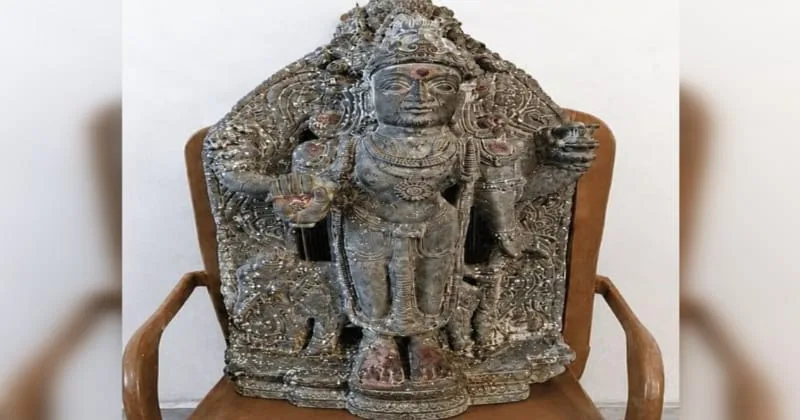
Karaikal: What began as a routine fishing trip turned into a remarkable archaeological discovery when a group of fishermen from Karaikal recovered an ancient stone murti, believed to be over 500 years old, from the Bay of Bengal. The unexpected find has sparked interest among historians, archaeologists, and law enforcement agencies, who are now working to uncover the idol’s origin, age, and historical significance.
A routine fishing expedition off the Tamil Nadu coast led to the recovery of an ancient murti believed to be more than 500 years old, after it became entangled in the fishing net of a group of fishermen from Karaikal in Puducherry.
According to reports by All India Radio (AIR), 16 fishermen had departed from the Karaikal Fishing Harbour on July 2 for a deep-sea fishing expedition in the Bay of Bengal. While fishing off the coast of Mahabalipuram around July 10, they noticed that their fishing net had become unusually heavy, leading them to believe it had snagged on a large object beneath the sea.
As they hauled the net aboard, they were surprised to discover an ancient stone murti covered with thick layers of marine deposits, shells, and sediments, suggesting that it had remained submerged underwater for a considerable period.
Recognising the possible historical importance of the artefact, the fishermen refrained from attempting to clean or alter it. Instead, after returning to Karaikal, they handed the murti over to Karaikal Deputy Collector Pooja, ensuring that it would be preserved and examined by the authorities.
Preliminary assessments indicate that the murti could be over 500 years old and may have originated from Tamil Nadu, though its exact age and provenance are yet to be scientifically established. Experts from the archaeology department are expected to examine the sculpture in detail to determine the period it belongs to, the deity it represents, and the artistic style in which it was carved.
The discovery has also prompted a police investigation. Officials are trying to determine how such a significant murti came to rest on the seabed in the Bay of Bengal. Investigators are exploring multiple possibilities, including whether the idol was lost during a maritime incident centuries ago or whether it was deliberately dumped into the sea.
Authorities are also examining a possible Sri Lankan murti-smuggling link, considering that antique murtis have often been targeted by international smuggling networks dealing in cultural artefacts. The investigation will seek to establish whether the sculpture was being illegally transported before ending up underwater.
Historians note that the southeastern coast of India has a long maritime history, with ancient ports, trade routes, and temples dating back several centuries. Coastal erosion, cyclones, shipwrecks, and changing shorelines have occasionally led to archaeological artefacts being discovered in the sea.
The murti has now been placed in safe custody while experts conduct further examinations. Officials say detailed archaeological analysis, including stylistic studies and material assessment, will help establish the murti’s age, historical significance, and original place of worship. The findings are expected to provide valuable insights into the region’s rich cultural and maritime heritage while aiding the ongoing investigation into its mysterious journey to the depths of the Bay of Bengal.