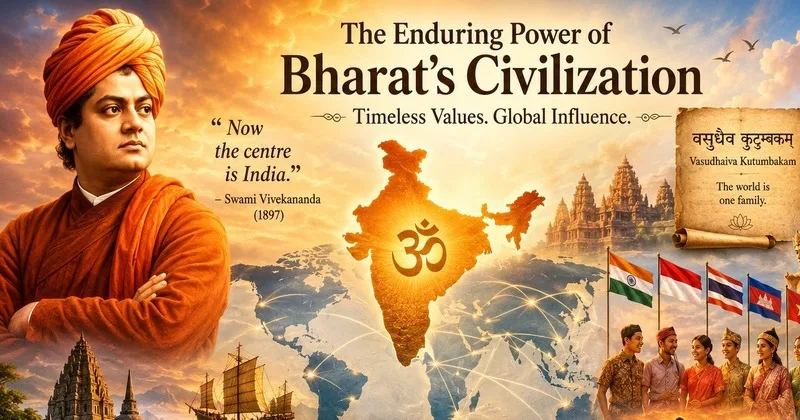
The year was 1897. Returning to India after his celebrated tour of the West, Swami Vivekananda delivered a historic address in which he proclaimed, “Now the centre is India.” This was far more than an emotional declaration; it reflected his profound understanding of the future course of world civilisation. He warned: “Shall India die? Then from the world all spirituality will be extinct, all moral perfection will be extinct, all sweet souled sympathy for religion will be extinct, all ideality will be extinct; and in its place will reign the duality of lust and luxury as the male and female deities, with money as its priest, fraud, force, and competition its ceremonies, and the human soul its sacrifice.”
For Vivekananda, India was never merely a nation-state. It was a civilisation, a way of life, and a moral and spiritual force whose existence was inseparable from the welfare of humanity. In his vision, India’s destiny was intertwined with the destiny of the world. A similar sentiment was expressed by Rabindranath Tagore in his essay ‘Dhormer Saral Adarsha’ (The Simple Ideal of Religion), where he wrote: “The simple ideal of Dharma once belonged to India; we find its true expression in the Upanishads.” Both thinkers viewed India not simply as a geographical entity but as the custodian of an enduring civilizational ethos.
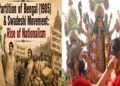
Yet history took a tragic turn in 1947. The Partition of India, carried out on the basis of the Two-Nation Theory, politically divided this ancient land despite countless efforts to preserve its unity. Overnight, millions were uprooted from their homes. Communal violence engulfed the subcontinent, and an immeasurable human tragedy accompanied the birth of two new states. The trauma did not end there. Independent India would subsequently confront terrorism, border conflicts, separatist movements, and repeated external and internal challenges. And yet, India did not bow. In the words of Kazi Nazrul Islam, it has remained “ever with its head held high.”
Partition altered India’s political map, but it could not erase the reach of the Bhartiya civilisation. The cultural sphere that once radiated from the Indian subcontinent continues to leave its imprint across present-day Pakistan, Bangladesh, Nepal, Sri Lanka, Myanmar, Thailand, Cambodia, Vietnam, Malaysia, and Indonesia. Nor was this influence confined to Southeast Asia alone. Large parts of West Asia also preserve traces of ancient Indian commerce, philosophy, and cultural exchange.
Indonesia offers perhaps the most remarkable example of this civilizational continuity. Despite being the world’s largest Muslim-majority nation, the imprint of Indian civilisation remains unmistakable. On the island of Bali, the epics Ramayana and Mahabharata continue to shape cultural life. The famous Ramayana ballet is regularly performed at the Prambanan Temple complex near Yogyakarta. Indonesia’s national emblem is Garuda, its state-owned airline is named Garuda Indonesia, and countless Indonesians bear names of Sanskrit origin. Even in a Muslim-majority society, figures such as Rama, Arjuna, Bhima, and Ganesha are not objects of controversy but accepted components of the nation’s shared cultural heritage.
This enduring connection once again drew global attention during Indian Prime Minister Narendra Modi’s recent visit to Indonesia. Speaking before members of the Indian diaspora in Jakarta, Indonesian President Prabowo Subianto remarked with evident pride that genetic testing had revealed that part of his ancestry could be traced to the Indian subcontinent. “I have Indian DNA,” he declared. Nor was this an isolated observation. During his visit to India in 2025, he had similarly noted that relations between India and Indonesia stretch back thousands of years. Many Indonesian words derive from Sanskrit, countless personal names have Indian origins, and elements of Indian civilisation continue to shape everyday life in Indonesia. As he memorably put it, “India is embedded in our genes.”
To dismiss these remarks as merely personal sentiment would be to overlook a much deeper historical reality. They reflect a civilizational relationship that historians have documented for decades. Through maritime trade, intellectual exchange, religious interaction, and people-to-people contact, Indian civilisation extended its influence across vast regions. This expansion was not achieved through military conquest or imperial domination. Rather, it emerged through the attraction of ideas, cultural dialogue, and mutual respect.
India’s ancient scriptures themselves embody this spirit of openness. The Rig Veda proclaims, “Ā no bhadrāḥ kratavo yantu viśvataḥ”— “Let noble thoughts come to us from every direction.” Likewise, the celebrated maxim of the Maha Upanishad, Vasudhaiva Kutumbakam— “The world is one family”—encourages humanity to transcend narrow boundaries. These principles constitute the foundation of India’s greatest strength. In the language of contemporary international relations, this is what is known as soft power: influence exercised not through coercion or economic pressure but through culture, values, education, philosophy, and the ability to inspire trust and admiration.
As the world increasingly rediscovers the importance of civilizational identity, India too has begun to reassess its own cultural inheritance. For decades, academic and political discourse has been shaped by debates surrounding ‘cultural Marxism’. In today’s context, however, an equally significant idea may be described as ‘cultural Indianness’—not as a project of political expansion or religious domination, but as the rediscovery of historical relationships forged through millennia of exchanges in philosophy, literature, art, language, and shared human experience.
India’s greatest civilizational strength has always been its remarkable capacity to absorb, adapt, and assimilate. This was precisely the message that Vivekananda proudly articulated before the Parliament of the World’s Religions in Chicago in 1893. India never sought to impose its culture upon others. Instead, it cultivated relationships through dialogue, mutual enrichment, and cultural exchange. That is why the memory of Indian civilisation continues to be preserved with respect across so many parts of the world. The global order today stands at a moment of profound uncertainty. The war in Ukraine, continuing conflicts in West Asia, rising tensions in the Indo-Pacific, climate change, terrorism, and deepening geopolitical polarisation have left humanity searching for new paradigms of cooperation. In such a world, India’s civilizational philosophy, rooted in ethical responsibility, coexistence, and respect for diversity, offers an alternative framework for international engagement. This explains why India today is increasingly viewed not merely as a rising economic power but as a civilizational state capable of contributing ideas as well as capabilities to the international system.
Against this backdrop, Vivekananda’s declaration, “Now the centre is India”, acquires renewed significance. The India he envisioned was not confined by political frontiers. It was a civilisation whose influence transcended borders, shaping minds, cultures, and the moral imagination across continents. President Prabowo Subianto’s recent remarks serve as a contemporary reminder of that enduring truth.
India’s true strength lies not only in its economy, military capability, or technological achievements. Its deepest source of influence is its millennia-old civilisation—its culture, philosophy, and timeless message of human welfare. Political boundaries may change. Maps may be redrawn. But the influence of a civilisation cannot be contained within lines on a map. Bharat’s own history stands as living proof of that enduring reality. More than a century after Vivekananda’s prophetic words, India appears once again to be moving toward the civilisational centrality he so confidently envisioned—not through conquest, but through the quiet, enduring power of ideas.