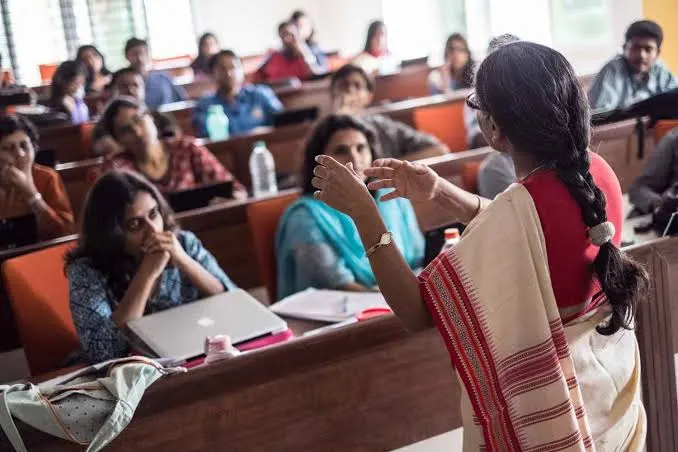
India’s higher education system continued its expansion in the academic year 2023-24, with total student enrolment touching a record 4.50 crore and the Gross Enrolment Ratio (GER) reaching 30, according to the latest All India Survey on Higher Education (AISHE) reports released by the Union Ministry of Education on Wednesday.
The survey, regarded as the country’s most comprehensive database on higher education, provides detailed information on student enrolment, institutional capacity, faculty strength, social inclusion and gender representation across universities, colleges and standalone institutions.
The latest findings indicate that India’s higher education sector has maintained a steady growth trajectory over the past decade, reflecting expanding access to colleges and universities, greater participation by women, and improved representation of Scheduled Castes (SCs), Scheduled Tribes (STs) and Other Backward Classes (OBCs).
The AISHE reports for 2022-23 and 2023-24 show that higher education enrolment increased from 4.46 crore in 2022-23 to 4.50 crore in 2023-24, marking the highest level recorded since the survey was introduced.
The increase also reflects a significant long-term trend. In 2014-15, total enrolment in higher education stood at 3.42 crore. Over the past decade, enrolment has therefore increased by 1.08 crore students, representing a growth of 31.5 Percent.
Gross Enrolment Ratio continues upward climb
One of the key indicators highlighted in the report is the Gross Enrolment Ratio (GER), which measures the proportion of students aged 18-23 years enrolled in higher education.
According to the survey, the overall GER rose from 29.5 in 2022-23 to 30 in 2023-24.
The increase continues a decade-long upward trend. In 2014-15, India’s GER stood at 23.7, meaning the country has witnessed an increase of more than six points over ten years.
The improvement assumes significance because GER is widely used as a benchmark for measuring access to higher education. A rising GER indicates that a larger share of young people are entering colleges and universities.
The Ministry of Education said the sustained rise reflects the expansion of educational infrastructure, increased availability of institutions in rural and semi-urban regions, and various policy interventions aimed at improving access to higher education.
The figures are also important in the context of India’s long-term educational goals under the National Education Policy (NEP) 2020, which seeks to significantly expand access to higher education over the coming decade.
Female participation reaches a new milestone
The AISHE report highlighted continued progress in women’s participation in higher education.
Female enrolment reached 2.24 crore in 2023-24, compared with 2.18 crore in the previous academic year. In 2014-15, female enrolment stood at 1.57 crore.
This translates into an increase of 42.2 Percent over the past decade, significantly outpacing the overall growth in enrolment.
The report also showed a rise in female Gross Enrolment Ratio. Female GER increased from 30.2 in 2022-23 to 31.2 in 2023-24.
A decade earlier, female GER was 22.9.
The figures indicate that women are entering higher education at an increasing rate and are benefiting from improved educational opportunities across the country.
The growth is particularly significant because female participation has expanded steadily across different regions, disciplines and institutional categories.
Gender parity index remains above one
The survey also highlighted improvements in gender balance through the Gender Parity Index (GPI), which measures the ratio of female GER to male GER.
The GPI stood at 1.08 in 2023-24.
A GPI value above 1 indicates that female participation in higher education exceeds male participation.
According to the report, the index has remained above 1 for seven consecutive years, reflecting a sustained trend of stronger female representation in higher education.
The achievement marks a significant shift from earlier decades when women faced substantial barriers in accessing higher education.
Reports have often cited increased awareness, improved school completion rates among girls, scholarship programmes, hostels for women students and greater social acceptance of higher education for women as contributing factors behind the trend.
Greater Inclusion of scheduled castes and scheduled tribes
The AISHE report also showed notable improvements in higher education participation among historically disadvantaged communities.
The Gross Enrolment Ratio for Scheduled Caste students increased to 27.8 in 2023-24 from 18.9 in 2014-15.
Similarly, the GER for Scheduled Tribe students rose to 22.8 from 13.5 during the same period.
The gains indicate that access to higher education among SC and ST communities has improved considerably over the last decade.
In absolute numbers, enrolment among SC students increased from 46.07 lakh in 2014-15 to 69.72 lakh in 2023-24.
This represents an addition of more than 23 lakh students over ten years.
ST enrolment also witnessed substantial growth, rising from 16.41 lakh in 2014-15 to 28.83 lakh in 2023-24.
The increase reflects a growth of more than 12 lakh students.
The report suggests that targeted scholarship programmes, reservation policies, improved educational infrastructure and outreach initiatives may have contributed to the rise in participation among these communities.
OBC enrolment registers strong growth
The survey recorded significant growth in enrolment among Other Backward Classes (OBCs) as well.
OBC enrolment rose to 1.80 crore in 2023-24 from 1.13 crore in 2014-15.
The increase of nearly 67 lakh students over the decade reflects expanding access to higher education among one of the country’s largest social groups.
The continued growth in enrolment among SCs, STs and OBCs points towards broader social inclusion within India’s higher education system.
These trends are often viewed as important indicators of equitable educational development and efforts to bridge historical disparities in access to higher education.
STEM education continues to expand
The AISHE report highlighted continued growth in Science, Technology, Engineering and Mathematics (STEM) education, a key area for India’s economic and technological development.
STEM enrolment increased from 91.5 lakh students in 2014-15 to 1.02 crore in 2023-24.
The increase reflects rising interest in science and technology disciplines as India seeks to strengthen its position in innovation, research, manufacturing and digital technologies.
The report also highlighted a significant improvement in women’s participation in STEM fields.
The share of women enrolled in STEM courses increased from 38.4 Percent in 2014-15 to 44 Percent in 2023-24.
The increase suggests that gender gaps in science and technology education are gradually narrowing.
Traditionally, engineering and technology programmes have seen lower female participation compared with other disciplines. However, the latest figures indicate a growing presence of women across STEM streams.
The trend is considered important for building a diverse scientific workforce and expanding opportunities for women in technology-driven sectors.
Faculty strength shows sustained growth
The AISHE survey also reported growth in faculty strength across higher education institutions.
The total number of teachers reached 17.32 lakh in 2023-24.
The expansion in faculty numbers corresponds with the growth in student enrolment and the increasing number of educational institutions participating in higher education.
Women accounted for 44.9 Percent of the total teaching workforce.
Female faculty strength increased from 5.69 lakh in 2014-15 to 7.78 lakh in 2023-24.
The growth reflects rising representation of women not only as students but also as educators and academic professionals.
A larger teaching workforce is considered crucial for maintaining quality standards, improving student-teacher ratios and supporting expanding educational infrastructure.
Broad institutional participation in AISHE Survey
The Ministry of Education noted that institutional participation in the AISHE survey remained consistently high.
More than 90 Percent of eligible higher education institutions participated in both survey years.
According to the ministry, 56,180 institutions participated in the 2022-23 survey, while 59,533 institutions submitted data for 2023-24 through the AISHE web portal.
The high participation rate enhances the reliability and comprehensiveness of the survey, making it one of the largest exercises of its kind in the world.
The database covers universities, colleges and standalone institutions across all states and Union Territories, providing policymakers with a detailed picture of the higher education landscape.
The All India Survey on Higher Education serves as the government’s primary source of official higher education statistics.
The annual exercise collects information on student enrolment, faculty strength, infrastructure, examination results, financial data and institutional characteristics.
The Ministry of Education stated that although the information is self-reported by institutions, it undergoes extensive validation and scrutiny before publication.
Officials said multiple layers of verification are employed to ensure the accuracy and consistency of the data.
The survey has become an important tool for policy formulation, resource allocation and monitoring progress towards national educational goals.
Decade of expansion in Higher Education
The AISHE findings underline the significant transformation of India’s higher education sector over the past decade.
The country has added more than one crore students to its higher education system since 2014-15, while also recording substantial gains in female participation, social inclusion and STEM education.
The rise in Gross Enrolment Ratio to 30 marks another milestone in expanding access to higher education, while improvements in SC, ST and OBC participation point towards broader inclusivity.
The growth in female enrolment, sustained Gender Parity Index above one, and increasing representation of women in STEM disciplines further highlight changing educational trends across the country.
With enrolment at a historic high, faculty strength expanding and institutional participation remaining robust, the latest AISHE report presents a picture of a higher education sector that continues to grow in scale, diversity and reach, even as policymakers focus on improving quality, research output and global competitiveness in the years ahead.