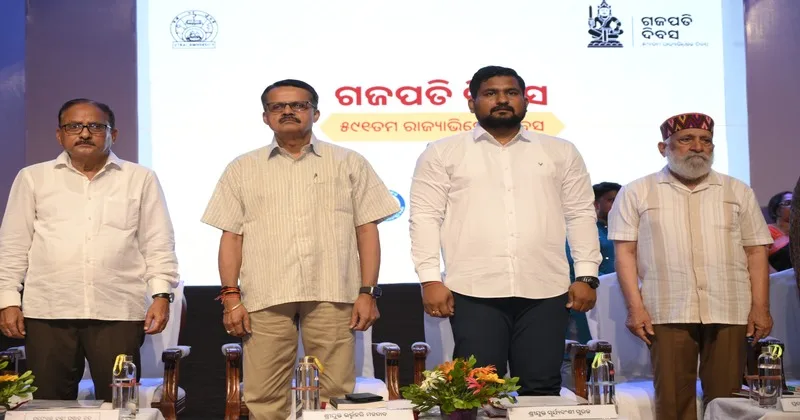
Bhubaneswar: The 591st coronation anniversary of the legendary Gajapati Emperor Kapilendra Deva was commemorated as “Gajapati Day” with great solemnity and cultural significance at the MKCG Auditorium of Utkal University in Bhubaneswar. The event brought together leading historians, academicians, literary figures, and distinguished personalities from diverse fields to honour one of medieval Bharat’s most formidable rulers and to reflect on his enduring political, military, and cultural legacy. Speakers emphasised the need to revisit historical narratives from a Bharatiya perspective, stating that future generations should be inspired by indigenous heroes through a more balanced and contextual understanding of history.
The program was jointly organised by the History Department of Utkal University, Odisha Sahitya Akademi, and Beyond Heritage Trust. Through exhibitions, documentary screenings, and scholarly discussions, the event highlighted the enduring significance of Kapilendra Deva’s reign in shaping Odisha’s historical identity.
Exhibition Showcases Life and Legacy of Kapilendra Deva
The event was inaugurated by Odisha Minister for Odia Language, Literature and Culture, Suryavanshi Suraj, who lit the ceremonial lamp and formally opened the celebration. He also inaugurated a special exhibition titled “War, Emperor and Eternal: Gajapati Kapilendra Deva,” which showcased the emperor’s life, military campaigns, administrative achievements, and cultural contributions through rare visuals, documents, and curated historical material.
The exhibition attracted significant attention for its detailed presentation of the Gajapati empire’s expansion and its administrative sophistication during Kapilendra Deva’s reign.
Kapilendra Deva: Symbol of Courage, Vision, and Cultural Pride
Addressing the gathering, Minister Suryavanshi Suraj described Kapilendra Deva as more than just a conqueror, calling him a visionary ruler and a powerful symbol of Odisha’s cultural identity. He stated that the emperor’s rule marked a golden era in Odisha’s history, strengthening its political identity while significantly contributing to the development and preservation of the Odia language, traditions, and cultural heritage.
“Kapilendra Deva represents courage, foresight, and cultural pride. His reign remains one of the most glorious chapters in Odisha’s history, and his achievements continue to inspire future generations,” the minister said. He further emphasised the need to preserve and promote Odisha’s rich historical legacy through academic and cultural initiatives.
Call for Rewriting History from a Bharatiya Perspective
A key highlight of the program was a strong call for re-examining historical narratives from a Bharatiya perspective. Professor Kuldeep Chand Agnihotri, a noted educationist and Vice-Chairman of the Haryana Sanskriti and Sahitya Board, stressed that history has often been written by victors, leading to the underrepresentation of indigenous heroes. He argued that despite Bharat gaining independence over seven decades ago, educational curricula still heavily reflect colonial and foreign narratives, while Bharatiya resistance, valour, and indigenous achievements remain largely overlooked.
“We need to remove the foreign lens and rewrite history from an Bharatiya perspective so that future generations can draw inspiration from our own heroes,” he stated.
Highlighting Kapilendra Deva’s contributions, he described the emperor as a formidable ruler who defeated powerful adversaries, including the Bengal Sultanate and the Bahmani rulers. He also noted Kapilendra Deva’s devotion to Lord Jagannath, citing the king’s belief that he himself was a servant of the deity.
Agnihotri urged universities and research institutions to intensify studies on such overlooked historical figures and ensure their inclusion in textbooks and academic discourse.
Documentary Screening Revives Glorious Past
A documentary titled “Lakhye Raja ra Mauda Mani: The Glorious Story of Gajapati” was screened during the event. The film presented a detailed account of Kapilendra Deva’s life, including his military conquests, territorial expansion, governance strategies, and historical achievements. It also highlighted the rise of the Gajapati empire and its cultural and administrative significance in medieval Bharat.
The screening received an enthusiastic response from the audience, offering a visual reconstruction of Odisha’s illustrious past and reinforcing pride in its historical heritage.
Scholarly Discussions on Odisha’s Historical Revival
The event also featured two major academic panel discussions. The first focused on “Reviving Research and Education in the Context of Odisha’s Glorious History,” while the second explored “From Regional Hero to National Symbol.”
Scholars and experts participating in the discussions emphasised the need for deeper academic research into Odisha’s cultural and historical contributions. They called for stronger documentation, archival preservation, and the integration of regional history into national narratives.
Participants stressed that many historical figures from Odisha remain underrepresented in mainstream discourse and urged educational institutions to bridge this gap through structured research and curriculum development.
Eminent Personalities in Attendance
The program was attended by several distinguished personalities, including Cuttack Member of Parliament Bhartruhari Mahtab, Padma Shri award-winning sculptor Adwaita Gadanayak, former Director of the National Mission for Manuscripts Professor Prafulla Kumar Mishra, Vice-Chancellor of Utkal University Professor Chandi Prasad Nanda, and Secretary of Odisha Sahitya Akademi Dr. Chandrashekhar Hota, among others. Their presence underscored the academic and cultural importance of the event and its relevance in contemporary historical discourse.
Preserving Heritage for Future Generations
Speakers at the event collectively emphasised the urgent need to pass Odisha’s rich historical legacy to younger generations. They underlined that preserving the memory of great rulers like Kapilendra Deva is essential for fostering cultural pride and historical awareness. They also called for the continued organisation of such events in the future to ensure that Odisha’s heritage receives greater recognition at both national and international levels.
The celebration concluded with a shared resolve to promote Odisha’s glorious past through research, education, and cultural initiatives, ensuring that the legacy of Kapilendra Deva continues to inspire generations to come.