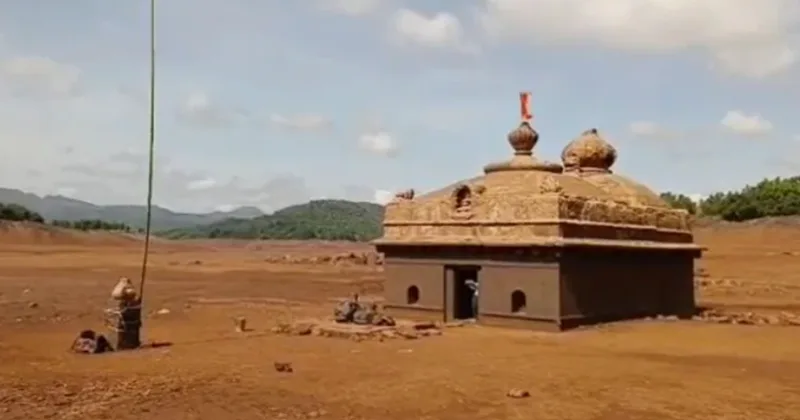
As the scorching summer heat causes reservoir levels to plummet across Bharat, a powerful testament to the nation’s enduring heritage is unfolding. From the backwaters of British-era and post-independence dams-like the Bhavanisagar in Tamil Nadu and the Bhatghar in Pune-magnificent, centuries-old Hindu temples are re-emerging from their watery graves.
These resilient stone structures, completely intact despite decades underwater, stand as a powerful testament to the indestructible roots of Sanatan Dharma. Their seasonal resurgence has sparked a profound civilisational awakening, as millions of devotees rush to reclaim and revive Bharat’s buried sacred heritage.
For decades, these sacred structures, some tracing back to the legendary Pandava and Hoysala eras, were submerged under the guise of modern development, forcing local communities to abandon their ancestral centres of faith. Yet, as the waters recede, the resilient stone architecture and underwater Shiva Lingams reappear completely intact, serving as a profound reminder of Sanatan Dharma’s indestructible roots. For the millions of devotees who rush to clean the sanctums and restart traditional rituals, the revival of these temples is not just an archaeological marvel; it is a spiritual awakening and a literal reclamation of Bharat’s glorious civilisational identity from beneath the surface.
This report compiles 12 ancient and historic Indian temples that periodically re-emerge from submerged dams, reservoirs, and rivers, highlighting the nation’s resilient underwater heritage and forgotten sacred architecture.
The Eternal Resilience of Shiva: Pandava-Era Kambareshwar Temple Defies Time Under Pune’s Bhatghar Dam
A spectacular testament to Bharat’s indestructible Vedic heritage has unfolded in Pune’s Bhor region. As the water levels of the Bhatghar Dam plummeted to a critical 6% capacity, the magnificent Kambareshwar Temple emerged once more from its watery exile. Tracing its sacred roots back over 5,000 years to the glorious Mahabharata era, this ancient sanctuary was heartlessly submerged in the 1970s under the guise of post-independence dam construction.
For nearly ten months every year, the temple remains hidden beneath the reservoir, yet its sacred stone architecture remains completely unyielding to the elements. As the waters receded, the temple revealed its self-manifested (Swayambhu) Shivling, beautiful idols of Mata Parvati and Nandi, and breathtakingly intricate stone carvings. Even when fully visible, the Sanctum Sanctorum (Garbhagriha) remains filled with knee-deep water, as if nature itself continuously performs Abhishekam (ritual washing) on Mahadev. The temple’s annual summer resurgence serves as a powerful reminder that while modern boundaries may shift, the sacred footprints of the Pandavas cannot be erased.
Reclaiming the Sacred Soil: Ancient Sri Narayanaswamy Mandir Resurfaces Near KRS Backwaters
In Karnataka, the ancient Sri Narayanaswamy Temple has triumphantly broken through the surface after spending nearly three consecutive years fully underwater. Located near Bore Ananduru village, this medieval masterwork was submerged decades ago during the construction of the Krishna Raja Sagara (KRS) Dam-a period when countless symbols of India’s civilisational identity were quietly drowned for state projects.
Despite decades of submersion, the temple’s grand gopuram (gateway tower) and foundational stone pillars stand perfectly intact, a testament to the superior architectural genius of our ancestors. While the central deity was safely relocated by faithful villagers to Majjigepura long ago to keep traditional worship alive, this year’s severe drop in water levels brought forth another divine surprise: the resurgence of ancient stone idols known as “Eeranna” and “Sooranna.” Adorned with beautiful Shiva carvings and historic Kannada inscriptions, their reappearance has ignited a wave of cultural pride and a collective yearning to honour the forgotten, sacred heritage hidden beneath Karnataka’s reservoirs.
Devotion Reawakened: Hidkal Reservoir Retreat Reveals the Historic Vitthal Temple
In Belagavi, a wave of spiritual fervour swept through local communities as the entire structure of the historic Vitthal Temple emerged from the Hidkal Dam backwaters. Built in the majestic Hemadpanti architectural style-renowned for its interlocking stone masonry that requires no mortar-this holy temple survived complete submersion when Hunnur village was flooded for a dam project in 1977.
While usually only the topmost tip of the gopuram peeks out during peak summer, the drastic retreat of the reservoir exposed the full glory of the stone temple for only the second time in forty years. Refusing to let their heritage sit abandoned, thousands of passionate devotees from across Karnataka and Maharashtra rushed to the site. In a beautiful display of community devotion (Kar Seva), visitors meticulously cleaned the mud-laden sanctum and shared images of the grand structure across social media, turning a low-water crisis into a massive celebration of Sanatan Dharma’s enduring spirit.
Risen From the Mahanadi: 500-Year-Old Gopinath Dev Temple Reclaims Its Domain in Odisha
The sacred landscape of Odisha witnessed a divine revelation as the 55–60 foot sandstone pinnacle of the 500-year-old Gopinath Dev Temple rose proudly above the waters of the Mahanadi River near Padmavati village. Dedicated to Lord Vishnu, this late 15th-century architectural marvel was swallowed by the river when the Mahanadi forcefully changed its course during catastrophic floods in the 19th and early 20th centuries.
Though researchers from the Indian National Trust for Art and Cultural Heritage (INTACH) formally documented the visible mastaka (top section) of the temple, the site holds deep spiritual gravity for local Hindus. Long ago, ancestors of the village painstakingly relocated the main deity to safety before the waters claimed the structure. The reappearance of this towering Vishnu temple has renewed a urgent call among cultural revivalists to document and protect the dozens of ancient, holy temples that currently lie hidden and neglected beneath the Mahanadi’s currents.
Prayers on the Water: Submerged Hafeshwar Mahadev Temple Inspires Gujarat’s Faithful
In Gujarat, severe drought conditions and dwindling reservoir levels have brought about the historic resurfacing of the ancient Hafeshwar Mahadev Temple for the first time in nearly 25 years. This legendary Shiva temple was completely lost to public view following water management projects in the region, leaving a void in the spiritual lives of local tribal and Hindu communities.
Even though the structure was only partially exposed due to the receding waters, the spirit of devotion could not be dampened. Refusing to wait for the government or the elements, hundreds of faithful devotees hired boats to reach the sacred site out in the water. In an inspiring act of reverence, they offered prayers directly to the structure and lovingly whitewashed the exposed portions of the stone walls. For the people of Gujarat, the temple’s emergence during a water crisis is a poignant sign that Mahadev stands with his devotees through times of hardship.
Conserving the Sacred Crater: Changing Waters Surround Kamalja Devi Temple at Lonar Lake
While other temples across the nation emerge from droughts, a different kind of challenge is unfolding at Maharashtra’s historic Lonar Lake, where rising water levels have partially submerged the 1,200-year-old Kamalja Devi Temple. Situated within a unique 50,000-year-old meteor impact crater, this ancient complex is one of nearly 15 historic temples protected by the Archaeological Survey of India (ASI) at this sacred site.
Attributed to changing rainfall patterns, underground springs, and ecological shifts, the rising waters have triggered major conservation concerns among cultural activists and researchers from IIT Bombay. For centuries, these temples have stood as silent sentinels of India’s scientific and spiritual history. The current situation has put immense pressure on authorities to implement rigorous, long-overdue protective engineering to ensure that these invaluable monuments of the ancient world are safeguarded against the rising tides.
The Chalukyan Glory Defies Watery Exile: Shri Palasnath Mandir Rises from Maharashtra’s Ujani Dam
In a stunning revelation of India’s enduring architectural and spiritual genius, the 1,000-year-old Shri Palasnath Mandir has broken through the receding waters of the Ujani Dam near Palasdeo. Built between the 9th and 11th centuries by the imperial Chalukya kings, this majestic monument dedicated to Lord Shiva and Lord Vishnu was sacrificed and submerged in 1978 during post-independence dam construction. Crafted in the revered Hemadpanthi style, the temple boasts a rare Saptabhumij shikhar (a seven-tiered spired tower), representing the pinnacle of ancient Indian engineering. Despite being buried under water for decades, its intricate carvings, grand stone pillars, sacred sanctum, and expansive verandahs stand miraculously intact. As severe drought conditions pull back the reservoir, the temple stands proudly once more, drawing thousands of devotees, historians, and patriots to witness a sacred heritage that refuses to be erased by modern intervention.
In the Footsteps of Chhatrapati Shivaji Maharaj: Wagheshwar Temple Breaks Its Seven-Month Silence
The historic Wagheshwar Temple in Pune has re-emerged from the depths of the Pavana Dam, igniting intense cultural pride across Maharashtra. Dating back 700 to 800 years to the 11th–12th century, this Hemadpanthi stone marvel has been subjected to an annual eight-month watery exile ever since the dam was constructed between 1965 and 1971. Though decades of state-sponsored submersion have left parts of the sabha mandap (assembly hall) and surrounding walls in ruins, the soul of the temples remains unbreakable. Local traditions proudly record that the great Maratha king, Chhatrapati Shivaji Maharaj himself, visited this very temple to offer prayers after his legendary Konkan-Sindhudurg campaign. The discovery of ancient stone inscriptions on the resurfaced walls has galvanized history enthusiasts and devotees, turning the site into a living monument of both Hindu spirituality and Maratha valor.
Resurrecting the Hoysala Frontier: Sri Madhava Perumal Temple Uncovers Lost Trade Roots in Tamil Nadu
A profound piece of Southern India’s hidden civilizational tapestry has come to light as the Bhavanisagar Reservoir receded to reveal the forgotten Sri Madhava Perumal Temple in Erode, Tamil Nadu. Submerged for nearly 68 years beneath the dam, this 14th-century Hoysala-era sanctuary was originally built by the great commander Veera Siddha Keththaya Dhandanayaka inside the historic Dhandanayaka Fort. Despite severe structural pressure from decades underwater, the temple’s carved stone pillars and profound inscriptions have survived. These newly exposed inscriptions reveal that the site was once a vital, thriving trade capital over a millennium ago, linking western Tamil Nadu with Karnataka and Kerala. For cultural revivalists, the resurfacing of Madhava Perumal is a clear call to document the lost village of Thuravalur and honor the ancient Hindu merchant guilds who once managed India’s global trade from these very temple grounds.
The Undying Flame of Devotion: Someshwar Temple Reclaims Goa’s Submerged Kurdi Village
Every summer, a deeply moving spiritual reclamation takes place in Goa as the Selaulim Dam waters recede to expose the drowned village of Kurdi and its ancient Someshwar Temple. In the 1980s, an irrigation project forced over 3,000 residents from their ancestral roots, swallowing 630 homes and their sacred spaces. Yet, the heart of the village—the centuries-old Shiva temple housing a Swayambhu (self-manifested) Lingam—has remarkably survived decades of annual submersion. The moment the waters pull back, the ruins become a theater of intense devotion. Former villagers and devotees from across the region gather amidst the remnants of old schools and homes to celebrate the Shree Someshwar Utsav, proving that the bond between a Hindu community and its deities can never be broken by the tides of displacement.
Outliving the “Temples of Modern India”: Nagara-Style Ranganath Cluster Reemerges in Himachal
In the shadows of the Bhakra-Nangal Dam—a project famously labeled by post-independence planners as part of the new “Temples of Modern Bharat”-the true, ancient temples of the land are staging a brilliant resurgence. Every winter and spring, the magnificent Shri Ranganath Temple Cluster emerges from the receding waters of the Gobind Sagar reservoir in Bilaspur, Himachal Pradesh. Built between the 6th and 17th centuries in the grand Nagara architectural style, this five-temple complex was the beating spiritual heart of Old Bilaspur before it was submerged in 1964. Of the 28 sacred structures intentionally drowned by the project, only eight have survived the watery onslaught. The stubborn endurance of the intricately carved Ranganath, Khaneshwar, and Nardeshwar temples has finally forced the Himachal Pradesh government to initiate a major conservation and relocation project, vindicating those who argue that India’s true living heritage must never be sacrificed for materialistic expansion.
Mahadev in Deep Meditation: The Mystical Nilkantheshwar Temple of Gujarat
For six months of the year, the 500-year-old Nilkantheshwar Mahadev Temple remains hidden beneath the Karjan Dam catchment area in Gujarat’s Junaraj village. Built during the glorious Parmar Dynasty era by the Rajput ruler King Chaukrana, this architectural gem features ornate carvings, a golden arch, and a breathtaking pale, marble-like Shivling. Rather than viewing the dam’s seasonal submersion as a loss, local devotees beautifully interpret this phase as Mahadev entering deep, cosmic meditation (Samadhi) underwater. The moment the waters recede after the monsoon, thousands of faithful flock to the site to welcome the deity’s re-emergence with vibrant rituals and worship. Standing alongside smaller surrounding temples, Nilkantheshwar remains an inspiring symbol of how traditional faith seamlessly adapts to preserve its sacred heritage against modern structural changes.
The periodic resurgence of these twelve sacred temple complexes is a divine wake-up call for a nation redefining its identity. For decades, the narrative of modern Bharat championed concrete dams over historical temples, leaving our architectural masterpieces buried and forgotten under millions of gallons of water. Yet, the stubborn survival of these structures-defying decades of intense water pressure and structural neglect-proves the unparalleled brilliance of ancient Indian engineering and the unyielding power of local devotion. When the waters recede, it is not just history that resurfaces; it is the living spirit of the community.