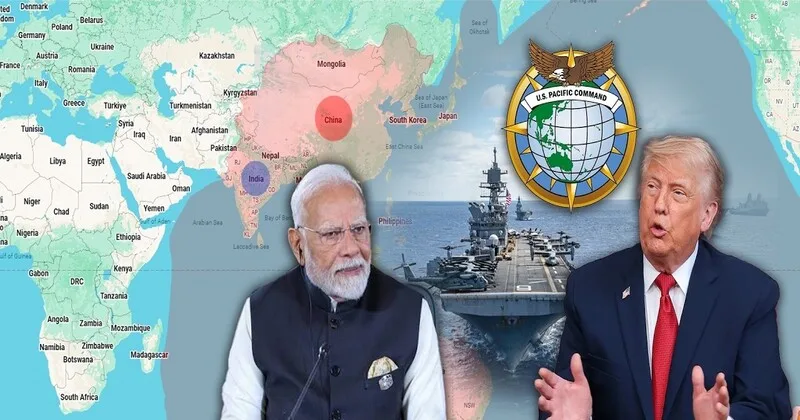
Amidst the ongoing West Asia conflict, the US has renamed the Indo-Pacific Command back to the US Pacific Command. The US armed forces have seven geographical commands as per specific area of responsibility around the globe. US Pacific Command is the oldest and the largest unified combat command of the US armed forces. The area of responsibility of this command stretches from west coast of the US to east coast maritime boundary of India. Founded in 1947 as the US Pacific Command, it was renamed as the US Indo-Pacific Command in 2018 under President Trump 1.0 administration. The renaming back to the original designation as the US Pacific Command under President Trump 2.0 administration needs to be monitored from the Indian perspective.
The name change in 2018 as the US Indo-Pacific Command was meant to signify the growing strategic connect between the Indian Ocean and Pacific Ocean. The Indo-Pacific region covers the Indian Ocean and the western and central Pacific Ocean. Indo-Pacific region is world’s fastest growing area and obviously has the maximum interest of USA and China. The region is home to about 55 per cent of the world population and accounts for 60 per cent of the global GDP. Economically, it is the fastest growing region which accounts for two third of global economic growth. India, China, Australia, Brunei, Singapore, Malayasia, Indonesia, Philippines, South Korea, Thailand, Vietnam, Japan, New Zealand, Maldives and Bangladesh are some of the key Indo-Pacific nations.
In the US security calculus, India’s strategic role to counter growing Chinese influence is paramount. As the lone super power, the US has dominated the affairs of the Indo-Pacific region for a long time. The US has huge military presence in the region in terms of miliary bases, deployment of aircraft carrier ships and bilateral/regional security groupings. The US hegemony has now been challenged by China, beginning with its belligerence in South China Sea. In the South China sea, continuous friction with countries like Philippines is happening and the naval vessels have come close to formal attack. Economically, China dominates the ASEAN block and through them desires to dominate the Indo-Pacific.
It is to counter Chinese domination in the region that the US is supporting India more actively for the last eight years. India and US have made significant progress in operationalising the Indo-Pacific Maritime Domain Awareness (IPMDA), a Quad initiative comprising of India, US, Australia and Japan. China has been opposed to the term Indo-Pacific as such. It views the concept as a US led containment strategy aimed to suppress China’s rise as an economic and military power. China has been opposed to the groupings like the Quad and trilateral security and defence partnership AUKUS (Australia, UK and the US). Both these groupings have been formed to promote a secure Indo-Pacific. Beijing views the removal of ‘Indo’ from the name as a potential rollback of such multilateral encirclement.
Officially, China has given mixed signals and is likely to watch the future US actions in the Indo-Pacific. For the US, the renaming aligns with Pentagon’s broader rebranding exercise under Trump 2.0 administration, championed by Defence Secretary Pete Hegseth. As far as India is concerned, the command’s area of responsibility and operations are said to remain the same. In the short term, the renaming may just be a rebranding exercise to assuage China. President Trump visited China in May. In practical terms, the visit did not achieve much though President Trump did signal a change towards its Taiwan policy. It is feasible that an understanding to drop the word ‘Indo’ is part of some unwritten agreement between the US and China.
But the US is aware of the expansionist agenda of China in the Indo-Pacific. Therefore, as long as the world has a common understanding of the term ‘Indo-Pacific’, India need not be much concerned about the renaming of the US Pacific Command. India should now monitor if there is any change in the commitment of the US towards Indo-Pacific, be it joint exercises, common military protocols or maritime surveillance of the region. Marco Rubio, the US Secretary of State has officially commended the importance of India in the global affairs and reaffirmed its commitment to strengthening the Indo-US relations.
The trade deal between both the countries is being finalised and there is a likelihood of President Trump visiting India early next year. Marco Rubio has also confirmed the likelihood of the Quad members meeting soon. Thus, the renaming of the US Pacific Command is just a rebranding exercise, with the prime importance of India in the Indo-Pacific region intact.