The arrival of Myanmar President Min Aung Hlaing in India is not merely another diplomatic visit between neighbours. It signals the return of a deeper geopolitical contest unfolding quietly in India’s eastern frontier, a contest involving rare earth minerals, strategic connectivity, border security and the larger battle for influence in China’s immediate backyard. From Bodh Gaya to New Delhi and Mumbai, the symbolism and substance of this five-day visit reveal how India is recalibrating its Myanmar policy at a time when the global competition over critical minerals and supply chains is intensifying.
The visit began on a carefully chosen civilisational note. President Min Aung Hlaing visited the Mahabodhi Mandir in Bodh Gaya, meditated under the sacred Bodhi Tree and paid obeisance at the Sujata Mandir in Bakraur. He also visited the Burmese Monastery in Bodh Gaya before heading to New Delhi for high-level political and strategic meetings. The spiritual imagery was deliberate. India and Myanmar are tied not only by geography but also by centuries-old Buddhist and cultural links. Yet behind the religious symbolism lies a much harder strategic reality.
Deepening the bonds of friendship and cooperation.
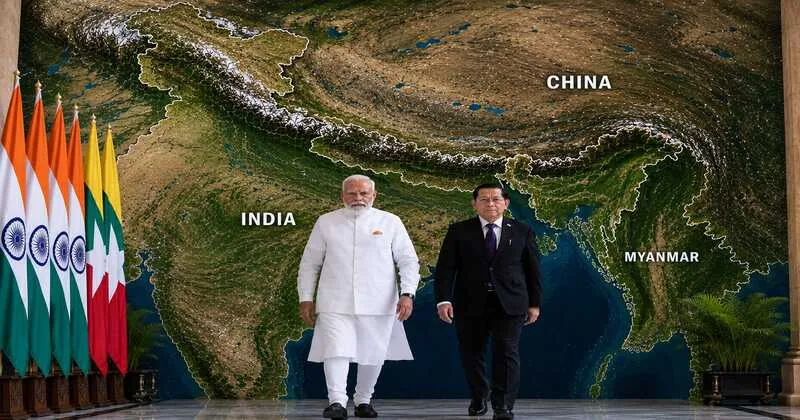
PM @narendramodi greets President U Min Aung Hlaing of Myanmar upon his arrival at the Hyderabad House for bilateral talks. pic.twitter.com/yxisKFGBHn
— Randhir Jaiswal (@MEAIndia) June 1, 2026
Myanmar today occupies a central place in India’s Act East policy and its broader Indo-Pacific calculations. Sharing a 1,643-km border with Arunachal Pradesh, Nagaland, Manipur and Mizoram, Myanmar is India’s only land bridge to Southeast Asia. At a time when China’s influence has expanded across South Asia through infrastructure financing, ports and economic corridors, Myanmar has become one of the most critical theatres where India seeks to balance Beijing’s dominance. The timing of the visit is equally significant. It comes less than two months after Min Aung Hlaing assumed office as President following Myanmar’s parliamentary elections held in December and January. The core of the current engagement revolves around a subject that has become central to global power politics, rare earth minerals.
The Rare Earth Race and China’s Shadow
Myanmar possesses some of the world’s most valuable deposits of heavy rare earth minerals, particularly dysprosium and terbium located in Kachin and Shan states. These minerals are indispensable for high-performance permanent magnets used in electric vehicles, wind turbines, advanced electronics and defence systems. Their unique ability to retain magnetic properties under extreme heat makes them crucial for aerospace engines, radar systems and stealth technologies. For India, the importance of these minerals extends directly into national security.
India is pursuing indigenous fighter aircraft development and advanced defence manufacturing under the strategic vision of Aatmanirbhar Bharat and the Make in India initiative, aimed at strengthening self-reliance in critical defence technologies and reducing dependence on foreign supply chains. Dysprosium and terbium are critical for aero-engines that must withstand temperatures reaching nearly 1600 degrees Celsius. Rare earth elements are also used in radar systems, guidance systems, missile technologies and stealth coatings. In other words, access to these minerals is no longer merely an industrial requirement; it is a strategic necessity.
Myanmar’s significance becomes even greater because China currently dominates the processing and extraction ecosystem around these minerals. Most rare earth deposits mined in Myanmar are exported or smuggled into China for refining because Myanmar itself lacks processing capability. Beijing has therefore used Myanmar’s mineral wealth to reinforce its near-monopoly over global rare earth supply chains. That monopoly has become a growing concern for countries across the world. Rare earths are increasingly viewed as the oil of the technological age. Nations that control these supply chains possess enormous leverage over defence manufacturing, green energy technologies and industrial production.
Pleased to call on President U Min Aung Hlaing of Myanmar in New Delhi today.
Appreciate his positive sentiment towards deepening our longstanding bilateral cooperation.
Look forward to his meeting with PM @narendramodi to advance our partnership for peace, progress and… pic.twitter.com/GYPbfYauCB
— Dr. S. Jaishankar (@DrSJaishankar) May 30, 2026
India, despite possessing the world’s third-largest reserves of rare earths, particularly monazite and thorium, contributes less than one per cent of global production. Constraints ranging from radioactivity concerns and land acquisition issues to inadequate refining technology have prevented India from fully utilising its own reserves. Myanmar’s resources therefore offer India a strategic opening. Access to Myanmar’s heavy rare earths would not only support India’s defence and industrial ambitions but also reduce China’s overwhelming control over critical mineral supply chains. It would gradually expand India’s influence in a region where Beijing has invested aggressively through the Belt and Road Initiative.
Reports indicate that the issue of rare earth cooperation is expected to figure prominently in discussions between Prime Minister Narendra Modi and President Min Aung Hlaing. Myanmar’s northern regions rich in rare earth deposits have already become strategically contested zones. China has long extracted minerals from Kachin state, while Myanmar’s military has recently intensified operations in border areas where these deposits are located even as several rebel groups continue to exert influence there. For New Delhi, therefore, rare earth cooperation is inseparable from border stability and strategic engagement with Myanmar’s ruling establishment.
Connectivity, security and the Act East vision
India’s Myanmar strategy extends far beyond minerals. Connectivity remains the second major pillar of the relationship. Myanmar is the geographical hinge connecting India’s Northeast to Southeast Asia. Without Myanmar, India’s Act East policy cannot move beyond rhetoric into real economic integration. This is why projects such as the Kaladan Multi-Modal Transit Transport Project hold enormous strategic value. The Kaladan project seeks to connect India’s eastern seaboard with Myanmar through a combination of sea, river and road transport networks. It is expected to provide an alternative route to India’s Northeast while reducing dependence on the narrow Siliguri Corridor. The government has targeted completion by 2027.
Connectivity discussions are expected to dominate meetings during the visit. External Affairs Minister Dr S Jaishankar has already discussed connectivity and trade with the Myanmar President. Ministry of External Affairs spokesperson Randhir Jaiswal has stated that border security, connectivity and issues of mutual interest will be key themes in the talks. India’s concerns are rooted in both economics and security. Myanmar’s instability directly affects India’s Northeast, particularly Manipur and Nagaland. Insurgent networks, illegal trafficking and refugee flows across the porous border create constant security challenges. Stable ties with Myanmar’s government are therefore viewed in New Delhi as essential for managing border security.
This explains the high-level security engagement accompanying the visit. National Security Adviser Ajit Doval met Min Aung Hlaing in New Delhi. Earlier in Moscow, on the sidelines of the International Security Forum and the 14th Meeting of High Representatives for Security Matters, Doval met Myanmar’s National Security Adviser Tin Aung San. The two sides reviewed cooperation in security, defence and connectivity while discussing regional developments. Myanmar’s NSA is also expected to visit India again in July for the fifth meeting of National Security Advisers of BIMSTEC, indicating that the security partnership is becoming institutionalised. India’s approach toward Myanmar is therefore pragmatic. Unlike Western powers that largely engage Myanmar through the prism of democracy and sanctions, India views Myanmar through the lens of geography, connectivity and strategic balance.
Trade, investment and the strategic economy
Economic ties between the two countries have also grown steadily despite Myanmar’s political turbulence. India-Myanmar bilateral trade increased by 23 per cent in FY25 to reach $2.15 billion. Myanmar exported goods worth $1.53 billion while Indian exports stood at $614.3 million. Pulses remain central to the trade relationship, accounting for nearly 77 per cent of Myanmar’s exports to India. Pulses exports increased by 29 per cent in FY25. India is currently Myanmar’s fourth-largest trading partner.
Another notable development has been the operationalisation of the rupee-kyat settlement mechanism since January 2024. The mechanism allows trade settlement in local currencies, reducing dependence on dollar transactions and insulating trade from currency volatility.There is substantial room for expansion. Myanmar could increase imports of Indian fuel and pharmaceuticals under the rupee-kyat framework while continuing beans and pulses exports in rupees. Indian medicines already enjoy significant acceptance in Myanmar because of their affordability and quality.
Investment ties are also developing. According to Myanmar government statistics, India is the eleventh-largest investor in the country with approved investments of US$782.821 million through 39 Indian enterprises out of total foreign investments worth US$96.05 billion from 53 countries as of March 31, 2025. President Min Aung Hlaing’s Mumbai visit for business and industry interactions further underlines the economic dimension of the trip. The Myanmar–India business forum is expected to focus on expanding cooperation in infrastructure, trade and manufacturing.
PM @narendramodi holds bilateral talks with Myanmar President U Min Aung Hlaing at Hyderabad House in New Delhi.#India #Myanmar @MEAIndia pic.twitter.com/ZOv5MwxRkI
— All India Radio News (@airnewsalerts) June 1, 2026
Yet beneath all these engagements lies a larger strategic calculation. China has spent years expanding its footprint in Myanmar through roads, pipelines, dams and ports linked to the Belt and Road Initiative. Beijing views Myanmar as a crucial gateway to the Indian Ocean, providing China access that bypasses the vulnerable Malacca Strait. India understands this reality clearly.
What New Delhi is now attempting is not confrontation with China but strategic balancing. By strengthening ties with Myanmar through Buddhism, trade, connectivity, security cooperation and rare earth engagement, India is trying to build durable influence in a region that directly affects its national security and economic future. The message behind Min Aung Hlaing’s visit is therefore unmistakable. India is no longer viewing Myanmar merely as a troubled neighbour on its border. It is increasingly treating Myanmar as a strategic gateway, to Southeast Asia, to critical mineral security and to a larger geopolitical contest shaping the future balance of power in Asia.