There was a time when Northeast India was considered to lag behind on the country’s development map due to geographical isolation, limited connectivity, a lack of investment and various developmental challenges. However, everything has changed; under the Modi government, the notion of lagging behind has become a thing of the past for these “Ashtalakshmi” (eight forms of wealth-prosperity) states.
Indeed, the impact of the comprehensive strategy implemented by the BJP-led central government, under the leadership of Prime Minister Narendra Modi, to bring this region into the mainstream of national development over the last decade is now clearly visible. Rapid transformations in sectors such as road, rail and air connectivity, digital infrastructure, tourism, industry, skill development and cross-border trade have positioned the Northeast among India’s most promising regions.
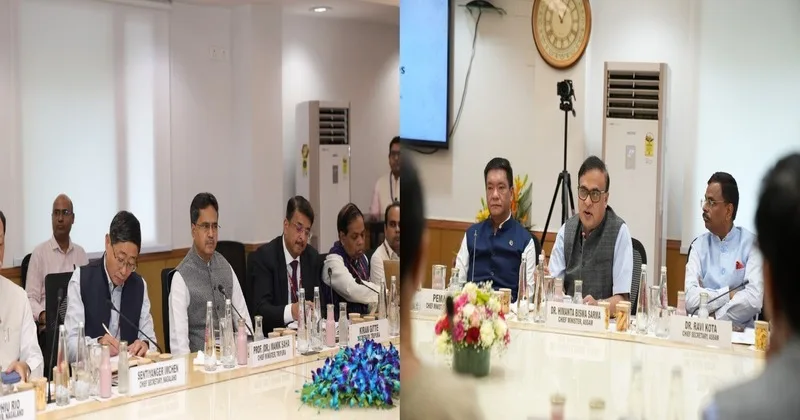
In this context, a recent dialogue meeting between NITI Aayog and the Chief Ministers of the Northeastern states further highlighted this changing landscape. Chief Ministers from Arunachal Pradesh, Assam, Manipur, Meghalaya, Mizoram, Nagaland, Sikkim and Tripura participated in the meeting organized by NITI Aayog. The objective was to share the states’ development experiences, innovations, challenges and future priorities.
The dialogue featured in-depth discussions on subjects such as agriculture, health, education, skill development, rural development, tourism, livelihoods, digital infrastructure and good governance. The meeting clearly signaled that the Modi government is developing the Northeast not merely through isolated projects, but as a model for long-term transformation.
Arunachal Pradesh Emerging as a Hub of Hydropower and People-Centric Governance
Arunachal Pradesh Chief Minister Pema Khandu stated that the Northeast is emerging as a new engine of development today. He highlighted the state’s immense hydroelectric potential as crucial for meeting India’s energy needs. He also referred to innovative initiatives such as ‘Sarkar Aapke Dwar’, ‘Seva Aapke Dwar’ and ‘Cabinet Aapke Dwar’, through which the administration is reaching villages and citizens directly. This model exemplifies how the Modi government is focusing on administrative accountability and efficient service delivery alongside substantial investments.
Shri Pema Khandu, Chief Minister of Arunachal Pradesh, highlighted that the North-East is undergoing a significant transformation and emerging as a key engine of growth. Emphasising the State’s immense potential, particularly in hydropower, he stressed the need to further… pic.twitter.com/hNbzm47bBu
— NITI Aayog (@NITIAayog) June 12, 2026
Assam: A Hub of Development, Investment and Regional Balance
Assam Chief Minister Himanta Biswa Sarma stated that regional balance is crucial for inclusive development. He described the historic tripartite agreement aimed at facilitating mineral oil operations in the Assam-Nagaland border areas as an excellent example of cooperative federalism.
According to Chief Minister Himanta Biswa Sarma, Assam has achieved remarkable improvements in social development indicators and has emerged as one of the fastest-growing states in the country. Rapid strides in education, healthcare, investment and industrial development have established the state as the economic gateway to the Northeast.
At the Interaction with Chief Ministers of the North Eastern States, Shri Himanta Biswa Sarma, Chief Minister of Assam, emphasised that development must be balanced to avoid regional disparities and ensure inclusive growth.
He appreciated the historic agreement between Assam and… pic.twitter.com/EeJXBx1iGm
— NITI Aayog (@NITIAayog) June 12, 2026
Meghalaya: Towards a Developed State via the ‘Transformation Journey 2032’
Meghalaya Chief Minister Conrad K. Sangma stated that the true objective of economic development should be to improve the standard of living of the people. Sharing the ‘Transformation Journey 2032’ vision, he presented a roadmap for building a developed Meghalaya. He highlighted the pivotal role of externally aided projects in infrastructure development and emphasized the need for greater cooperation among Northeastern states in areas such as trade, exports, and environmental sustainability.
At the Interaction with Chief Ministers of the North-Eastern States, Shri Conrad K. Sangma, Chief Minister of Meghalaya, emphasised that economic growth must translate into meaningful human development. He shared Meghalaya’s vision for a Transformation Journey 2032 aimed at… pic.twitter.com/oKoH7KwsjF
— NITI Aayog (@NITIAayog) June 12, 2026
Mizoram: Community Tourism as a Foundation for Economic Transformation
Mizoram Chief Minister Lalduhoma identified the state’s tourism potential as a key driver of economic growth. Sharing key details about the state, he noted that the community tourism model, driven by self-help groups and local communities, has achieved remarkable success. Tourist footfall in the state has increased manifold over the past four years. Additionally, while seeking support for the ‘Mizoram Ginger Mission,’ he stated that both employment and income could be boosted by incentivizing local agro-based industries.
At the Interaction with Chief Ministers of the North-Eastern States, Shri Lalduhoma, Chief Minister of Mizoram, highlighted the immense tourism potential of the State and shared its successful community-based tourism model driven by self-help groups and local communities. He… pic.twitter.com/aHX3x6oqdz
— NITI Aayog (@NITIAayog) June 12, 2026
Nagaland: Initiatives to Link Resources with Global Opportunities
Nagaland Chief Minister Neiphiu Rio emphasized that assistance from the 15th Finance Commission is essential to sustain the momentum of development. He highlighted the prospects for oil and gas exploration, new economic activities and the expansion of the agricultural sector within the state. Chief Minister Neiphiu Rio has stated that there is a need to take Nagaland’s renowned coffee to international markets, a goal that requires the cooperation of the Central Government and other states. This clearly indicates that the Northeast is moving beyond mere production towards a path of branding, value addition, and export-led growth.
At the Interaction with Chief Ministers of the North-Eastern States, Shri Neiphiu Rio, Chief Minister of Nagaland, emphasised the importance of continuing the support provided through the 15th Finance Commission to sustain the State’s development momentum.
He highlighted the… pic.twitter.com/VneovrUnVQ
— NITI Aayog (@NITIAayog) June 12, 2026
Manipur: Prioritizing Reconstruction, Rehabilitation and Trust-Building
While providing an update on the ongoing rehabilitation and reconstruction efforts in the state, the Chief Minister of Manipur stated that a robust monitoring mechanism is essential to ensure aid reaches the affected communities. He emphasized the need for better coordination between the Centre and the State to effectively implement resettlement plans and restore normalcy. This highlights that social stability, alongside development, is a key priority for the Central Government.
At the Interaction with Chief Ministers of the North Eastern States, Shri Y. Khemchand Singh, Chief Minister of Manipur, reaffirmed the State Government’s commitment to inclusive development and the vision of a Viksit Bharat.
He emphasised the importance of collaborative efforts… pic.twitter.com/KYweySMNvD— NITI Aayog (@NITIAayog) June 12, 2026
Sikkim: A Development Model Based on Digital Connectivity and Tourism
Sikkim Chief Minister Prem Singh Tamang stated that tourism, air connectivity and digital infrastructure are the key pillars of the state’s development. He underscored the need to continue the North East Industrial Development Scheme (NEIDS) and noted that improved digital networks and commercially viable air connectivity would play a crucial role in attracting investment, boosting industry and creating jobs.
At the Interaction with Chief Ministers of the North-Eastern States, Shri Prem Singh Tamang, Chief Minister of Sikkim, highlighted the critical role of tourism, connectivity and digital infrastructure in driving the State’s development.
He emphasised the need for commercially… pic.twitter.com/ia7Ws6cnwc
— NITI Aayog (@NITIAayog) June 12, 2026
Tripura: Rapidly Transforming from a Border State into a Trade Hub
Tripura Chief Minister Dr. Manik Saha stated that the state’s long international border and geographical challenges need to be transformed into opportunities. He emphasized strengthening integrated check-posts, rail connectivity, air services and trade infrastructure. Additionally, highlighting the potential in sectors such as bamboo, rubber, textiles, pharmaceuticals, sports and tourism, he requested further support for skill development, value addition and export promotion.
At the Interaction with Chief Ministers of the North-Eastern States, Dr. Manik Saha, Chief Minister of Tripura, highlighted the State’s geographical constraints, extensive international border and skill gaps, emphasising the need for targeted interventions to accelerate economic… pic.twitter.com/lDH5DKBsRB
— NITI Aayog (@NITIAayog) June 12, 2026
The Northeast’s Pivotal Role in ‘Viksit Bharat 2047’
It is noteworthy that the theme of this year’s NITI Aayog Governing Council meeting was ‘Inclusive Human Development for Viksit Bharat 2047’. The objective is to ensure the holistic development and well-being of every citizen, irrespective of age group, region, gender, or socio-economic background. Discussions focused on how to extend the benefits of development to every citizen and align the states’ development visions with national goals. Special emphasis was placed on four key pillars during the meeting:
1. Strong human capital and future-ready skills
2. Productive employment and entrepreneurship
3. Health, nutrition and improved standards of living
4. Equal opportunities and social dignity
During the meeting, the experiences of the Northeastern states demonstrated that these “Ashtalakshmi” states are making rapid strides in these four areas. It was also highlighted that Digital Public Infrastructure (DPI), data-driven decision-making systems, inter-departmental coordination and robust monitoring mechanisms are essential for the success of development schemes.
Discussions were also held on developing a systematic mechanism to monitor short-term, medium-term, and long-term goals, ensuring the accountability and effectiveness of the schemes. This aligns with the Modi government’s working style, which prioritizes result-oriented governance.
A day prior to this, Prime Minister Narendra Modi chaired the 11th Governing Council meeting of NITI Aayog. This significant meeting was attended by Chief Ministers of various states, Lieutenant Governors and Administrators of Union Territories, Union Ministers, and senior officials from NITI Aayog. Following the meeting, Prime Minister Modi stated that the Centre and the states, driven by the spirit of cooperative federalism, are working together to accelerate India’s development journey.
He remarked that the collective efforts of the Centre and the states would play a pivotal role in achieving the shared goal of a ‘Viksit Bharat’. Emphasis was also placed on ensuring that the benefits of development schemes reach every section of society and that the development visions of individual states are aligned with the national development perspective. Good governance, Digital Public Infrastructure (DPI), inter-departmental coordination, partnership models and data-driven decision-making systems were identified as crucial for the effective implementation of development schemes.
Furthermore, the development of a systematic mechanism to monitor short-term, medium-term and long-term goals was discussed to ensure accountability and enable an accurate assessment of outcomes. During this meeting, NITI Aayog stated that the primary objective is to establish better coordination between the states and the central government and to formulate a shared roadmap for inclusive and sustainable development. If the Centre and the states work together towards these goals, the country could gain fresh momentum in realizing the vision of ‘Viksit Bharat 2047’.
Furthermore, this dialogue with the Chief Ministers of the Northeastern states demonstrates that the central government views the region not merely as a geographical frontier, but as a leading driver of India’s economic, strategic and social progress. Current activities indicate that the development model emerging in the Northeast, integrating road and rail connectivity, digital networks, energy, tourism, education, skill development, women’s empowerment, entrepreneurship and global trade opportunities, will prove to be one of the strongest cornerstones of ‘Viksit Bharat 2047’ in the years to come.