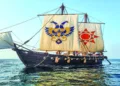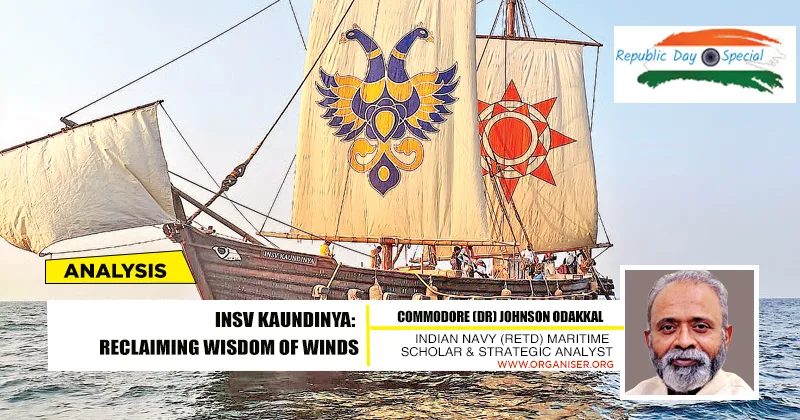
The arrival of INSV Kaundinya at the Port of Muscat on January 14, 2026, greeted by a ceremonial water salute on the auspicious day of Makara Sankranti, was more than a successful naval exercise. It was the culmination of a visionary collaborative project between the Indian Navy and the Ministry of Culture, steered by Sanjeev Sanyal, whose seminal work, The Ocean of Churn, has revived understanding of how the Indian Ocean shaped human history. This 19.6-metre wooden sailing vessel, built without a single metal nail, serves as a living bridge to a 5,000-year-old legacy of nautical excellence. Bharat’s identity as a maritime civilisation is anchored in a deep-seated geological and historical destiny. As Gondwana landmass drifted Northwards, Bharat “sailed” into its current peninsular position, embracing an intrinsic maritime fate. This legacy achieved its first formal pinnacle in the Indus Valley Civilisation (circa 3000 BCE), where the inhabitants of Lothal constructed the world’s first dry-dock. This facility, equipped to berth and service ships by leveraging a sophisticated understanding of tides and winds, facilitated trade routes reaching as far as Mesopotamia and Africa.
Legacy of Indigenous Shipbuilding
The strength of Indian maritime power lay in its unique shipbuilding traditions, which prioritised harmony with the environment over rigid resistance. Unlike European vessels, traditional Indian ships were often “stitched” using coir ropes made from coconut fibre. This technique allowed hulls to remain flexible, absorbing the immense stresses of the open ocean—a principle known as immersive buoyancy.
From the Kotia vessels of Mandvi to the Urus of Beypore and the swift Chhot boats of Bengal, Indian shipbuilders utilised renewable materials like teak, sal wood, and natural resins. These handcrafted traditions, passed down orally through generations of master craftsmen known as Maestri, ensured that Bharat remained a global hub for high-quality, sustainable vessel construction for millennia.
Golden Age of Nautical Competence
Bharatiya nautical prowess was defined by a mastery of the monsoon winds, turning the Indian Ocean into a predictable highway for connectivity long before the Western “Age of Discovery”. This expertise was utilised by various dynasties to project power and foster prosperity. The seafaring spirit of ancient Odisha is still celebrated through the Bali Yatra festival, recalling voyages across the Bay of Bengal to Sumatra, Java, and Bali. These mariners didn’t just trade; they carried Indian philosophy and scripts to the heart of Southeast Asia. Under Rajendra Chola in the 11th century, Bharat possessed a blue-water navy of hundreds of ships. This fleet was not used for territorial conquest but as a strategic tool to suppress piracy and secure the “Empires of the Sea”. The Cholas maintained a strategic presence that commanded respect as far as the Song Dynasty in China.
As European powers entered the Indian Ocean, Bharat’s maritime prowess shifted from commercial expansion to asymmetric resilience. On the Malabar coast, the Kunjali Marakkars defied Portuguese armadas for nearly a century. Using agile, shallow-draft vessels, they exploited local geography to outmanoeuvre heavily armed European carracks, proving that tactical ingenuity could negate superior firepower. In Western Bharat, Chhatrapati Shivaji Maharaj famously declared that “he who is victorious over the oceans is almighty”. This doctrine was upheld by Sarkhel Kanhoji Angre, who fortified the Konkan coast and became a formidable challenge to British, Dutch, and Portuguese naval ambitions.
Whether it was the riverine ingenuity of Lachit Borphukan at the Battle of Saraighat or the coastal defiance of Rani Abbakka, the Indian maritime psyche was always one of sovereignty and stewardship.
Colonial Eclipse
The eventual colonial period led to a systematic dismantling of indigenous maritime institutions, ushering in a period of “sea blindness”. Indigenous shipbuilding was curtailed, and India was relegated to the periphery of its own ocean. However, the post-Independence era has seen a steady reclamation of this heritage.
From the establishment of Hindustan Shipyard Limited—which launched the Jal Usha in 1948 to the advanced warship-building capabilities of Mazagon Dock Shipbuilders Limited, India has rebuilt its status as a premier naval power. Today, with aircraft carriers like INS Vikrant and a strategic vision encapsulated in SAGAR (Security and Growth for All in the Region), Bharat has returned to its role as a maritime pillar. The voyage of INSV Kaundinya is the most potent symbol of this modern resurgence. By retracing a 5,000-year-old trade route from Porbandar to Muscat without the aid of an engine, the 16-member crew, skippered by Commander Vikas Sheoran, proved that ancient Indian nautical science remains valid in the 21st century.
The vessel itself is a triumph of experimental archaeology. Using hand-twisted coconut coir and natural resins, the ship “harmonised” with the waves of the Arabian Sea just as the ships of the Harappan and Chola eras once did. This expedition demonstrates that the path to a “Green Resurgence” in shipping may well lie in the biodegradable, low-carbon materials of our past.
Bharat’s maritime journey is a saga of rise, eclipse, and a spectacular modern return. The Maritime India Vision 2030 and the broader Mahasagar doctrine signify a nation that no longer views the sea as a boundary, but as a theatre of prosperity and strategic depth.
INSV Kaundinya reminds us that our nautical prowess is not just a matter of historical record, but a living capability. As we navigate the complexities of the Indo-Pacific in this Amrit Kaal, we do so by looking at the same stars and harnessing the same winds that guided our ancestors. The oceans, once the theatre of our neglect, are now the compass of our resurgence. Sam No Varunah (May the Lord of the Oceans be auspicious unto us).