The countless sacrifices made during India’s struggle for independence were inspired by equally countless visionary personalities whose words awakened society and motivated people to fight for freedom. Among these towering figures, Bankim Chandra Chattopadhyay occupies a unique place. His call became a sacred mantra of India’s freedom movement. The immortal song “Vande Mataram”, composed by him, resonated on the lips of both revolutionary freedom fighters and participants in the non-violent national movement.
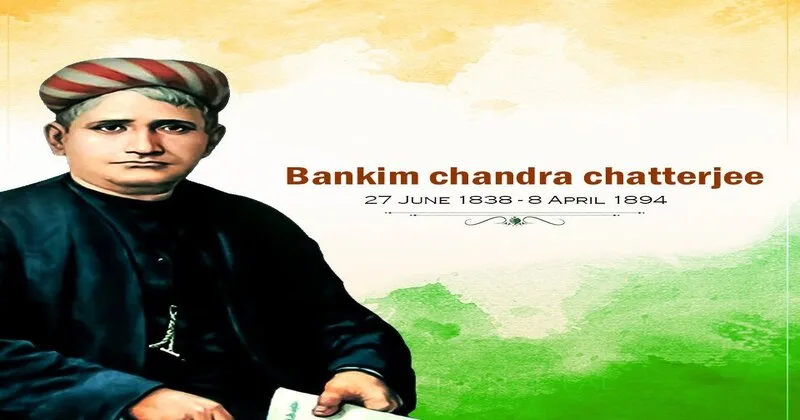
Bankim Chandra Chattopadhyay, the celebrated journalist, novelist, poet and nationalist thinker who devoted his entire life to the awakening of national consciousness and cultural pride, was born on June 27, 1838 at Kanthalpara, Naihati, in the present-day North 24 Parganas district of Bengal (some historical sources mention June 26 as his birth date). His father, Yadav Chandra Chattopadhyay, belonged to a prosperous and cultured family, while his mother, Durga Devi, was deeply rooted in India’s traditional values. Patriotism, self-respect and cultural consciousness were deeply embedded in his upbringing.
He received his education at Hooghly College and Presidency College. When the Revolt of 1857 broke out, he was pursuing his Bachelor of Arts degree. The horrifying reports of mass executions and brutal suppression carried out by the British deeply disturbed him. He carefully studied both the causes of the uprising and the reasons behind its failure. Although emotionally shaken, he remained committed to completing his education. In 1857, he became the first Indian graduate of Presidency College, a distinction that earned him immediate appointment as a Deputy Magistrate under the British administration. He later also served as a Secretary in the Bengal Government. However, he eventually resigned from government service. After qualifying in law in 1869, he dedicated himself to the intellectual awakening of Indian society.
Bankim Chandra was profoundly influenced by India’s glorious past as well as deeply pained by the growing tendency among many Indians to surrender their identity and self-respect before colonial rule. Determined to restore national confidence, he began his literary mission with the objective of reviving India’s cultural pride and collective spirit.
His first published work, Rajmohan’s Wife, was written in English and subtly portrayed the social compulsions of colonial India. His first Bengali novel, Durgeshnandini (1865), introduced readers to the immense inner strength of Indian civilization. Through this work, he sought to inspire society much like Goswami Tulsidas had done centuries earlier through the Ramcharitmanas. This was followed by Kapalkundala (1866). In 1872, he founded the influential monthly journal Bangadarshan, through which he emerged as one of India’s finest nationalist journalists.
The magazine regularly published articles highlighting Bengal’s glorious history and India’s civilizational heritage, thereby inspiring cultural awakening. His celebrated novel Vishabriksha was also serialized in this journal. As its title suggests, the novel symbolically examined the social weaknesses and shortsightedness that had contributed to India’s decline. Similarly, in Krishnakanter Will, he offered sharp satire on British colonial rule.
On November 7, 1876, at Kantalpara village in Bengal, Bankim Chandra composed the immortal hymn “Vande Mataram.” The song later became an integral part of his masterpiece Anandamath, published in 1882. The first two stanzas were written in Sanskrit, while the remaining portions were composed in Bengali. The first English translation of Vande Mataram was prepared by Sri Aurobindo.
Although nearly every one of his writings inspired national awakening, Anandamath and its immortal song Vande Mataram became enduring symbols of patriotism, sacrifice and resistance. The novel was inspired by the historical Sannyasi Rebellion in Bengal, during which ascetics and monks rose against British oppression in defense of India’s culture and traditions. Though brutally suppressed, their spirit found everlasting expression through Anandamath. Its publication rekindled nationalist sentiment across the country, and “Vande Mataram” soon became the rallying cry at public meetings and patriotic gatherings throughout Bengal and beyond.
His final novel, Sitaram (1886), depicted resistance against medieval oppression. Other notable novels include Mrinalini, Indira, Radharani, Krishnakanter Will, Devi Chaudhurani, and Muchiram Gur’s Life. Besides fiction, he authored numerous essays and poems on religion, society, politics, and contemporary issues. The profound impact of his literary contributions ensured that almost every major nationalist movement of his era drew inspiration from his ideas. His writings consistently invoked India’s ancient culture, spiritual heritage, and civilizational values. He remained deeply committed to the ideals of national freedom.
Among his most influential works was Krishnacharitra, in which he sought to define the moral and ethical foundations necessary for an ideal society. The publication of Vande Mataram in Bangadarshan generated a remarkable wave of patriotic enthusiasm throughout India. Bankim Chandra successfully established a harmonious relationship between Sanatan traditions and the essential ideals of nation-building.
He also expressed deep concern over what he considered the growing cultural confusion among Hindus. His famous observation reflects this anguish:
“Hindu society abandons Kumarasambhava to read Swinburne, abandons the Bhagavad Gita to read Mill, and ignores the stone sculptures of Odisha while admiring the porcelain dolls of the English”.
These words continue to reflect his passionate appeal for cultural self-respect and intellectual independence.
In his work Dharmashastra, he placed patriotism above all other religious identities. In Lok Rahasya, he criticized the politics of dependency and urged Indians to stand firmly on their own feet. Through Amar Durgotsav, he discussed widow remarriage, women’s freedom and strongly opposed the blind imitation of Western customs. Above all, he envisioned the motherland as a living mother worthy of devotion and sacrifice.
Thus, the entire life of Bankim Chandra Chattopadhyay was dedicated to awakening Indian society to its national identity, cultural heritage and civilizational values. Through journalism, novels, poetry, essays and public discourse, he tirelessly worked to inspire self-respect and national consciousness. The great champion of India’s cultural renaissance passed away on April 8, 1894. His departure marked only the end of his earthly life; his thoughts, ideals, and immortal creation “Vande Mataram” continue to inspire generations of Indians and remain deeply enshrined in the nation’s collective consciousness.