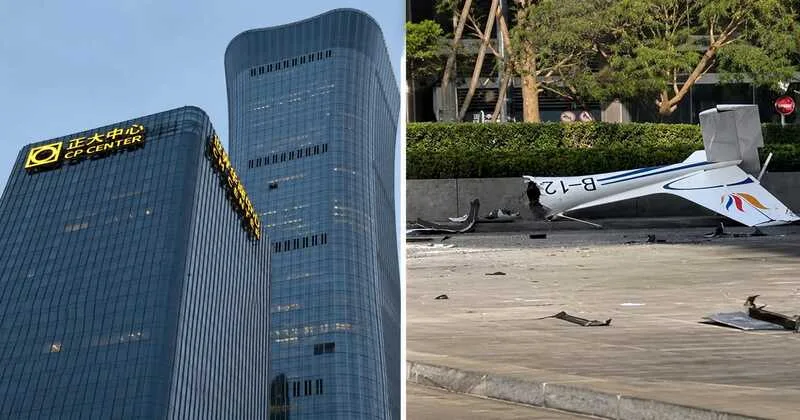
NEW DELHI: A small aircraft crashed into Beijing’s tallest skyscraper on the evening of June 26, shattering windows of the 109-storey CITIC Tower and triggering a massive emergency response in the heart of the Chinese capital’s central business district. The incident, which occurred at around 6 p.m. local time, remains shrouded in uncertainty, with Chinese authorities yet to issue an official statement on the cause of the crash, the number of people on board, or whether there were any casualties.
Visible damage could be seen on the upper section of the 1,732-foot CITIC Tower, also known as China Zun, located in Beijing’s Chaoyang district. Online footage, consistent with the location of the building, showed debris falling from the skyscraper shortly after the impact. Images that briefly circulated on Chinese social media before being removed showed wreckage scattered on the road below, including broken components that appeared to be part of the aircraft’s tail section.
The circumstances surrounding the incident remain unclear. Authorities have not confirmed whether the crash was accidental or deliberate, and no official explanation had been released as of the time of publication.
Residents who spoke to foreign media said they first heard about the crash at around 6 p.m. local time but noted that city authorities had made no public announcement regarding the incident. The absence of official information has fuelled speculation and confusion, particularly because Beijing is known for maintaining some of the world’s strictest airspace restrictions.
🇨🇳 A plane crashed into Beijing's tallest skyscraper
Debris fell near the eastern entrance of the China Zun Tower.
The China Zun skyscraper is in the top 10 tallest buildings in the world. The height of the tower is 528 meters. pic.twitter.com/Tt8hmDkc3V
— Visegrád 24 (@visegrad24) June 26, 2026
One Beijing resident questioned how such an aircraft could have entered the capital’s tightly controlled airspace. Speaking to Reuters, the resident said, “I was wondering, didn’t Beijing’s air-defense radar detect something as obvious as this?”
Plane crashes are exceptionally rare in Beijing, where the state maintains extensive security controls over both manned and unmanned aircraft. Since May 1, authorities have effectively prohibited the sale, rental and operation of drones across the capital owing to heightened security concerns.
Heavy security response near China’s tallest building
The affected skyscraper, officially known as China Zun, serves as the headquarters of CITIC Group, one of China’s largest state-owned financial services companies. The landmark tower stands approximately four to five miles east of Zhongnanhai, the heavily guarded compound where senior Chinese Communist Party (CCP) leaders, including President Xi Jinping, live and work.
By Friday night, the area surrounding the building had been sealed off by a significant police deployment. Fire engines, ambulances and other emergency vehicles lined the streets outside the tower as security personnel restricted public access.
According to Reuters, police prevented several bystanders from filming or photographing the scene and instructed others to delete images they had already captured. A police officer also ordered Reuters journalists to leave the area. When asked why they were being removed, the officer simply replied, “We all know why!”
A courier who arrived near the tower shortly after the incident told the British news agency that he had rushed to the site after hearing a loud crash as what he described as a car-sized plane struck the building.
An office worker in a nearby building also recounted witnessing the aftermath. Speaking to Reuters, the 39-year-old said she looked out from her office window at around 6:45 p.m. and saw a blue tarp covering a large object on the roadside, approximately the size of a Volkswagen Beetle.
“I was on my way down to dinner when someone said a plane had crashed into the next building. So we went to look out the window and saw police cars, ambulances and the blue tarp on the road,” she said.
Another bystander told Reuters that he also heard the loud impact and remarked that “it’s very strange for a plane to fly into this area,” reflecting widespread disbelief that an aircraft could reach one of Beijing’s most tightly protected districts.
Information blackout raises further questions
As questions mounted over the unprecedented incident, China’s state-controlled media remained silent. At the time of publication, no major Chinese state media outlet had reported on the crash despite its occurrence in one of the country’s most prominent business districts.
Information about the incident also appeared to be swiftly removed from China’s tightly controlled internet. Posts containing images of the damaged building disappeared from social media platforms within hours. Searches for the tower’s name on Baidu, China’s equivalent of Google, returned no results related to the crash on Friday night. Likewise, searches on Douyin, the Chinese version of TikTok, produced no posts concerning the incident.
The plane that just hit Beijing's tallest building wasn't a missile.
It was a two-seater training aircraft.
And nobody is talking about what that actually means.
🚨 🚨 🚨 A SUNWARD SA60L "AURORA" LIGHT SPORT PLANE JUST PUNCHED A HOLE INTO CITIC TOWER — 109 STORIES UP — IN THE… pic.twitter.com/LlzKZYGbOF
— 🇨🇳 Guo Shen 郭深 (@GuoShenCN7) June 26, 2026
Similarly, posts on Xiaohongshu, also known as Red Note, had been removed, with searches for the building displaying only content uploaded before Friday.
The apparent suppression of online discussion has drawn attention because the Chinese Communist Party has long maintained strict control over information relating to disasters, major accidents and other sensitive incidents, including plane crashes and building collapses.
With authorities yet to disclose the cause of the crash, the number of occupants, possible casualties or the identity of the aircraft, the incident continues to raise serious questions about security within Beijing’s heavily protected airspace. The absence of official information, combined with eyewitness accounts, rapid censorship of online content and the unusually heavy security presence around the scene, has only intensified public curiosity over one of the most extraordinary aviation incidents to occur in the Chinese capital in recent years.