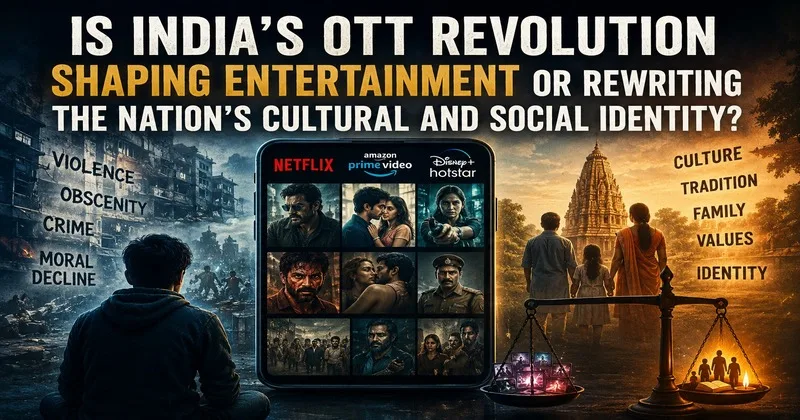
What is being served on OTT platforms in the name of entertainment in India can no longer be dismissed as mere “creative freedom.” This is no longer just about web series, bold content, or the changing tastes of a younger audience. It has increasingly become part of a larger cultural, ideological, and psychological campaign in which India’s civilisational memory, the image of Hindu society, the dignity of the family, and the confidence of social life are being systematically weakened.
This assault is not always direct. It often works through stories, characters, visuals, dialogue, satire, framing, and selective representation. The viewer is made to believe that he is simply watching “entertainment,” while in reality, a deeper process is at work: disgust toward India, ridicule for Hindu symbols, suspicion toward family life, and confusion toward morality are quietly being planted in the mind.
Cultural Poison in the Name of Entertainment
A large section of OTT content today is flooded with violence, obscenity, profanity, broken relationships, crime, and psychological chaos. These things are not merely shown; they are increasingly normalised. The standard defense is simple: “This is how society is, and we are only reflecting reality.”
But the obvious question is: Is this all that Indian society is? Does India not also contain stories of sacrifice, compassion, duty, devotion, family bonds, courage, motherhood, spiritual discipline, social cooperation, and moral struggle? If a civilisation of thousands of shades is repeatedly reduced to its darkest, ugliest, and most fractured images, that is not neutral realism. It is narrative engineering.
This is precisely what is happening. Indian society is often portrayed as if villages and small towns are inhabited only by rapists, murderers, caste tyrants, corrupt politicians, hypocritical priests, and oppressive families. States such as Uttar Pradesh, Bihar, Haryana, Rajasthan, and Madhya Pradesh are repeatedly presented in a visual language that makes them look less like living societies and more like breeding grounds of barbarism. And whenever a religious or Hindu-cultural character appears, he is often shown as a fraud, a criminal, a lustful hypocrite, or a power-hungry manipulator. Is this merely a coincidence? Or is there a conscious attempt to frame India in a particular ideological mold?
The Construction of Hindu Society as the Permanent Villain
The most serious aspect of this trend is the repeated framing of Hindu society as the permanent culprit. Whether the theme is caste, patriarchy, feudal violence, superstition, or moral decay, the villain often emerges from a traditional, religious, rural, family-bound, or Hindu-cultural setting. More dangerously, the moral conclusion of many such stories quietly pushes the audience toward one assumption: Indian tradition itself is the problem.
Religion, family, marriage, social hierarchy, guru-shishya traditions, masculinity, motherhood, and inherited moral norms are all placed under constant suspicion. This is not to say that social evils should not be shown. They should be shown. A healthy society must have the courage to confront its own failures. But there is a clear difference between self-criticism and civilizational prosecution.
If every story ultimately suggests that Indian civilisation is fundamentally oppressive, violent, and hypocritical, then this is not social criticism. It is a civilizational indictment. A healthy culture practices introspection; a sick discourse cultivates self-hatred. Much of OTT today is packaging that self-hatred as modernity, realism, and progress.
From Direct Attack to Strategic Darkness
A few years ago, when OTT platforms faced strong public resistance for directly mocking Hindu deities, symbols, and religious sensitivities, the strategy began to change. Open insult became less frequent; cultural erosion became more subtle.
Instead of openly abusing religion, the new formula became: show the family as toxic, marriage as a prison, masculinity as violence, female freedom as sexual chaos, villages as sites of backwardness and brutality, and Indian social structures as something from which liberation is the only path to modernity. This is the modern method of cultural subversion.
Civilisations are not always defeated by swords. Sometimes they are defeated by making their own children ashamed of them. If a new generation begins to believe that its culture is nothing but hypocrisy, that its religion is only an instrument of oppression, that its family is merely a structure of control, and that its history is a source of embarrassment, then half the war has already been won without a battle. OTT has become one of the most effective instruments in this psychological war.
The Politics of Scriptwriting and Selective Morality
Even in stories based on real events, one often sees a peculiar script pattern. Hindu society is collectively shown as narrow, violent, regressive, or morally compromised, while the moral “light” of the story is carried by a carefully selected ideological character. The result is that the story reflects not society as it is, but the ideological preferences of the scriptwriter.
This is why many viewers have now begun to read OTT content not merely as entertainment, but through the lens of framing, omission, symbolic coding, and narrative bias. Who is chosen as the oppressor? Who is shown as religious? Who is given moral depth and who is reduced to a caricature? Who speaks the language of violence, and who represents “progress”? These are no longer accidental details. They are central to the narrative architecture.
Social Consequences: Glamour of Crime, Weakening of Family
To say that OTT content has no effect on society is to misunderstand the power of media. Entertainment does not merely mirror society; it shapes social imagination. It tells people what is “cool,” what is “backward,” what is “normal,” and what deserves shame.
When criminals are shown with style, intelligence, and rebellious glamour, the emotional texture of crime changes. When marriage and family are repeatedly portrayed as sites of betrayal, suffocation, and sexual hypocrisy, the moral legitimacy of the family weakens. When profanity, adultery, addiction, and violence are constantly presented as the “real language of life,” the moral resistance of the young gradually erodes.
OTT is even more powerful because it enters the home directly—through phones, tablets, laptops, and television screens. It is not a public cinema hall with social filters; it is a private psychological environment. Children, adolescents, women, and entire families consume it in isolation, often under the guidance of algorithms that recommend more of the same once a pattern is established. This is not simply entertainment. It is habit formation through immersive repetition.
The Shield of “Creative Freedom” and the Absence of Responsibility
The greatest convenience available to the OTT industry is that it can hide behind the slogan of “freedom of expression” whenever criticism arises. Ask a question, and the answer comes quickly: “Do you want censorship? Are you against artistic freedom?”
This is an intellectual dodge. In any free society, freedom is inseparable from responsibility. If digital platforms reach millions of viewers, influence children’s psychology, shape perceptions of religion and culture, and alter the public image of a nation, then they cannot be treated as morally neutral distributors.
The issue is not that OTT should be crushed under state censorship. The issue is that total irresponsibility cannot be renamed freedom. What is needed is clearer age classification, stronger grievance redressal, ethical accountability toward religious and cultural symbols, and above all, a serious review of ideological uniformity in content production. If every second major series presents India and Hindu society through almost the same moral template, then this is not merely market preference. It may also reflect a deep ideological bias within the content ecosystem.
The Way Forward: Not Just Anger, But Cultural Counter-Action
The greatest mistake Indian society can make is to remain trapped in outrage while failing to create alternatives. If one side is constantly producing stories and the other side is only protesting, the eventual defeat of the latter is inevitable. The answer must therefore be threefold.
First, India must invest in high-quality alternative storytelling rooted in civilizational depth, family life, social complexity, faith, women’s strength, local culture, and historical memory. This should not be propaganda. It should be artistically powerful, emotionally compelling, and intellectually modern.
Second, society must cultivate media literacy. Viewers must learn to distinguish between a story and a narrative, between representation and framing, between criticism and manipulation. They should be able to identify omission, symbolic coding, and ideological packaging.
Third, OTT platforms must be asked difficult questions about cultural accountability. Not only what they show, but from what civilizational lens they repeatedly choose to show India.
The Final Question: Will India Lose Its Own Story?
That is the central question before us today. Will India tell its own story, or will its story be written by those who are alienated from it, hostile to it, or ashamed of it? Is modern entertainment to become a permanent courtroom in which Hindu society is always the accused, the family always the prison, religion always the hypocrisy, and tradition always the oppression? If so, then this is no longer a question of cinema or streaming. It is a question of civilizational survival.
A nation is not defeated merely when false stories are told about it. It is defeated when it stops answering those stories, begins to feel ashamed of its own memory, and allows its next generation to be trained against itself. That is the danger India faces in the age of OTT.
If we continue to dismiss this as just another “web-series controversy,” then the cultural consequences in the coming years may be far deeper than we imagine. The need of the hour is therefore clear: an alert audience, accountable policy, alternative creation, and civilisational self-confidence.
The war unfolding in the world of entertainment is far larger than the scenes visible on screen. It is being fought over India’s soul, memory, and social imagination. And in such a war, neutrality is not wisdom. It is a slow surrender.