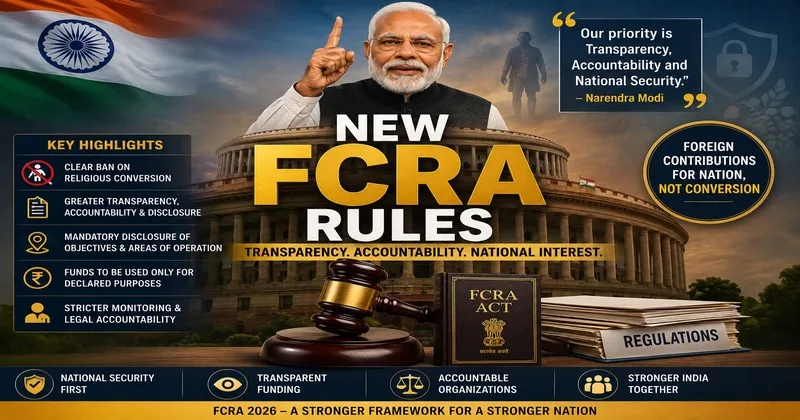
The Government of India has established unprecedented control over the utilization of foreign funds through new amendments made to the Foreign Contribution (Regulation) Act (FCRA). In line with the indications given by Home Minister Amit Shah in Parliament, the most significant aspect of the new rules notified by the Ministry of Home Affairs is that foreign funds can no longer be used for activities related to religious conversion.
For years, allegations- many of which were proven true, had persisted that certain foreign-funded non-governmental organizations (NGOs), religious institutions, and missionary networks were utilizing foreign funds for religious conversion under the guise of social service, education, and healthcare. Following numerous investigations and legal actions, the Central Government has further tightened FCRA regulations, prioritizing transparency, accountability and national security.
It is noteworthy that the Foreign Contribution (Regulation) Act was first enacted in 1976. Its objective was to ensure that funds received from foreign sources did not influence India’s politics, social fabric, or national interests. It was implemented in a revised form in 2010, with significant amendments subsequently made in 2020 and 2026. Under the FCRA, organizations receiving funds from foreign sources are required to register with the Ministry of Home Affairs. This registration is valid for five years, after which it must be renewed.
Greater Transparency Than Before
Commenting on the amended FCRA rules, Rakesh Mittal, National Treasurer of ‘Sewa International’, states, “The amendments introduced by the Central Government in this regard certainly deserve to be welcomed. There will now be greater transparency than before, as applications for registration certificates or new registrations must clearly specify the objectives for which registration is being sought or granted. These objectives must be selected from the list prescribed in the schedule attached to the rules.” According to him, non-governmental organisations (NGOs) will also be required to provide details regarding the states or Union Territories where they intend to carry out their activities. Naturally, this change will bring greater transparency to the system.
Rakesh Mittal stated, “Organisations that already hold FCRA registration must update the objectives specified in their registration and inform the Central Government within one year. The revised rules categorize various activities into distinct groups and impose specific restrictions on political or ideological activities in certain instances. Twenty-two types of activities have been included under educational objectives; however, a stipulation has been added requiring that any awareness programs concerning constitutional rights, fundamental duties and civic responsibilities be of a ‘strictly non-political nature’.”
Numerous sub-categories have been created under the five main categories
According to Mittal, “The 18 categories for cultural objectives include ‘promoting contemporary arts inspired by Indian traditions,’ but with the stipulation that ‘political or ideological content is excluded.’ Sixteen types of activities are permitted under religious objectives. These include religious education, moral instruction, ‘satsang’, discourses, meditation practices (excluding religious conversion) and activities such as the development and maintenance of graveyards and cremation grounds.”
According to the National Treasurer of ‘Sewa International,’ 19 categories have been designated for economic objectives and 30 activities for social objectives. The objective of the amended rules is to make the activities of organizations receiving foreign contributions clearer and more transparent and to restrict them to their stated purposes. He notes that the Central Government has already established five categories for receiving funds under the FCRA: religion, culture, social welfare, education and the economy. All these sub-categories fall under these five main categories.
Rakesh Mittal further explains that the new FCRA rules make it mandatory for all voluntary organizations to declare their objectives and scope of work. Each organization must specify the purpose for which it is receiving foreign funds and the states where those funds will be utilized. Organizations with foreign nationals among their key office-bearers will generally not be granted FCRA registration. The next tranche of foreign funds will be released only after at least 75 percent of the previously received funds has been utilized for the designated purposes. Organizations are required to provide the government with details regarding their social media accounts, websites and publications. Trustees, directors, partners, office-bearers and all key individuals involved in the organization’s operations have now been brought within the ambit of legal accountability.
Clear Ban on Conversion in New Rules
Mittal states, “For the first time, the amended rules define specific categories of religious activities. In these amendments, released late at night on June 22, 2026, the government has permitted activities such as religious education, moral preaching, ‘satsangs’, discourses, meditation camps, the publication of religious literature, the construction of places of worship and the provision of facilities for pilgrims; however, the rules explicitly state that ‘no activity related to religious conversion shall be permitted.’”
Welcoming these reforms, Vishva Hindu Parishad (VHP) national spokesperson Vinod Bansal said, “Reports from investigative agencies and cases registered across various states indicate that conversion activities have often been and continue to be, conducted under the guise of social service rather than through direct religious programs. Attempts are made to establish religious influence through education and scholarship schemes. Outreach is expanded via healthcare services and free medical camps. Poor families are lured with financial assistance and employment opportunities. Religious propagation is carried out through social welfare programs in tribal areas. Religious literature and promotional materials funded by foreign sources are distributed. Naturally, these new rules will help curb religious conversion.”
Objective of the Rules: Making Foreign Funding More Transparent and Accountable
Ramendra Singh, National Secretary of the organization Seva Bharati, stated, citing the Ministry of Home Affairs, that the new rules aim to make the foreign funding system more transparent, accountable and streamlined. The government holds the view that foreign funds should be utilized solely for the specific purpose for which permission was granted. A clear demarcation between religious, social, educational, and cultural activities is essential to prevent any form of illegal or misleading activity.
Ramendra Singh says, “The manner in which the central government has strengthened the monitoring mechanism clearly indicates that, in the coming years, organizations receiving foreign funding will have to operate in a far more transparent and accountable manner than before. FCRA is no longer merely a law for financial regulation; it has evolved into a crucial instrument for national security, social balance and institutional accountability.”
How Many Organisations Have Had Their Licenses Cancelled?
According to Ministry of Home Affairs data, the FCRA registrations of thousands of entities have been cancelled, or their renewal applications rejected, over the past few years. Since 2015, the Government of India has cancelled the FCRA licenses of more than 20,000 (approximately 21,933) non-governmental organisations (NGOs) due to violations of various rules and the failure to file mandatory annual returns. These organizations are no longer permitted to receive funds from abroad.
Several Cases of FCRA-Related Disputes Have Emerged So Far
The case involving the US-based organization ‘Compassion International’ garnered significant attention in India regarding issues of foreign funding and religious conversion. In 2016–17, following a review of the activities of associated Indian organizations, the Ministry of Home Affairs blocked the FCRA renewal for several entities. Consequently, the network’s operations in India effectively ceased.
Similarly, the financial transactions of numerous foreign-funded entities, including World Vision India and Gospel for Asia, also came under scrutiny. Government agencies sought to verify whether foreign funds were utilized in accordance with declared social objectives. These inquiries reinforced the need to further tighten the FCRA regime.
In 2021, the FCRA renewal for the Missionaries of Charity, founded by Mother Teresa, was also temporarily withheld. Although the matter was resolved following the necessary procedures, the incident signaled that no organization would be granted special exemptions regarding compliance with FCRA regulations.
In recent years, concerns have also mounted regarding religious conversion activities in tribal areas. In this context, in June 2026, the Bengaluru police registered a case against the US-based missionary organization ‘The Timothy Initiative’ (TTI) and its associates. According to the Enforcement Directorate, the organization was accused of receiving foreign funds without valid FCRA registration and utilizing them for missionary activities. Investigative agencies claim that the utilization of foreign funds exceeding Rs 92 crore is being probed in this case.
These incidents have underscored the government’s concern that foreign funds must be used solely for declared and approved purposes. Against this backdrop, FCRA regulations have been made progressively stricter and more transparent.
Overall, the 2026 amendments to the FCRA regulations could prove to be a watershed moment for the foreign funding regime in India. For the first time, religious conversion has been explicitly categorized as a prohibited activity and clarity has been established regarding the utilization of funds, organizational objectives, operational scope and the accountability of responsible office-bearers.