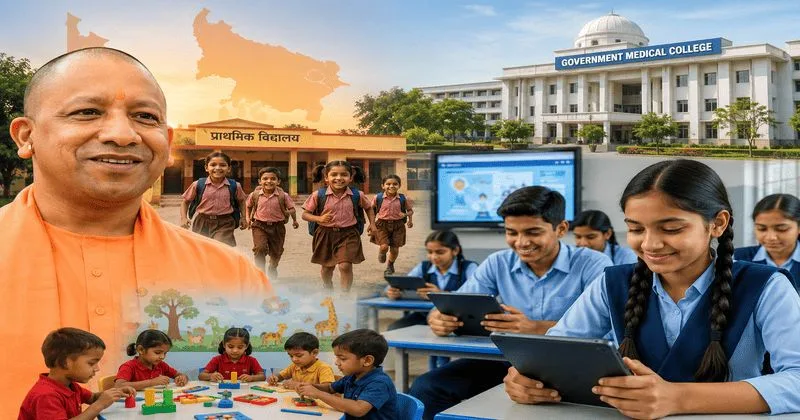
LUCKNOW: When the Yogi Adityanath government assumed office in 2017, Uttar Pradesh’s education sector faced multiple challenges. Thousands of government schools lacked basic infrastructure such as functional toilets, drinking water facilities, electricity connections, boundary walls and adequate furniture. Learning outcomes remained a concern, digital education had limited reach, and access to quality higher and professional education varied significantly across regions.
Over the past nine years, Uttar Pradesh has embarked on an ambitious journey to transform its education ecosystem. Under the leadership of Chief Minister Yogi Adityanath, education has emerged as a key pillar of Uttar Pradesh’s development strategy. The government’s approach has gone beyond increasing enrolment numbers to focus on infrastructure, learning outcomes, technology integration, teacher empowerment, skill development and institutional expansion.
The scale of change is reflected in official figures. More than 1.32 lakh government schools have been upgraded under Operation Kayakalp with an investment of over Rs 11,000 crore. The transformation extends beyond school education. Uttar Pradesh has rapidly expanded medical education infrastructure, increased higher education opportunities, modernised technical institutions, distributed digital devices to students and introduced transparent examination systems. All together, these reforms represent one of the most comprehensive education modernisation efforts undertaken by any Indian state in recent years.
Transforming Government Schools Through Operation Kayakalp
When the Yogi government came to power in 2017, a significant number of government schools lacked basic infrastructure. Operation Kayakalp, launched in 2018, sought to address this challenge through a statewide school modernisation campaign. Operation Kayakalp focused on improving 19 key infrastructure facilities in government schools across Uttar Pradesh. These included functional toilets for boys and girls, clean drinking water, electricity connections, boundary walls, classroom furniture, kitchen sheds for mid-day meals, playgrounds, and various school beautification and safety measures. As a result of this large-scale transformation, nearly 97 per cent of government schools in the state now have access to modern infrastructure.
Project Alankar: Modernising Secondary Education
While Operation Kayakalp focused on primary schools, Project Alankar targeted secondary schools. Under the initiative, 2,295 government secondary schools were upgraded across 27 parameters. Under this transformation drive, schools across Uttar Pradesh have been equipped with modern facilities such as smart classrooms, computer laboratories, Wi-Fi connectivity, science labs, libraries, vocational training centres, CCTV surveillance systems, biometric attendance mechanisms, rainwater harvesting units, and solar energy infrastructure. These initiatives show the government’s evolving approach to education from merely ensuring basic amenities to developing technology-enabled, sustainable, and future-ready institutions that can better prepare students for the demands of the modern world.
Early Childhood Education and NEP 2020 Reforms
The implementation of the National Education Policy (NEP) 2020 has also brought renewed attention to early childhood education in Uttar Pradesh. UP has been working towards integrating pre-primary education with foundational schooling through initiatives such as Bal Vatika and stronger coordination between schools and Anganwadi centres. These efforts go hand-in-hand with NEP’s 5+3+3+4 curricular structure, which recognises the importance of learning during a child’s formative years.
Uttar Pradesh has integrated early childhood education into its school reform agenda by establishing more than 70,000 Bal Vatikas for children aged 3 to 6 years in primary and composite schools across the state. UP has also emerged as a major participant in the PM SHRI Schools initiative launched under the National Education Policy 2020. These schools are being developed as model institutions that are equipped with modern infrastructure, smart classrooms, experiential learning environments and innovative teaching methodologies.
From Schooling to Learning: Mission Prerna and NIPUN Bharat
A major criticism of earlier education policies across India was that they focused heavily on enrolment while paying less attention to actual learning outcomes. Mission Prerna introduced competency-based education and continuous assessment mechanisms in primary schools. The programme focused on ensuring that children acquire age-appropriate literacy and numeracy skills.
According to ASER data, only 6% of UP government school students in Class 3 could read a Class 2-level text in 2014. The figure rose gradually to 12.3% in 2018 and further increased to 16.4% in 2022, making Uttar Pradesh one of the few states that did not register a learning loss in this category following the pandemic. By 2024, the proportion had climbed to 27.9%, indicating not merely a recovery from pandemic-related disruptions but a sustained improvement in foundational literacy and numeracy outcomes.
NIPUN Bharat Mission is another important part. The programme focuses on foundational literacy and numeracy and has now expanded through NIPUN 2.0 to include students from Classes 3 to 5. Teacher training, activity-based learning, regular assessments and academic monitoring have become central components of the initiative.
Digital Learning Revolution
The Yogi government has also prioritised technology-driven education reforms. Over the years, smart classrooms, ICT laboratories, digital learning content and online educational resources have been introduced across schools and higher education institutions.
Under the Swami Vivekananda Yuva Sashaktikaran Yojana (DigiShakti Scheme), around 60 lakh youth have already received smartphones and tablets. In 2026, the state approved the procurement of 25 lakh additional tablets at an estimated cost of around Rs 3,000 crore under the Swami Vivekananda Yuva Sashaktikaran Yojana. The devices are intended for students enrolled in higher education, technical education, diploma programmes, ITIs and skill development courses.
Teacher Recruitment and Empowerment
Teacher shortages had long been a major challenge in Uttar Pradesh’s education system. According to the Uttar Pradesh government, more than 33,400 posts in secondary education, including principals, lecturers and trained graduate teachers, were filled between 2017 and 2022. This large-scale recruitment drive helped fill long-pending vacancies and strengthened subject-specific teaching capacity across schools.
Alongside recruitment, several reforms were introduced to improve transparency and efficiency, including digital attendance systems, online transfer mechanisms, professional training programmes, and technology-enabled classroom support. In recent years, the Yogi government has also placed greater emphasis on teacher welfare and healthcare support with the aim of improving working conditions and enhancing the overall quality of education.
Expansion of Higher Education
Higher education has expanded considerably since 2017. New universities, degree colleges and specialised institutions have been established across various districts, improving access for students in underserved regions. The implementation of the National Education Policy (NEP) 2020 has further accelerated reforms. It has reduced regional disparities and increased opportunities for students from rural and semi-urban areas to pursue higher studies closer to home.
Alongside expansion, universities and higher education institutions have increasingly emphasised innovation, entrepreneurship and research. Startup incubation centres, innovation hubs and industry-academia collaborations are helping create pathways for students to participate in Uttar Pradesh’s growing startup and technology ecosystem.
Medical Education
In 2017, Uttar Pradesh had only 12 to 17 government medical colleges. Today, the number has increased to 48 government medical colleges, alongside 36 private medical colleges. The state has also witnessed a substantial increase in MBBS and postgraduate medical seats.
The expansion has continued. For the 2025-26 academic session alone, the state approved an additional 950 MBBS seats and 271 postgraduate seats, taking the total MBBS intake to approximately 12,800 seats and postgraduate intake to 4,297 seats.
Strengthening Skill and Technical Education
To improve employability among youth, the Yogi government has modernised Industrial Training Institutes (ITIs), polytechnics and vocational training centres. Digital infrastructure, industry-linked curricula, upgraded laboratories and skill-based learning programmes have been introduced to better align education with labour market requirements. The objective has been to align education with the requirements of industry and emerging technologies while creating a skilled workforce for the state’s rapidly growing economy.
Empowering Girls Through Education
A major component of Uttar Pradesh’s educational transformation has been the emphasis on girls’ education. The Yogi government has strengthened residential educational facilities through Kasturba Gandhi Balika Vidyalayas (KGBVs). Today, Uttar Pradesh has 746 KGBVs catering to girls from disadvantaged backgrounds. These institutions have been equipped with smart classrooms, ICT laboratories, digital learning tools and modern educational facilities.
Various scholarship programmes and welfare initiatives have also contributed to improving educational access for girls. The Mukhyamantri Kanya Sumangala Yojana has encouraged continued schooling by providing financial assistance at different stages of a girl’s life.
Under Operation Kayakalp, separate toilets for girls and enhanced safety measures are provided which has further contributed to reducing dropout rates.
Transparent Examination System and Anti-Copying Measures
One of the major governance reforms has been the strengthening of examination integrity. Uttar Pradesh has adopted strict anti-copying measures, CCTV surveillance, digital monitoring systems and enhanced security protocols for board and recruitment examinations. These reforms have significantly improved transparency and public confidence in the examination process. For the 2025, UP Board examinations, nearly 2.5 lakh CCTV cameras were deployed across more than 8,100 examination centres, with live feeds monitored through state and district-level control rooms. The state also implemented the Uttar Pradesh Public Examination (Prevention of Unfair Means) Act, 2024, aimed at curbing cheating and examination malpractice.
Scholarships and Inclusive Growth
The Yogi government has consistently emphasised inclusive growth through education. Large numbers of students belonging to Scheduled Castes, Scheduled Tribes, Other Backward Classes, minority communities and economically weaker sections have benefited from scholarship programmes and financial assistance schemes.
These initiatives seek to ensure that economic constraints do not become barriers to education. Direct Benefit Transfer (DBT) mechanisms have improved transparency and reduced delays in scholarship disbursement. As of March 2026, nearly 28 lakh students received Rs 3,350 crore in scholarships and fee reimbursements through Direct Benefit Transfer (DBT) under various government schemes.
A Comparison with the Pre-2017 Scenario
The transformation becomes clearer when viewed against the backdrop of the pre-2017 education landscape.
Before 2017
- Large numbers of government schools lacked basic infrastructure.
- Learning outcomes remained a major concern.
- Digital learning had limited reach.
- Medical education opportunities were comparatively restricted.
- Examination-related irregularities frequently attracted public attention.
- Skill development infrastructure required substantial modernisation.
Since 2017
- Mission Prerna and NIPUN Bharat have prioritised foundational learning.
- Around 60 lakh students have received smartphones and tablets.
- Government medical colleges have increased from 12-17 to 48.
- Examination systems have become more technology-driven and transparent.
- ITIs, polytechnics and vocational institutions have undergone extensive modernisation.
While challenges remain, Uttar Pradesh’s education sector has witnessed a structural transformation over the past nine years. The focus has shifted from merely improving access to building a technology-enabled, learning-oriented and future-ready education ecosystem. From modernising more than 1.32 lakh schools and expanding medical education to empowering students through digital access and strengthening foundational learning, the reforms have touched nearly every level of the education system.
As Uttar Pradesh advances towards its trillion-dollar economic vision, education is expected to play a central role in creating a skilled workforce, fostering innovation and improving social mobility.