China's Economic Crisis Reaches the Bureaucracy
June 26, 2026
  • Read Ecopy
  • Circulation
  • Advertise
  • Careers
  • About Us
  • Contact Us
Android AppiPhone AppArattai
Organiser
  • ‌
  • Bharat
    • Assam
    • Bihar
    • Chhattisgarh
    • Jharkhand
    • Maharashtra
    • View All States
  • World
    • Asia
    • Europe
    • North America
    • South America
    • Africa
    • Australia
  • Editorial
  • International
  • Opinion
  • RSS @ 100
  • More
    • Op Sindoor
    • Analysis
    • Sports
    • Defence
    • Politics
    • Business
    • Economy
    • Culture
    • Special Report
    • Sci & Tech
    • Entertainment
    • G20
    • Azadi Ka Amrit Mahotsav
    • Vocal4Local
    • Web Stories
    • Education
    • Employment
    • Books
    • Interviews
    • Travel
    • Law
    • Health
    • Obituary
  • Subscribe
    • Subscribe Print Edition
    • Subscribe Ecopy
    • Read Ecopy
  • ‌
  • Bharat
    • Assam
    • Bihar
    • Chhattisgarh
    • Jharkhand
    • Maharashtra
    • View All States
  • World
    • Asia
    • Europe
    • North America
    • South America
    • Africa
    • Australia
  • Editorial
  • International
  • Opinion
  • RSS @ 100
  • More
    • Op Sindoor
    • Analysis
    • Sports
    • Defence
    • Politics
    • Business
    • Economy
    • Culture
    • Special Report
    • Sci & Tech
    • Entertainment
    • G20
    • Azadi Ka Amrit Mahotsav
    • Vocal4Local
    • Web Stories
    • Education
    • Employment
    • Books
    • Interviews
    • Travel
    • Law
    • Health
    • Obituary
  • Subscribe
    • Subscribe Print Edition
    • Subscribe Ecopy
    • Read Ecopy
Organiser
  • Home
  • Bharat
  • World
  • Operation Sindoor
  • Editorial
  • Analysis
  • Opinion
  • Culture
  • Defence
  • International Edition
  • RSS @ 100
  • Magazine
  • Read Ecopy
Home International Edition News

China’s Economic Crisis Reaches the Bureaucracy: Beijing downgrades officials amid debt and fiscal strain

China's fiscal crisis is no longer confined to balance sheets. As debt mounts and economic pressures intensify, Beijing has begun reshaping its own bureaucracy, exposing the growing strain on the country's governance model

Dr Vishnu AravindDr Vishnu Aravind
Jun 26, 2026, 07:00 am IST
in News, World, China, International Edition
Follow on Google News
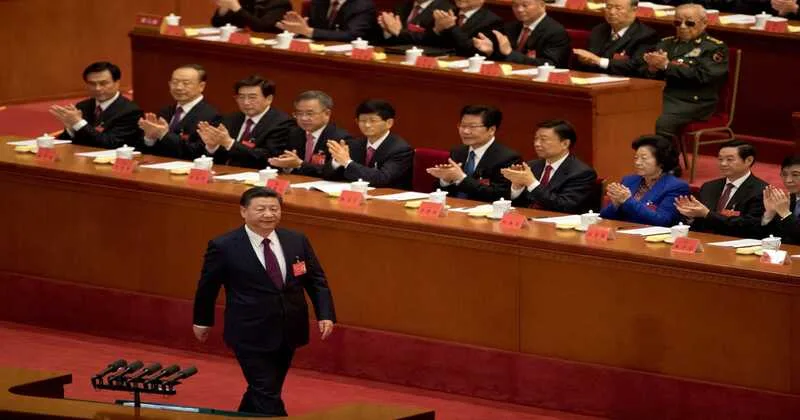
Mounting debt and shrinking revenues are forcing Beijing to rethink the size and structure of its sprawling bureaucracy

Mounting debt and shrinking revenues are forcing Beijing to rethink the size and structure of its sprawling bureaucracy

FacebookTwitterWhatsAppTelegramEmail

China’s mounting fiscal pressures have reached the heart of its vast administrative machinery, as authorities in several cities have begun downgrading the official status of internal government departments and officials in a move that has fuelled debate over the sustainability of the Chinese Communist Party’s (CCP) sprawling bureaucracy.

In recent weeks, local governments across eastern Jiangsu Province have replaced the designation of “division-level” offices with “section-level” offices, while officials previously known as “division chiefs” and “deputy division chiefs” have been redesignated as “section chiefs” and “deputy section chiefs.” Within China’s bureaucratic hierarchy, the changes represent a formal downgrade in administrative status. The adjustments have already been introduced in the cities of Huai’an, Wuxi and Nantong, according to reports by the Chinese state-owned newspaper The Paper.

Although the CCP has presented the exercise as a routine standardisation of administrative terminology, insiders have interpreted the changes as part of Beijing’s broader attempt to curb the continuous expansion of the state bureaucracy and contain personnel-related expenditure at a time when local governments are grappling with severe financial strain.

Read More: Lucknow Coaching Fire: UP CM Yogi Adityanath orders statewide fire safety audit, forms special teams across districts

For years, the number of government employees at the local level has steadily expanded. However, weakening government revenues have made the growing administrative apparatus increasingly difficult to sustain. With tens of millions of people dependent on state finances, Beijing has reportedly become dissatisfied with the inability of many local governments to curb staffing despite repeated instructions to tighten expenditure.

Reports say that the downgrading of titles could represent the first stage of a longer-term restructuring programme, potentially paving the way for reductions in administrative posts and compensation while simultaneously reinforcing central control over local administrations.

Administrative downgrades signal deeper structural pressures

The most detailed announcement came through a notice issued on June 17 by the Huai’an Municipal Bureau of Commerce, which stated that every internal department previously classified as a “division” had been redesignated as a “section” in accordance with unified regulatory requirements.

Departments including the General Affairs Division, Finance Division and Market Development Division were all renamed as sections. The notice further clarified that, because of the administrative reclassification, the corresponding titles of division chief and deputy division chief had been automatically removed without requiring separate dismissal notices.

A similar notice was issued on June 15 by the Nantong Municipal Transportation Bureau, which explained that the restructuring had been carried out in line with requirements issued by the city’s staffing and institutional management authorities.

Although the changes currently affect only administrative nomenclature rather than organisational functions, observers believe they may foreshadow a broader effort to streamline government structures. According to insiders, Beijing appears to be applying pressure gradually, first by reducing the rank attached to official titles before potentially moving towards structural consolidation and workforce reductions.

The exercise also reflects growing concern within the CCP leadership over the unchecked expansion of local government staffing. While municipalities had previously been instructed to reduce expenditure and limit personnel growth, many failed to respond meaningfully. The current downgrades are therefore viewed as an instrument for imposing tighter discipline from the centre.

Beyond financial considerations, analysts argue that the changes also strengthen Beijing’s political oversight by reducing the autonomy and prestige traditionally associated with local bureaucratic offices.

Oversized bureaucracy under growing financial strain

The renaming exercise has also drawn renewed attention to the extraordinary size of China’s administrative system.

According to estimates published by Chinese news portal NetEase, a typical medium-sized Chinese city may employ approximately 1,200 officials holding division-level rank across Party and government agencies alone. When subordinate agencies, public institutions and state-owned enterprises are included, that figure rises to between 1,500 and 1,850 officials.

The number of section-level officials is substantially larger. Estimates indicate that a prefecture-level city may have between 5,800 and 12,500 section-level cadres within government agencies, while the overall number exceeds 11,000 after accounting for affiliated institutions and state-owned companies.

The scale of this bureaucracy has become increasingly controversial as local governments confront declining land-sale revenues, rising debt burdens and slowing economic growth, all of which have significantly weakened local fiscal capacity.

For many years, the designation of “division chief” carried not only administrative significance but also considerable symbolic value. Within official circles, the title projected greater authority, while externally it conveyed influence during investment promotion activities, government meetings and official receptions.

According to the reports, the terminology itself gradually became a symbol of prestige. By replacing division chiefs with section chiefs, authorities are stripping away part of that accumulated status and reducing the appearance of administrative hierarchy that had developed over time.

Although the changes may appear technical on the surface, they have reignited wider debate over whether China’s government payroll system remains financially sustainable. The administrative downgrades increasingly reflect the intersection of local government debt, collapsing land-sale revenues, slowing economic growth, an oversized bureaucracy and Beijing’s determination to tighten its grip over local administrations as broader economic pressures continue to weigh on the Chinese system.


Topics: ChinaChinese Communist PartyEconomic Crisis
ShareTweetSendShareSend
✮ Subscribe Organiser YouTube Channel. ✮
✮ Join Organiser's WhatsApp channel for Nationalist views beyond the news. ✮
Previous News

ED raids Karnataka Excise Dept officials: Rs 13.3 Cr seized, Minister Satish Jarkiholi’s brother-in-law under scanner

Related News

History of Venezuela Earthquakes: How the oil rich nation remains engulfed in natural, political, economic & crises

Chinese President Xi Jinping

China Back to Mao Era? Xi unveils new doctrine of party supremacy over state and people

Yoga Day celebrations in Shanghai, China

International Yoga Day: Global celebrations echo the message of health, well-being and timeless ancient Indian wisdom

UK retailers demand tougher curbs on Chinese online giants amid deepening EU–Beijing trade rift

Prestige Denim Mills' $20 million project marks India's industrial entry into one of Africa's fastest-growing textile hubs

India enters Egypt’s textile battlefield, challenging Chinese, Turkish and Pakistani dominance in Africa

In China's strategic map of threats, geography continues to give India a significance that cannot be overlooked

The Rival China Cannot Ignore: Why India matters more than Beijing admits

Load More

Latest News

Mounting debt and shrinking revenues are forcing Beijing to rethink the size and structure of its sprawling bureaucracy

China’s Economic Crisis Reaches the Bureaucracy: Beijing downgrades officials amid debt and fiscal strain

Y.D. Manjunath, Additional Excise Commissioner and brother-in-law of Karnataka PWD Minister Satish Jarkiholi

ED raids Karnataka Excise Dept officials: Rs 13.3 Cr seized, Minister Satish Jarkiholi’s brother-in-law under scanner

Former -DMK Minister EV Velu (File Photo)

Tamil Nadu: Anti-graft agency raids 13 locations linked to ex-DMK Minister EV Velu over alleged contract irregularities

Government introduces AIR SUVIDHA portal following WHO Ebola emergency for international travellers

The Emergency: India’s darkest chapter, the struggle for democracy and the ban on the RSS

Exposing Western Media’s Climate Hypocrisy: When Europe burns it’s just weather, When India heats up it’s a crisis

Rahul Gandhi’s 2018 Panama Papers Remark: Congress leader apologetic in MP High Court, but political fallout continues

UP Govt orders audit of various coaching centres that are illegally constructed

Lucknow Coaching Fire: UP CM Yogi Adityanath orders statewide fire safety audit, forms special teams across districts

India’s education debate needs clarity, not noise

Scuffle at the Tiruvananthapuram Municipal Corporation on June 25

Keralam: Nine BJP councillors injured as CPM protest demanding Mayor’s resignation turns violent at Thiruvananthapuram

Load More
  • Privacy
  • Terms
  • Cookie Policy
  • Refund and Cancellation
  • Delivery and Shipping

© Bharat Prakashan (Delhi) Limited.
Tech-enabled by Ananthapuri Technologies

  • Home
  • Search Organiser
  • Bharat
    • Assam
    • Bihar
    • Chhattisgarh
    • Jharkhand
    • Maharashtra
    • View All States
  • World
    • Asia
    • Africa
    • North America
    • South America
    • Europe
    • Australia
  • Editorial
  • Operation Sindoor
  • Opinion
  • Analysis
  • Defence
  • Culture
  • Sports
  • Business
  • RSS @ 100
  • Entertainment
  • More ..
    • Sci & Tech
    • Vocal4Local
    • Special Report
    • Education
    • Employment
    • Books
    • Interviews
    • Travel
    • Health
    • Politics
    • Law
    • Economy
    • Obituary
  • Subscribe Magazine
  • Read Ecopy
  • Advertise
  • Circulation
  • Careers
  • About Us
  • Contact Us
  • Policies & Terms
    • Privacy Policy
    • Cookie Policy
    • Refund and Cancellation
    • Terms of Use

© Bharat Prakashan (Delhi) Limited.
Tech-enabled by Ananthapuri Technologies