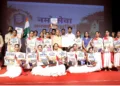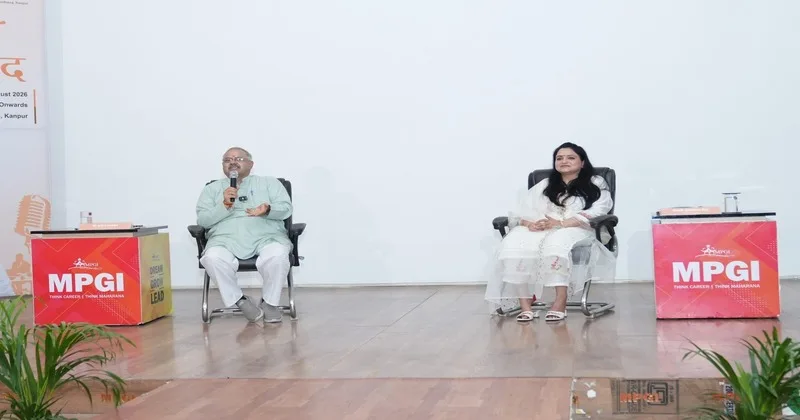
NEW DELHI: When the British education policy came to Bharat, it issued orders that disrupted our traditional education system and way of thinking. Despite this, after completing their education, a spirit to do something for the country emerged among the youth. Young people became associated with the Anushilan Samiti and became active in the National Congress in Nagpur. A clear thought emerged in their minds that Bharat was different from other countries of the world, which were generally formed on the basis of language, said Sunil Ambekar, RSS Akhil Bharatiya Prachar Parmukh while addressing a youth dialogue programme, organised at the N-Block Auditorium located on the Maharana Pratap Group of Institutions campus on the occasion of the centenary year of the Rashtriya Swayamsevak Sangh (RSS).
During the programme, RSS Akhil Bharatiya Prachar Pramukh Shri Sunil Ambekar Ji directly interacted with the youth, answered their questions and inspired them to play an active role in nation-building.
He said that the Sangh was established with the objective that the movement for the independence of the country should continue uninterrupted. The fundamental idea of the Sangh has been that the activity and understanding of society are most important. We need such youth who can come forward themselves and take responsibility. The creation of any nation or ideology requires immense dedication and devotion.
Ambekar Ji said that the identity of a good person is that he works not only for himself but also for the welfare of society. Whatever strength and resources the Sangh had, they were fully devoted to the welfare of society. Although obstacles such as bans also came due to political reasons, the path of national service did not stop. During student movements, the youth clearly conveyed the message that such politics would not continue. During the Emergency and times of crisis, democracy was restored in Bharat within nineteen months, in which the Sangh played an important role. “Who are we? We are those who think about the culture and welfare of the entire world. We are proud of our Bharat and our ancestors that they never did anything for which we had to go to other countries and apologise.”
He said that the meaning of Dharma goes beyond any narrow framework and means accepting the ‘universal rule’ and ‘service from the self’. In the Sangh, exercises for the mind and self-management are practised every day. If an individual has good control and management over himself, he can achieve anything in life. For the smooth governance of the country and the creation of its future, we need dedicated teachers, doctors and skilled citizens in every field. If you are a student, your sadhana begins with education itself. Whatever work you are doing must be performed with complete dedication and quality.
Ambekar Ji called upon the youth to go out and work in villages and at the grassroots level so that they could gain practical experience. This develops a deep understanding of national governance and leadership. For example, in camps in Maharashtra, different rooms were named after Alluri Sitarama Raju and Ram Ji, where people speaking different languages came together and sang songs. There is a narrow vision that confines an individual, whereas a broader vision inspires us to move beyond our own boundaries and see the entire country. The Sangh provides this broad national outlook.
He said that today’s youth is very active on digital and social media platforms, but their activity should not remain limited to the screen. The youth should take interest in good subjects and connect with people who are doing positive work in society. It is necessary to participate in the Sangh’s programmes of two days, three days or two hours and come out of the cage of one’s own limitations.
He called upon the youth to resolve to see some good things and think positively every day. Changing one’s nature may certainly be difficult, but it is not impossible. Highlighting the issue of ‘brain drain’, he said that if we want to give the world an Indian perspective, we must remain connected to our roots. Today’s youth believes in Bharat and considers saying ‘Bharat Mata Ki Jai’ a matter of pride and being ‘cool’. The youth is positive, wants to work in a constructive manner and has faith in the Constitution of India.
At the conclusion of his address, he said that while the influence of Western civilisation is increasing on one hand, the challenge is how we connect our Sanskrit language, national language and cultural heritage with modern technology. With the new energy of youth above 18 years of age, we will create a new Bharat and a new model of the economy. On reservation and social harmony, the thinking is absolutely clear that the welfare and development of every section should be the primary objective of the nation.
The programme was presided over by Ms. Bhuvanpriya Ji, Managing Director of Maharana Pratap Group of Institutions. In her presidential address, she said that today’s youth have an important responsibility towards society and the nation. She called upon the youth to understand their duties and responsibilities along with their rights and contribute to nation-building through education, discipline, values and social participation.
The programme began with the collective singing of Vande Mataram and concluded with the national anthem. The programme was conducted by Mayank Shukla.
On the occasion, RSS Kshetra Karyavah of Eastern Uttar Pradesh Anil Srivastava Ji, Sah Kshetra Prachar Pramukh of Eastern Uttar Pradesh Manojkant Ji, Sah Prant Pracharak of Kanpur Prant Muneesh Ji, Kanpur Prant Karyavah Shri Ramkesh Ji, Director of Maharana Pratap Group of Institutions Dr. Vivek Kumar Singh Ji, Director Dr. Shivani Kapoor Ji, Vibhag Pracharak Barrister Ji and Kanpur West Karyavah Sameer Ji, among others, were present along with a large number of teachers, staff members and students.