As India marks fifty years since the Emergency, remembrance must rise above partisan triumphalism and political score-settling. The Emergency is not merely the history of one government, one party or one political movement. It is part of the constitutional history of the Republic itself. Its lessons belong equally to supporters and critics of every political persuasion.
The true significance of the Emergency lies in what it revealed about democracy. It demonstrated how fragile freedom can become when power is concentrated, institutions become compliant, and dissent is treated as an obstacle rather than a democratic necessity. The constitutional framework survived, but many of the assumptions that citizens held about the permanence of liberty were profoundly shaken.
Yet the Emergency also revealed something equally important. It exposed not merely the vulnerability of Indian democracy but its extraordinary resilience. Across prisons, courtrooms, university campuses, newspaper offices and countless ordinary homes, Indians refused to accept that freedom was a gift that could be withdrawn at the discretion of the State. Socialists, Gandhians, journalists, student activists, lawyers, political workers and swayamsevaks stood on the same side of a larger constitutional struggle. Their ideological differences remained, but their commitment to liberty proved stronger.
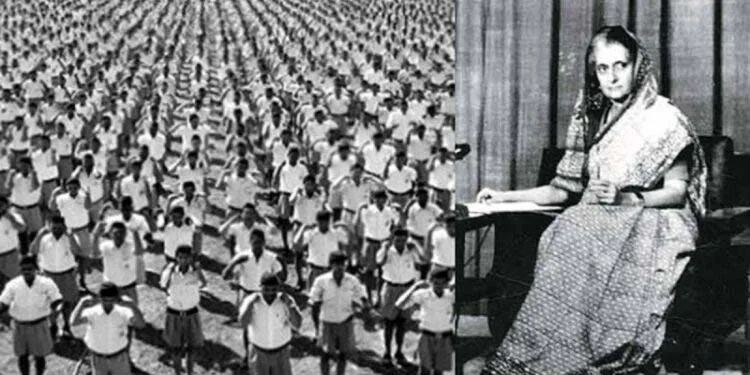
The role played by the Rashtriya Swayamsevak Sangh during this period deserves recognition within this broader democratic narrative. Thousands of swayamsevaks faced arrest, organisational networks were disrupted by the ban imposed on the RSS, and many volunteers became active participants in underground resistance efforts. Their contribution formed an important part of a wider national movement that sought not political advantage but the restoration of democratic freedoms. The struggle against the Emergency remains a reminder that the defence of liberty is most effective when it transcends ideological boundaries.
Ultimately, the most decisive verdict on the Emergency came neither from historians nor from constitutional experts. It came from the people of India. In the general election of 1977, voters accomplished through the ballot box what countless authoritarian regimes throughout history had sought to prevent. They peacefully removed a government that appeared politically invincible and reaffirmed a principle that lies at the heart of democratic civilisation: power belongs to the people and remains answerable to them.
Fifty years later, the greatest lesson of the Emergency is not that democracy is invulnerable. Democracies can weaken. Institutions can fail. Rights can be curtailed. Constitutional safeguards can be tested. The enduring lesson is something far more hopeful. Democracy survives when citizens refuse to surrender it.
The prisons have long since emptied. The censorship orders have faded into archives. The personalities who dominated that era belong to history. Yet the warning of 1975 remains relevant to every generation. Freedom rarely disappears in a single dramatic act. More often, it recedes gradually—one institution at a time, one compromise at a time, one silence at a time.
The men and women who resisted the Emergency understood this truth. Some paid with imprisonment, others with the loss of careers, and many with years of uncertainty and sacrifice. Their courage ensured that India’s longest democratic night did not become a permanent darkness.
If the Emergency was the Republic’s darkest hour, the democratic awakening that followed was among its finest moments. The lesson endures after fifty years: liberty survives not because power is always restrained, but because free citizens remain determined to restrain it. In the end, it was not authority that prevailed. It was freedom.