Venezuela, the richest oil reservoir of the world that has the potential to be one among the energy superpowers of the globe. However, this South American country is historically haunted with a steep economic and political crisis, coupled with recurring natural disasters that further mounts the toll. The latest massive earthquake that rocked Venezuela, has resurfaced the catastrophe-ridden chapters of its history, which is dominated by the dark scars of natural disasters, economic fissures and political upheavals.
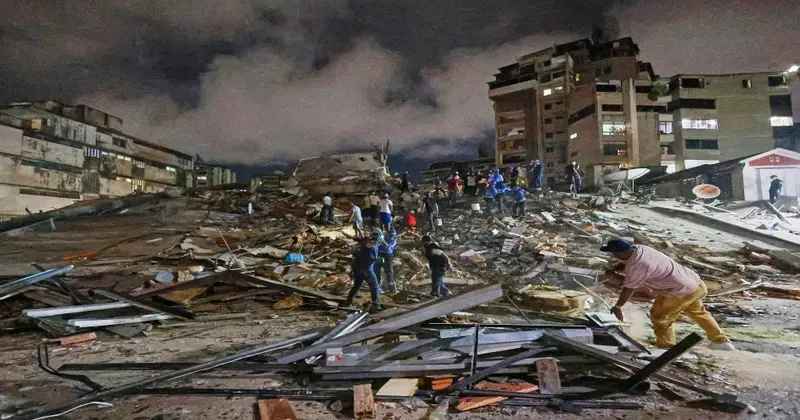
On the evening of June 24, within a span of a few seconds two strong earthquakes rocked Venezuela, causing a massive toll. Most provinces of the country have been devastated, with humungous buildings in the capital city of Caracas, falling into ruins within seconds. As per the US Geological Survey, the first earthquake of 7.1 magnitude had its epicentre off the Caribbean coast in Venezuela and the second earthquake had magnitude 7.5. “People evacuated swaying buildings in Caracas and remained outside, many visibly shocked as they saw entire walls that had collapsed”, reported local media sources.
These intense earthquakes are said to be the strongest tremors in Venezuela since 1900, thus has triggered huge casualties and human toll. As per the latest updates, more than 32 people have died and at least 700 have been severely injured. The acting President of Venezuela, Delcy Rodríguez, has declared a state of emergency vowing to the massive damage caused by the earthquake. As the rescue operations are underway, humanitarian assistance flows into Venezuela from the neighbouring countries. The earthquakes have damaged the International Airport near Caracas, the country’s main airport. Schools are also closed for several days and the school buildings will be used as shelters, rehabilitation and donation centers.
This massive earthquake, which is the most intense in more than a century, has further mounted the pressure or burden on the South American country of Venezuela, which is hitherto entangled in an economic and political crisis. The earthquake also reopened the dark chapters of Venezuela, demonstrating how historically recurring political, economic and natural disasters are interconnected in causing sheer burden on the crisis-hit nation.
History of horrific earthquakes jolting Venezuela & impacting the political destiny
Venezuela, sits on a very fragile geographic location. Between the Caribbean Sea and the Atlantic Ocean. This vulnerable geography and landscape stimulate repeated powerful earthquakes, thus devastating the country. For example, in 1812, a strong earthquake of 7.5 to 7.7 magnitude hit Venezuela. It ruptured the majority of the country, including the capital city of Caracas. This earthquake hit the country during Venezuela’s War of Independence, which was fought between Spanish Royalist Forces and Republics. Venezuela under the Caracas junta was fighting against Spanish Royal Forces.
However, the strong earthquake during the war destroyed key military, logistics and administrative hubs of Venezuela. Thus, the Spanish forces gained upper hand and Caracas suffered from economic toll, weak military coordination, logistical crunch etc. This is how, historically, the political destiny of Venezuela is repeatedly dominated by its recurring natural disasters.
Similarly, in 1900 a strong earthquake of similar magnitude hit Venezuela, causing extensive damage. Similarly, in 1967, another massive earthquake rocked the country leading to the collapse of huge buildings and the death of more than 200 people. Post this disaster, Venezuela upgraded its building architecture and standards to sustain against natural disasters. Building codes were strengthened, seismic design standards were upgraded and structural designs were reviewed from time to time.
However, engineering and scientific strengths could not halt geographical realities. Again in 1997, Cariaco earthquake hit the country and killed dozens of people, illustrating visible ruptures. In 1999, yet again, a heavy downpour triggered powerful landslides and floods along Venezuela’s northern coast, killing tens of thousands of people. This is one of the deadliest disasters in modern Latin American history. It hit the country, when Caracas was on the verge of holding a referendum for a new constitution. This, yet again illustrates how political destiny is defined by natural disasters in Venezuela.
This disaster, infact, gave the new Hugo Chávez government an opportunity to further consolidate authoritarianism by imposing emergency powers and the armed forces running relief efforts emerged as a significant picture. This history of 1812, 1900 and 1999 has yet again repeated today, with a high-intensity earthquake, massive devastation coupled with political upheavals. The President of Venezuela Nicolas Maduro remains under the custody of President Trump in the United States. The interim President is ruling and a steep economic crisis is echoing the fragility of Venezuela. The earthquake has further deepened the faultlines, as a state emergency has been imposed.
Earthquake exposes the economic crisis of Venezuela
The latest massive earthquake has further mounted pressure on the hitherto economic crisis that has engulfed Venezuela. The nationwide state of emergency has brought economic activities to halt. The main airport of the country is closed, thus straining the key lifeline for economic activity. Hospitals are flooded with patients, thus treatment, rehabilitation and reconstruction efforts causing additional burden on the hitherto drained exchequer. Power outrages and network disruptions have curtailed the oil production capacity, yet another fissure on the fragile economy.
Venezuela is said to have one of the worst economic crises in modern history. The country is grappling with hyperinflation at 611.8 per cent. GDP rate is drastically depleting and more than 70 per cent of the country is reeling under acute poverty. The public debt of Venezuela is around USD 250 billion, which is double the GDP. More than 8 million people have fled the country, unable to bear the multipronged crisis. The interim government is aiming for debt restructuring and regaining access to international markets.However, it is said to be difficult amid unsustainable & weak oil exports and limited fiscal resources coupled with unstable government apparatus.
The recent massive earthquake has thus further derailed economic activities. The recovery, rehabilitation and reconstruction efforts are also difficult due to the mounting economic crisis. Indeed, a double edge sword for Caracas. Thus, natural disasters, triple digit inflation, political corruption, authoritarianism and unstable governments, paralysed oil production and exports despite vast potential, are the recurring features of Venezuela. Natural disasters are severely impacting the political and economic fate of Venezuela, the steep economic crisis and political instability of Caracas are further complicating the strain imposed by the natural disasters!