
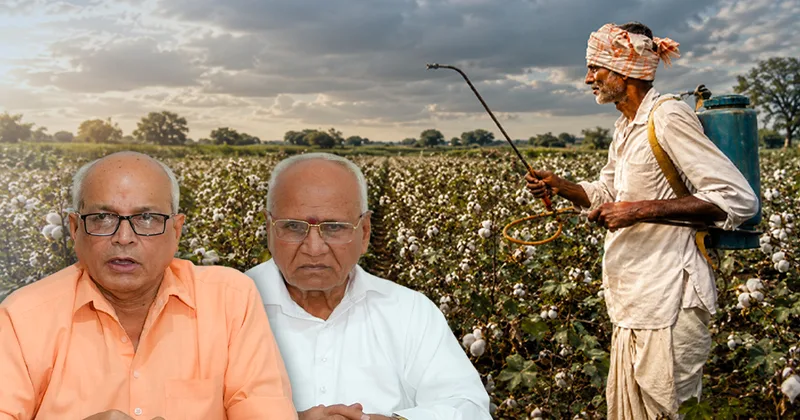
NEW DELHI: The Bharatiya Kisan Sangh (BKS) held a press conference on June 23 in which its leaders expressed grave concern over massive decline in cotton cultivation and production in Bharat owing to the usage of BT Cotton.
While speaking to media, Bharatiya Kisan Sangha National General Secretary Mohini Mohan stated that the primary reason for the crisis was owing to the widespread adoption of genetically modified BT Cotton.
Mohini Mohan Mishra stated that he had written a letter to Union Agriculture and Farmers’ Welfare Minister Shivraj Singh Chouhan in which he had urged the Centre to take swift corrective measures, including the de-notification of BT Cotton varieties BG-I and BG-II and a complete prohibition on genetically modified (GM) crops in the country.
He further added that the copy of the letter was sent to the Union Minister for Environment, Forest and Climate Change Bhupender Yadav so that appropriate action could be taken
Mohini Mohan Mishra ji stated that it is essential to effectively combat the false narrative that is being propagated by the proponents of GM crops regarding the benefits of BT Cotton. He informed the media that the ground reality is different and farmers across the country are facing the brunt of using BT cotton
BKS has categorically stated that BT Cotton was never a high-yielding variety and had failed to achieve its primary objective of effectively controlling the pink bollworm, the pest for which the technology was originally developed.
Mohini Mohan Mishra ji added that despite several years of cultivation, the pink bollworm has developed resistance, thereby causing extensive damage to the crops and increasing the difficulties of the farmers.
Mohini Mohan Mishra ji also highlighted that the widespread adoption of BT Cotton led to the gradual disappearance of several traditional and indigenous cotton varieties which were more adaptable to India’s diverse agro-climatic conditions. This, the organisation claimed, has contributed to a decline in overall productivity and reduced resilience within the cotton sector.
Calling for a return to indigenous agricultural systems, BKS reiterated that India must revive and promote its high-yielding native cotton varieties and traditional farming practices so as to effectively combat the present challenges in cotton cultivation.
Mohini Mohan Mishra ji informed that it is an admitted fact that BT cotton had failed. To substantiate this point, Mishra ji informed that both Monsanto and India’s Central Institute for Cotton Research have admitted that BT Cotton had failed.
The points highlighted by Monsanto and India’s Central Institute for Cotton Research include:
- The (target of GM technology) main pest (bollworm) is developed resistance.
- New sucking pests have emerged as major pests causing significant economic losses”
- Productivity of BG I and BG II cotton has fallen sharply.
- Pesticide expenditure has gone up increasing cost of production.
- Crop failure of these BG I and BG II pushed farmers under stress to take drastic steps for face saving.
BKS stated that despite BT cotton harming the productivity, the failed seeds were not withdrawn from the market.
In 2014 Mahyco faced a ban in Karnataka for supplying failed seeds that didn’t results in controlling pink bollworm.
Often Maharashtra government compensate their cotton farmers to address their loss.
There BKS demanded that government should immediately take action against the suppliers of failed seeds and compel them to withdraw these seeds from the market immediately or face stringent punishment like ban and jail term of their highest office.
Price Fixation of Cotton Seeds
Putting forward their demand about price fixation about Cotton seeds, BKS stated:
- Government may take suo-moto notice of non-gm cotton seeds with long stapple, yielding better that Bg I and Bg II.
- The price of these non-Gm high yielding varieties now runs around 300 to 400 rupees per packet in the market.
BKS has proposed to the government to incentivise for more non-Gm hybrids cotton seeds development without any traces of Gm materials, their multiplication and distribution with strong check posts
Adopt ICAR approved technique to increase non-Gm cotton production
BKS has proposed to the government to adopt an ICAR approved technology that will help to increase the non-Gm cotton production and help in managing the domestic requirements as well as the exports.
Padma Shri awardee Shrirang Devba Lad from Parbhani, Maharashtra who developed this technique stated that this is a high-density, sustainable farming method that increases cotton yields by up to 300 per cent. It focuses on planting with 3×1-3×1foot spacing, pruning non-fruit-bearing branches (monopodia) around 45–50 days after sowing, and topping to manage height, enhancing nutrient flow for better boll development.