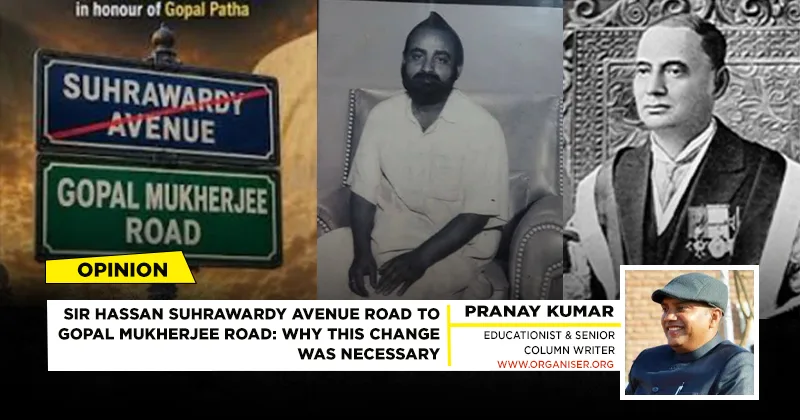
On June 21, the Kolkata Municipal Corporation, on the occasion of West Bengal Day, renamed “Sir Hassan Suhrawardy Avenue” Road as “Gopal Mukherjee Road.” While the Congress, the Trinamool Congress, and Left-liberal intellectuals have argued that the road was named not after “Huseyn Shaheed Suhrawardy” but after his uncle, “Sir Hassan Suhrawardy”, who was a renowned educationist, physician, social worker, and Vice-Chancellor of the University of Calcutta between 1930 and 1934, the majority population of Bengal views this change as a necessary intervention to restore the rightful place and recognition of a great hero, popularly known as “Gopal Patha,” who had been deliberately consigned to oblivion. In reality, the political parties and self-styled intellectuals opposing the renaming of “Suhrawardy Avenue” are, much like in several other historical debates, presenting a selective interpretation of the issue and attempting to draw a veil over the darker aspects of the Suhrawardy legacy. The “Hassan Suhrawardy” whom they tirelessly celebrate as a distinguished educationist, physician, and social reformer cannot be separated from the political legacy and ideological background that he shared with his nephew, “Huseyn Shaheed Suhrawardy.” The two were not only heirs to the same family lineage, but both were leaders of the Muslim League, both nurtured divisive politics, both were ardent supporters of Muhammad Ali Jinnah’s Two-Nation Theory, and neither ever opposed the Muslim League’s demand for a separate nation for Muslims.
In fact, the truth is that “Hassan Suhrawardy” was awarded a knighthood by the British government because, on February 6, 1932, during the convocation ceremony of the University of Calcutta, he deliberately and forcefully prevented the great revolutionary and freedom fighter Bina Das from shooting the then Governor, Stanley Jackson. As Stanley Jackson was delivering his address from the stage, the 21-year-old revolutionary Bina Das rose from her seat, advanced towards the dais, drew a revolver from beneath her academic gown, and fired five shots in quick succession at Jackson. At that very moment, Suhrawardy rushed forward, grabbed Bina Das’s arm, struggled with her, and forced the revolver upwards, causing her aim to miss and thereby saving the life of the British Governor. Although Bina Das had never received any formal training in the use of firearms, her intense patriotism gave her the courage to undertake such a daring act. Naturally, she was sentenced to nine years of rigorous imprisonment for her action. Yet even after her release from prison, her courage remained undiminished. She continued to participate actively in the freedom movement and, significantly, for taking part in the “Quit India Movement” of 1942, she was once again imprisoned in 1945. After Independence, she declined the pension offered to freedom fighters and chose to live the life of an ordinary citizen.
On the very day that the great revolutionary Bina Das was sent to prison for the first time, February 6, 1932, Hassan Suhrawardy was awarded a knighthood for displaying extraordinary loyalty to the British Raj and the colonial establishment. Thereafter, he came to be known as Sir “Hassan Suhrawardy.” So pleased was the British government with this demonstration of loyalty that, in April 1933, it named the road after him as “Suhrawardy Avenue.” Following the renaming of Suhrawardy Avenue, it has also been widely propagated that Suhrawardy returned his title of “Sir” in 1946. This, however, is only a half-truth. The full truth is that, at the call of the Muslim League, he renounced the title in order to secure wider acceptance for the demand for Partition, and not, as is often claimed, as an act of protest against British rule. What is more, Hassan Suhrawardy’s daughter later became Pakistan’s first woman civil servant, represented Pakistan at the United Nations on numerous occasions, and was posthumously honoured with Pakistan’s highest civilian award, the “Nishan-e-Imtiaz.” His nephew went on to become the Prime Minister of Pakistan. This raises an obvious question: Why should any city, road, or building in India bear the name of a person who displayed unwavering loyalty towards the British, played a role in sending a great patriot and revolutionary to prison, supported the Partition of India as a leader of the Muslim League, and envisioned his own future and that of his descendants in a separate nation founded upon a distinct political identity? It is equally worth reflecting upon whether, in Germany, a public square, road, or building could be named after Alois Hitler, the father of Adolf Hitler, who died in 1903 and bore absolutely no responsibility for the atrocities committed by the Nazis. Could such an honour be bestowed upon someone associated with Hitler’s legacy? If not, then why are those responsible for Partition and the massacres that accompanied it still glorified in India? Is it because such questions would peel back the layers of history and expose many faces? Is it because the dark deeds of those who deliberately pushed truly heroic personalities to the margins of history would become widely known? Or is it because those who spent decades polishing and projecting a flattering image of themselves through carefully orchestrated historical narratives fear that the revelation of the truth would permanently stain their reputations?
As for Hassan Suhrawardy’s nephew, “Huseyn Shaheed Suhrawardy”, history records not one but two major massacres under his name. At that time, Bengal was governed by an interim Muslim League administration, and Huseyn Shaheed Suhrawardy served as its Prime Minister, the designation then used for what is now called the Chief Minister. During the Muslim League’s proclaimed “Direct Action Day,” the leadership of events in Bengal rested in his hands. It has been alleged that he deliberately created conditions that facilitated large scale violence against Hindus. Prior to August 16, 1946, of the twenty four police stations in Calcutta, twenty two were placed under Muslim officers and the remaining two under Anglo Indian officers. At the same time, police personnel and government employees were granted a three day public holiday, ensuring that neither the police could reach victims in time nor the administration intervene effectively. Because of the holiday, most people remained in their homes, making them easy targets for the rioters. According to historians and contemporary accounts, Suhrawardy himself was present in the control room at the Lalbazar Police Headquarters during the riots and was preventing even the limited number of police personnel who remained on duty from taking stringent action against the rioters. As a consequence, more than 6,000 Hindus were killed in Calcutta alone, over 17,000 people were injured, and more than 100,000 Hindus were rendered homeless. This was followed by large scale violence in Noakhali, where thousands of Hindus were killed, countless families suffered irreparable losses of life and property, and innumerable mothers and sisters were subjected to inhuman suffering and barbaric atrocities. These events left an indelible mark on the history of pre Partition India, a mark that cannot be forgotten even today.
It is noteworthy that Huseyn Shaheed Suhrawardy later went on to become the Prime Minister of Pakistan from 1956 to 1957. An even more remarkable fact is that the Income Tax Department had assessed an income tax liability of nearly five million rupees against him for the years 1945 to 1946 and 1946 to 1947. However, Prime Minister Jawaharlal Nehru displayed exceptional generosity and trust towards him and, on December 12, 1948, wrote to the then Finance Minister John Mathai and the Chief Minister of West Bengal, Dr. Bidhan Chandra Roy, intervening in the tax recovery and attachment proceedings pending against him. As a result, Suhrawardy left permanently for Pakistan in 1948 without paying any tax.
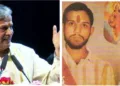
In contrast, when fanatical and extremist rioters, operating under Suhrawardy’s protection, were massacring Hindus on the streets of Calcutta and Noakhali, Jawaharlal Nehru and the Congress leadership of the time were occupied in Delhi with negotiations concerning the transfer of power and other political deliberations. The Hindu community of Bengal felt utterly helpless and abandoned. It was at this critical juncture that Gopal Chandra Mukherjee, popularly known as Gopal Patha, stepped forward to protect the victims. He organised Hindu youths and formed a defence force that mounted an effective resistance against the rioters. Under his leadership, this resistance compelled those involved in violence, looting, and arson to retreat. He not only provided shelter and security to countless people but also thwarted the plans of Jinnah, Suhrawardy, and the Muslim League to bring Calcutta within Pakistan. What is particularly significant is that even amid an atmosphere charged with vengeance and frenzy, Gopal Patha gave clear instructions to his associates that resistance should be directed only against those directly involved in the riots. Women, children, and the elderly were not to be harmed under any circumstances. His response, therefore, was not one of blind retaliation but an organised effort undertaken for the protection of society under extraordinary circumstances.
Indeed, conditions had become so grave that even Mahatma Gandhi, often revered as the apostle of nonviolence, was ultimately compelled to seek Gopal Patha’s assistance. On August 31, 1947, Gandhi was staying at Hyderi Manzil in Beliaghata, Calcutta. On that very night, an angry and violent mob attacked his residence. A few days later, fresh violence erupted in the area, resulting in further loss of life. In these circumstances, Gandhi’s secretary, Nirmal Kumar Bose, contacted Gopal Patha and requested his assistance. Gopal Patha agreed to deploy armed members of his defence force for Gandhi’s protection, provided he received Gandhi’s written consent. He also stipulated that Gandhi himself should ask for the withdrawal of the police and military forces stationed there. Nirmal Kumar Bose has recorded this entire episode in his well known book “My Days with Gandhi.” He further noted that the young men accompanying Gopal Patha did not possess licensed weapons. Nevertheless, Gandhi permitted them to remain responsible for his security because no other practical option was available to him at that time.In the light of all these historical facts and events, the renaming of Suhrawardy Avenue as Gopal Mukherjee Road is not merely a matter of changing the name of a road. It is a question of reassessing a historical memory in which, for a long time, neither the suffering of the victims nor the contributions of their defenders received the recognition they deserved. The roads, memorials, and public institutions of any nation are not merely markers of geography.
They are symbols of a society’s historical consciousness, moral values, and collective memory. It is therefore natural for society to ask, from time to time, whether public honours should be bestowed upon individuals whose legacy is associated with bloodshed, Partition, violence, extremism, and fanaticism, or upon those who risked their lives to protect their communities and society in times of crisis. Viewed from this perspective, the transformation of “Suhrawardy Avenue” into “Gopal Mukherjee Road” is not simply a change of name. It is an attempt to draw a clear distinction between the heroes and villains of history. It is an important step towards making public memory more just, acknowledging historical responsibility, and honouring those individuals who, in the most difficult circumstances, struggled for the protection of their society, its self confidence, and its very existence, and who stood in defence of their identity, dignity, and self respect.