The West Bengal Budget 2026–27 is not merely an annual statement of government finances. It is the first economic blueprint of a newly elected government that has explicitly framed its mission as the restoration of Bengal’s historical economic and intellectual leadership. The budget is therefore best viewed not only as a fiscal document but also as a political economy statement outlining the contours of a new development paradigm.
At its core, the budget attempts to move West Bengal from a predominantly welfare-oriented model toward a developmental state model that combines infrastructure expansion, industrialisation, human capital formation and targeted social protection. Whether this transition succeeds will depend less on announcements and more on implementation capacity, fiscal sustainability and institutional reforms.
The Four Pillars of Growth
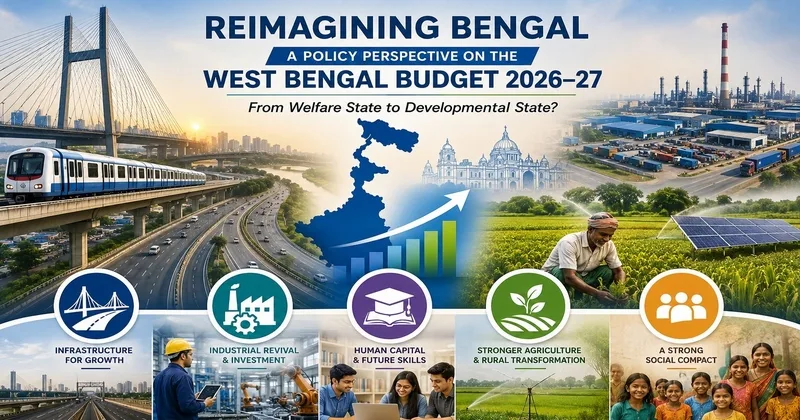
A close reading of the budget reveals four broad strategic pillars. First, the budget prioritises infrastructure-led growth. Major investments have been proposed in transportation networks, logistics infrastructure, bridges, urban mobility and riverine connectivity. The proposed Rs 900 crore New Town Elevated Corridor, the Rs 1,850 crore Dankuni–Mogra Road Corridor, the Rs 800 crore Mayurakshi bridge project, and the proposed Nandigram–Haldia bridge indicate a conscious attempt to address connectivity bottlenecks that have historically increased transaction costs across the state.
From the perspective of New Economic Geography theory, improved connectivity reduces market fragmentation and generates agglomeration effects, encouraging firms to cluster around economic corridors. If executed efficiently, these projects could strengthen Bengal’s integration with eastern India’s supply chains and improve competitiveness vis-à-vis states such as Gujarat, Maharashtra and Tamil Nadu.
Second, the budget seeks to revive industrialisation. The announcement of a West Bengal Investment Promotion Framework, industrial clusters, logistics parks under PM GatiShakti, the Durgapur Industrial Node, and the Dhubulia Industrial Cluster reflects an acknowledgement that sustainable employment generation cannot occur through public expenditure alone.
Perhaps the most significant signal is the recognition that investor confidence requires institutional reform. The proposal to reduce the “cost of doing business” arising from extortion, administrative uncertainty and operational disruptions addresses a long-standing concern of industry. Economic history demonstrates that capital flows not merely to locations offering incentives, but to jurisdictions offering predictability. The success of Gujarat, Karnataka and Telangana over the past two decades has rested largely on institutional credibility rather than subsidies alone.
Third, the budget places unprecedented emphasis on human capital. The proposed recruitment of one lakh government employees, establishment of a Sports University, expansion of medical infrastructure, AI Mission, Content Creator Labs, and annual training of one lakh youth in AVGC-XR (Animation, Visual Effects, Gaming, Comics and Extended Reality) sectors represent investments in future labour markets rather than legacy sectors.
The proposed West Bengal Impact AI Mission is particularly noteworthy. Artificial Intelligence is increasingly becoming a general-purpose technology comparable to electricity or the internet. States that create an early ecosystem for AI adoption are likely to capture disproportionate economic gains in the coming decade. Bengal’s strong educational base and large pool of engineering graduates offer a comparative advantage that has remained underutilised.
Fourth, the budget attempts to strengthen agriculture while promoting diversification. Additional assistance of Rs 3,000 per farmer family over and above PM-KISAN benefits of Rs 6000, electricity subsidy for irrigation, universal crop insurance coverage, promotion of solar irrigation, horticulture exports and climate-resilient agriculture indicate a shift from pure income support toward productivity enhancement.
This is particularly important because agriculture still supports a large share of Bengal’s workforce while contributing a much smaller share of Gross State Domestic Product (GSDP). Structural transformation theory suggests that sustained economic growth requires labour to gradually move from low-productivity agriculture to higher-productivity manufacturing and services. The budget appears conscious of this challenge.
A Strong Social Compact
The budget does not abandon welfare commitments. In fact, it strengthens several social protection measures. The increase in Dearness Allowance to 38 per cent, enhanced support for journalists, emergency detainees, tea garden communities, civil defence volunteers and food security initiatives reflects an effort to maintain political legitimacy during economic transition.
The proposed Rs 500 crore outlay under PM-AJAY for Scheduled Caste development across 1,500–2,000 villages is significant. Likewise, the expansion of Maa Ahar centres and investments in healthcare infrastructure suggest that growth and inclusion are being pursued simultaneously.
From a Keynesian perspective, such expenditure can also support aggregate demand in the short run, especially when private investment remains subdued.
Agriculture and Rural Bengal: The Real Test
The budget’s greatest challenge lies in rural transformation. West Bengal has one of India’s highest population densities and among the smallest average landholdings. Consequently, productivity gains alone cannot ensure substantial income growth. The state’s long-term success depends on developing agro-processing, food logistics, rural enterprises and non-farm employment.
The proposed allocation of Rs 200 crore for the Banglar Udyam Credit Card Scheme, targeting nearly two lakh young entrepreneurs with support of up to Rs 10 lakh each, is therefore potentially transformative. If even a fraction of these enterprises survive and scale, they could become important engines of rural employment.
However, international experience suggests that credit support alone rarely creates successful entrepreneurship. Access to markets, mentorship, technology and business networks will determine outcomes.
The Fiscal Question
Despite its ambitious vision, the budget raises important fiscal questions. Large-scale infrastructure projects, expanded social expenditure, recruitment drives and subsidy commitments will require substantial fiscal resources. Economic theory suggests that developmental expenditure can generate long-term returns if it raises productivity faster than public debt accumulates. However, if revenue growth fails to keep pace with expenditure commitments, fiscal pressures may emerge.
The state’s ability to attract private investment will therefore become critical. Every rupee of public capital expenditure must ideally crowd in multiple rupees of private investment. This multiplier effect will determine whether Bengal experiences a genuine growth acceleration or merely a temporary expenditure-driven expansion.
Why This Budget Matters Beyond Bengal
The significance of this budget extends beyond state boundaries. For decades, Bengal’s economic narrative was dominated by discussions of industrial decline, capital flight and governance constraints. The 2026–27 budget attempts to change that narrative by presenting a framework that combines infrastructure, investment, technology, human capital and welfare.
The emphasis on AI, logistics, industrial corridors, entrepreneurship and regulatory reforms aligns closely with India’s broader aspiration of becoming a developed economy by 2047. If successful, Bengal could emerge as the principal growth engine of eastern India, complementing rather than competing with the industrial ecosystems of western and southern India.
The West Bengal Budget 2026–27 deserves appreciation for its ambition, coherence and willingness to address structural issues rather than relying solely on short-term populism. The document recognises that prosperity cannot be built through welfare transfers alone and that employment generation requires investment, infrastructure, skills and institutional trust. Yet budgets do not transform economies; implementation does.
The future of Bengal will depend on whether the announced corridors are completed on time, whether industrial investors actually arrive, whether the AI Mission moves beyond rhetoric, whether agricultural diversification reaches farmers, and whether governance reforms improve business confidence.
The budget has provided a roadmap. The challenge now is execution. If implemented effectively, this could mark the beginning of Bengal’s transition from a consumption-driven economy to a production-driven one, restoring the state’s historical role as one of India’s foremost centres of economic dynamism and intellectual leadership.