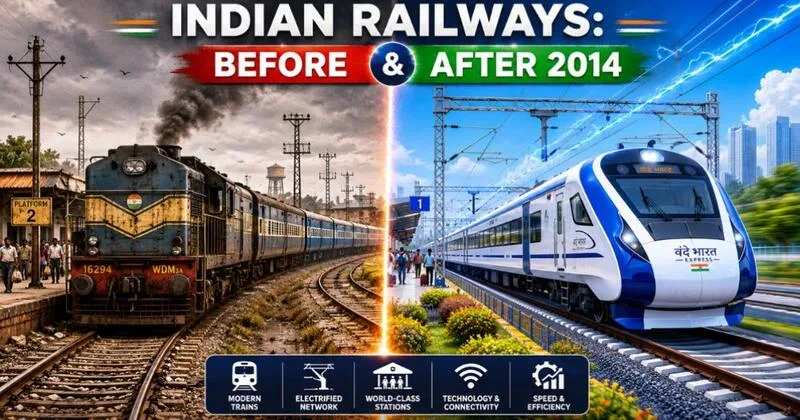
In 1853, a steam locomotive named Falkland hauled 14 carriages and 400 passengers from Bombay to Thane, covering 34 kilometres with the sound of a ceremonial 21-gun salute. Over the next 160 years, that single experimental route grew into one of the world’s largest railway networks, spanning tens of thousands of kilometres, running thousands of trains daily and touching more Indian lives. By 2014, Indian Railways was vast, essential and deeply rooted to remote places, which was structurally overdue for change.
What happened after 2014 is one of the most important infrastructure transformations in Indian modern history. To understand this, one has to look at where the system actually stood. The ambition was always plentiful, but in terms of hard metrics and then comparing it with where it stands today. The electrification, speed, safety, rolling stock, digital systems and capital investment represented incremental progress. It is a story of a system that decided, after decades of deferral, to finally close the gap between what it was and what it needed to be.
Electrification: From One in Five to Nearly Everything
In 2014, only 21,801 route kilometres of India’s broad gauge network had been electrified, roughly 20 per cent of the total. The remaining 80 per cent of trains ran on diesel, which is expensive to operate, polluting and dependent on imported crude oil. For a network of this size, the dependence carried serious economic and environmental consequences.
By March 2026, electrified route kilometres had risen to 69,873, covering 99.6 per cent of the 70,142 km broad gauge network. In twelve years, Indian Railways had electrified more track than it had managed in the previous nine decades combined. The consequences are concrete: in 2024–25 alone, electrification saved approximately 180 crore litres of diesel, reduced crude oil import dependency, and generated savings of around Rs 6,000 crore. Electric traction is roughly 70 per cent more economical than diesel operation. This achievement also repositions India globally. The UK has electrified 39 per cent of its rail network. Russia, 52 per cent. China, 82 per cent. India, at 99.6 per cent, now leads all of them.
Track and Speed: Infrastructure That Could Actually Keep Up
Before 2014, there was a genuine constraint on tracks and electrification. Large sections of the network had not been substantially renewed in decades. In 2014, a track capable of supporting speeds of 110 kmph and above covered just 31,445 kilometres, about 40 per cent of the network. The rest was slower, older and more prone to reliability issues.
Between 2014 and 2026, 54,600 kilometres of railway track were renewed. By February 2026, the length of high-speed-capable track had grown to over 85,000 kilometres, more than 80 per cent of the network. The physical precondition for faster trains across India now exists in a way it simply did not a decade ago.
The Trains: From Ageing Coaches to Vande Bharat
Before 2014, Indian Railways had no domestically designed semi-high-speed train. Intercity travel largely meant choosing between a handful of premium services like Rajdhani and Shatabdi, well-regarded but limited in reach, and a vast fleet of older coaches that offered basic and reliable service.
The post-2014 era introduced a different kind of ambition. The Vande Bharat Express, launched in February 2019, became India’s first indigenously designed and manufactured semi-high-speed train, built under the Make in India initiative. By FY 2025–26, approximately 3.98 crore passengers had travelled on the Vande Bharat network in a single year. Since its inception, the service has carried over 9.1 crore passengers across 1 lakh trips.
In January 2026, the Vande Bharat Sleeper extended this platform to overnight travel, carrying 1.21 lakh passengers in its first three months. At the other end of the affordability spectrum, the Amrit Bharat Express, fully non-AC, designed for low- and middle-income travellers, brought modern coaches to passengers who had long been underserved. By March 2026, 60 Amrit Bharat services were running across the network.
Safety: From Chronic Concern to Kavach
Safety before 2014 was one of Indian Railways’ most persistent and uncomfortable problems. Ageing track, inadequate signalling, and the complete absence of automatic train protection meant that collisions and derailments were a recurring feature of the network’s history. Inquiries followed accidents. Recommendations were made. Change was slow.
The post-2014 period brought a qualitative shift in approach. The Kavach Automatic Train Protection System, developed indigenously, continuously monitors train positions and speeds, applying brakes automatically when a collision risk is detected. It has now been commissioned over 3,100 route kilometres, with active implementation underway across an additional 24,400 kilometres. When complete, the entire track will cover a network larger than most countries’ entire rail systems.
Supporting Kavach are the parallel safety and surveillance investments. The Video Surveillance System has been deployed across 1,874 stations using AI-based analytics and facial recognition. The Integrated Passenger Information System is live at 1,405 stations. As compared to 2014, this is incremental in order to make a safe journey.
Digital Infrastructure: From Paper Tickets to RailOne
Before 2014, Indian Railways’ digital presence was rudimentary. Online ticket booking existed but was limited in scope. Station-level communication, real-time information systems and integrated telecom infrastructure were patchy at best. The operational backbone, signalling, surveillance, and communication ran on ageing systems.
The decade after 2014 saw a systematic upgrade. Internet Protocol Multi-Protocol Label Switching (IP MPLS) technology now forms the telecom backbone at 1,396 railway stations, supporting centralised video surveillance, Mobile Train Radio Communication, and Passenger Reservation Systems. In July 2025, the RailOne App consolidated ticket booking, train enquiries and grievance redressal into a single platform, replacing the fragmented digital experience passengers had endured for years.
Scale and Investment: What the Budget Says
The financial commitment behind this transformation is reflected in capital allocation. The Union Budget 2026–27 allocated Rs 2,78,000 crore to Indian Railways, the highest capital outlay in the sector’s history. It reflects a sustained, decade-long escalation in railway investment that has no precedent in the institution’s history.
In 2025–26, Indian Railways transported 741 crore passengers. Freight touched 1,670 million tonnes. Total revenue reached approximately Rs 80,000 crore. Around 25,000 trains ran daily. And under Make in India, 1,674 locomotives were produced domestically in a single year.
The High-Speed Horizon
The final dimension of the post-2014 transformation is the most ambitious. India is building its first bullet train. The Mumbai–Ahmedabad High-Speed Rail Corridor, covering approximately 508 kilometres, has been designed for operations at up to 320 kilometres per hour. Seven high-speed corridors spanning nearly 4,000 kilometres including Mumbai–Pune, Delhi–Varanasi, and Hyderabad–Bengaluru, have been announced as national growth connectors. Before 2014, high-speed rail in India was a recurring proposal that never moved beyond discussion. After 2014, it became a construction project.
Freight and Stations: The Invisible Backbone
Passenger services dominate headlines, but freight is where railways earn their economic weight. Before 2014, Indian Railways was steadily losing freight market share to road transport. A consequence of reliability issues, slow turnaround times and inadequate terminal infrastructure. The post-2014 period addressed this through the commissioning of 35 Gati Shakti Cargo Terminals, improving multimodal logistics connectivity and giving freight customers faster, more dependable options. By 2025–26, freight movement had reached a record 1,670 million tonnes, a number that reflects both better infrastructure and a deliberate policy push to win back cargo from the roads.
Station infrastructure saw parallel investment. Before 2014, most Indian railway stations had seen little meaningful development in decades. By March 2026, 119 stations had been redeveloped under the Amrit Bharat Station Scheme, offering modern facilities, better passenger amenities and an experience more in keeping with the scale of traffic these stations handle daily.
Indian Railways in 2014 was a network that had done extraordinary things on a thin budget over 160 years, but the infrastructure was visibly lagging behind the country it served. Electrification was at 20%. Track renewal was slow. Safety systems were inadequate. Trains were old. Digital systems were fragmented. The gap between what the railways aspired to be and what they actually delivered was wide and widely acknowledged.
What the decade after 2014 represents is not merely an upgrade of that system. It is a structural shift in what Indian Railways is capable of, measured not in promises, but in route kilometres electrified, tracks renewed, passengers carried on new trains, and a collision-prevention system being rolled out across a continent-scale network. The same institution, running on the same tracks, is unrecognisably transformed in almost every other way that matters. And with high-speed corridors under construction and Kavach still rolling out, the transformation is not yet finished.