Every factory floor, private security agency, warehouse and construction site in urban India runs on a layer of labour that the state rarely sees clearly. The contract worker, the agency guard, the daily-wage hand hired on a name and a photocopied document that no one verifies. For most employers, this is simply how the labour market works. For a police force, it is a blind spot, the precise place where a person operating under a false identity can embed himself inside the perimeter of a sensitive site without ever crossing a checkpoint. It is into this gap that the Crime Branch of Ahmedabad City Police has placed Pratiraksha, an Aadhaar-enabled workforce verification platform whose stated purpose is as direct as its name. It was tested by the Gujarat police under Operation Delta, where several illegal Bangladeshi workforces were detained.
Authorities and courts have repeatedly flagged undocumented migration as a security and enforcement concern, warning that workers without verifiable identity, including those using forged documents to gain employment in factories, security agencies and sensitive sites.
Pratiraksha lets a company register by itself, onboard its employees and have each worker’s identity validated through offline Aadhaar QR-code scanning. The output, on the policing side, is a compliance dashboard: structured digital records, real-time status tracking, jurisdictional oversight and anomaly detection that flags individuals attempting to use false identities. The platform’s own framing names the doctrine explicitly as preventive policing. The idea is not to react after an industrial security breach, but to make the breach harder to attempt in the first place by closing the identity loophole at the point of hiring.
Verification Without Surveillance: The Architecture Argument
Any system that pairs the words Aadhaar and police dashboard invites an immediate and legitimate objection: Is this surveillance by another name? The design choices Pratiraksha as a pre-emptive answer to that question, and they are worth examining on their own terms, because they represent a particular philosophy of how the state should handle citizen identity. Three features are embedded in Pratiraksha.
• First, verification is performed offline, where the Aadhaar QR code is scanned and validated locally rather than pinging a central server that logs every check.
• Second, authentication is consent-based, where the worker presents and authorises the scan rather than being checked covertly.
• Third, the platform states there is no third-party data sharing; the verification stays within the system rather than being syndicated to private brokers.
Together, these amount to a privacy-by-design posture: the system is built to confirm that a person is who they claim to be, without accumulating a live, queryable trail of where and when they were checked.
This is the architectural distinction at the heart of the matter. Surveillance is the continuous, often covert, observation of a population. Verification is a discrete, consented confirmation of identity at a specific transaction, such as the act of being hired. A system that verifies offline and shares nothing onward is doing something narrower than surveillance, and the narrowness is the point. Whether the implementation lives up to the promise is a fair question for auditors and the courts, but as a stated design philosophy, Pratiraksha is an argument that identity assurance and mass data collection need not be the same thing. For a publication-grade reading, that is the most consequential claim the platform makes.
Ahmedabad Crime Branch Uses ‘Pratiraksha App’ to Expose Fake IDs | Gujarat | TV9Gujarati#Ahmedabad #CrimeBranch #PratirakshaApp #OperationDeltaHunt #FakeDocuments #Gujarat #TV9Gujarati pic.twitter.com/gjUKpJptTf
— Tv9 Gujarati (@tv9gujarati) June 19, 2026
It also reframes the privacy debate in a useful way. The reflexive critique of Aadhaar-linked governance assumes a trade-off: more security means more surveillance. Pratiraksha’s design proposes that the trade-off can be engineered down. The consent, offline processing and data minimisation can deliver the security benefit while shrinking the privacy cost. That proposition deserves scrutiny rather than reflexive assent, but it is a more sophisticated position than the binary the debate usually offers.
None of these dissolves the legitimate concerns a watchful citizen should hold. A police-supervised registry of workers, however, privacy concentrates a sensitive function in the hands of the state, and the history of identity systems counsels caution about scope creep, the tendency of a tool built for one narrow purpose to quietly acquire others. The safeguards that matter here are not only technical but institutional, who can query the dashboard, under what authority, with what audit trail and what recourse a worker has if wrongly flagged. Pratiraksha’s published design addresses the data layer; the governance layer around it is what observers should ask to see. Naming that openly is not a criticism of the platform so much as the standard any serious internal-security tool should expect to meet.
Plugging the Industrial Blind Spot
Why workforce verification and why now? The security logic rests on a simple observation: critical and semi-critical infrastructure is protected at the gate but not at the payroll. A worker with a forged identity does not need to defeat a security cordon if he is hired through it. Private security agencies, industrial estates, ports, logistics hubs and large construction projects absorb enormous volumes of transient, contracted labour, and the verification of that labour has historically been left to the employer’s discretion, which in practice often means no verification at all.
Pratiraksha treats this as a policing problem rather than a private HR matter, and that reclassification is the substantive move. By bringing employee onboarding under a police-supervised verification regime, it converts a diffuse, unmonitored hiring practice into a structured, auditable record. The anomaly-detection layer is where the preventive value concentrates; a single identity surfacing across multiple registrations or a document that fails offline validation becomes visible to the jurisdiction rather than disappearing into a filing cabinet. The platform language says about identifying individuals using false identities to penetrate industrial workforces, and describes exactly this threat model.
The industrial-security framing matters for a state like Gujarat in particular. As one of India’s most industrialised states, with dense manufacturing clusters, major ports and a large migrant labour base, the attack surface that unverified workforces represent is proportionally larger. A verification platform is, in this light, less a citizen-services convenience than a piece of internal-security infrastructure closer in spirit to perimeter hardening than to e-governance. That is the distinction that elevates Pratiraksha above the ordinary run of government apps.
There is a federal dimension worth drawing out as well. Migrant labour does not respect state borders; a workforce hired in Gujarat is often drawn from across the country, which creates a serious concern, as a verification regime confined to one state’s industrial estates can only ever see part of the picture. This is precisely why an offline, Aadhaar-anchored model is interesting beyond Gujarat. Aadhaar is a national identity layer, so a platform built on it is, in principle, portable to any state that chooses to adopt it. If the architecture proves sound, the more consequential question is not what Pratiraksha does for Ahmedabad but whether the model becomes a template that other industrial states replicate, turning a city crime branch’s tool into a quietly national standard for workforce verification.
The Gujarat Blueprint: A Pattern
Pratiraksha is the latest entry in a sustained, deliberate pattern of police-developed technology emerging from Gujarat over the past two years, a pattern that suggests a coherent state strategy rather than a scatter of standalone launches.
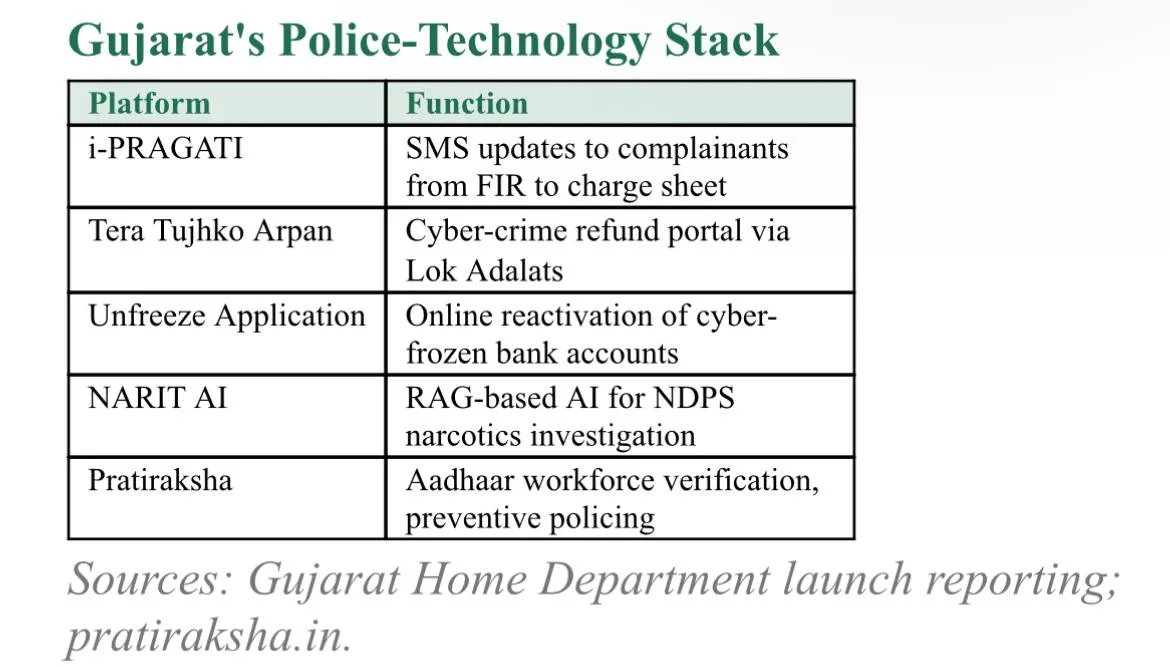
Read across the row, different platforms are there. i-PRAGATI removes human discretion from the flow of case information by automating SMS updates from FIR to charge sheet, attacking the opacity that breeds corruption and citizen frustration. Tera Tujhko Arpan lets cyber-fraud victims recover money without even filing an FIR, collapsing a bureaucratic barrier. The Unfreeze application has already reactivated more than 2.25 lakh bank accounts frozen during cybercrime investigations, sparing citizens repeated police-station visits. NARIT AI, launched in April 2026 as the country’s first state-police narcotics-investigation AI, runs on a closed, verified database precisely to keep its guidance grounded and auditable.
Four threads connect these systems, and Pratiraksha shares all four. Each is built largely in-house by the police rather than bought as an off-the-shelf product, giving the force ownership of its own doctrine. Each is engineered to reduce human interference and the discretion where leakage and abuse occur. Each leans on a closed or offline data posture rather than open, exposure-prone integration. And each is framed as citizen-facing assurance rather than citizen-facing control. The Home Department has signalled an intent to integrate these platforms under a unified system, the clearest evidence that this is an architecture being assembled, not a series of accidents.
What the Pattern Means and What It Has Yet to Prove
Taken together, the three lenses converge. The privacy architecture explains
• how Pratiraksha intends to be acceptable
• the industrial-security gap explains why it exists
• the Gujarat blueprint explains what it is part of a state methodically building indigenous, discretion-minimising, data-disciplined policing tools and moving toward stitching them into one fabric. For other states weighing how to modernise law enforcement without importing either foreign dependency or a surveillance backlash, that combination is the model worth studying.
The architecture and intent of Pratiraksha are documented as its outcomes are not yet public. The figures that would validate the claim through companies registered, workers verified, false identities actually detected and independent confirmation that the offline, no-sharing promises hold under audit. Remained to be released and ultimately, tested in court and by data-protection scrutiny. A privacy by design promise is a starting commitment, not a finished proof. Gujarat has built something architecturally serious, and the next measure of it is whether the shield performs as quietly and cleanly as it is designed to.