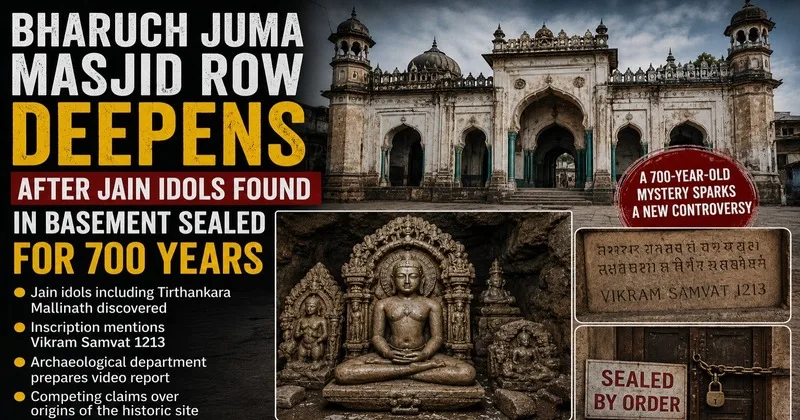
Bharuch: A long-standing dispute surrounding the historic Jama (Juma) Masjid in Bharuch, Gujarat, has intensified following reports that idols of Jain Tirthankara Mallinath and other Jain deities were discovered in a sealed basement of the structure. The basement is said to have remained closed for nearly 700 years, and the findings have triggered renewed debate over the monument’s historical and religious identity.
Another shocking revelation:
Ancient Hindu-Jain idols have been unearthed from the sealed basement of Bharuch's historic Jama Masjid in Gujarat.
Several sculptures, including an idol of the 19th Jain Tirthankara Mallinath, along with an inscription dated Vikram Samvat 1213,… pic.twitter.com/tAqJI0QVgz
— Megh Updates 🚨™ (@MeghUpdates) June 10, 2026
Discovery of murtis and archaeological findings
According to reports from the archaeological authorities, the basement inspection led to the recovery of several murtis believed to represent the 19th Jain Tirthankara, Lord Mallinath, along with other Jain deities. An inscription on some of the artefacts is said to reference Vikram Samvat 1213, suggesting a medieval-era origin.
The archaeological department has reportedly prepared a detailed video documentation of the findings and forwarded it to senior authorities for further examination. The investigation has also included documentation of structural elements and artefacts within the basement area.
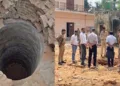
Following public attention and agitation, officials opened the sealed section for inspection and have initiated steps to assess alleged unauthorised installations within the premises, including lighting fixtures, fans, and ablution-related infrastructure reportedly installed without formal archaeological clearance.
Competing historical and religious claims
Hindu and Jain organisations say that the structure was originally a Jain religious site known as Samari Vihar. Some groups also associate the location with the birthplace of spiritual figure Chakradhar Swami. These groups say that the presence of Jain carvings on pillars and the reported discovery of murtis support their assertion that the site was once a Jain temple complex, later converted during historical invasions, including references to the 13th-century period of Alauddin Khilji. The inscription dated Vikram Samvat 1213 strengthens their demand for the restoration of the site’s earlier religious identity.
Mahant Muktanand Swami of the Shankaracharya Math in Navchowki Ovara, Bharuch, had said that the site corresponds to the ancient Jain Samari Vihar. He has cited the discovery of murtis and inscriptions as evidence supporting demands for recognition of its earlier religious identity.
Administrative and legal context
The archaeological department has documented the findings and submitted reports to higher authorities. Officials are now expected to determine the next course of action regarding the protected structure. The property is also subject to oversight frameworks involving the Waqf Board, which governs registered Islamic religious endowments.
To maintain law and order amid rising tensions, one of the main entrances to the basement has been temporarily sealed. Authorities are closely monitoring the situation to prevent escalation while the legal and historical assessments continue.
The archaeological documentation of Jain murtis bearing the Vikram Samvat 1213 inscription is currently under review. Further expert analysis, legal scrutiny, and administrative consultations are expected to determine the historical classification and protected status of the structure.