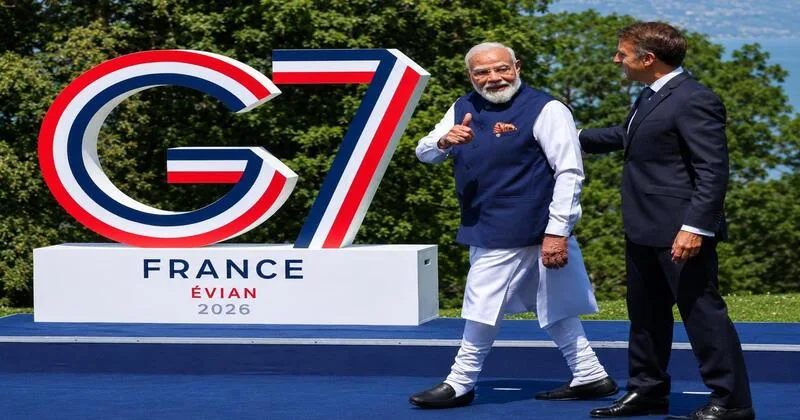
When Prime Minister Narendra Modi attended the recent G7 Summit in Evian, France, he did so as a guest rather than a member. Yet the distinction between guest and participant has become increasingly blurred. India is not part of the G7, does not belong to the Western alliance system and has consistently guarded its strategic autonomy. Nevertheless, successive G7 presidencies continue to invite New Delhi to the table. The reason lies not in diplomatic courtesy but in geopolitical necessity.
The G7 was originally conceived as a forum of advanced industrial democracies. Today, however, the global challenges confronting its members extend far beyond the boundaries of the transatlantic world. Economic fragmentation, supply-chain disruptions, technological competition, energy insecurity, climate governance and geopolitical instability cannot be addressed without engaging countries that shape global outcomes. Among them, India occupies a unique position.
As the world’s most populous country, one of its fastest-growing major economies and a leading voice of the Global South, India has emerged as a power that the G7 cannot afford to ignore. Its repeated presence at the summit reflects a broader transformation in global politics that influence is no longer determined solely by membership in Western institutions but increasingly by a state’s ability to shape international outcomes.
India’s growing relevance to the G7
India’s recurring invitations to the G7 are often viewed through the narrow lens of diplomatic protocol. In reality, they signal a deeper recognition that the effectiveness of the grouping depends on engagement with emerging powers whose decisions increasingly influence global governance.
The G7 countries account for a substantial share of global wealth and technological innovation, but they no longer dominate the world economy as they once did. The centre of economic gravity has shifted towards Asia, and India stands at the forefront of that transition. With sustained economic growth, expanding manufacturing capabilities and a rapidly growing digital economy, India has become integral to discussions on trade, technology and investment.
— G7 (@G7) June 16, 2026
The G7’s priorities increasingly overlap with India’s own strategic agenda. Whether the issue is resilient supply chains, semiconductor production, clean-energy transitions, digital governance or critical mineral security, India has become a central stakeholder. For G7 leaders, engaging India is therefore not merely desirable, it is necessary for achieving meaningful outcomes.
India’s participation also provides legitimacy to broader international initiatives. Policies framed exclusively by advanced Western economies often face scepticism across developing nations. New Delhi’s involvement helps bridge this gap by connecting global governance debates with the concerns of emerging and developing countries.
Strategic autonomy as a source of influence
A striking feature of India’s engagement with the G7 is that it occurs without formal alignment with the West. Unlike several close partners of the United States, India has carefully preserved its freedom of action in international affairs.
This strategic autonomy has often been misunderstood as reluctance to choose sides. In reality, it has enhanced India’s diplomatic value. New Delhi maintains close cooperation with the United States and Europe while simultaneously retaining relationships with Russia and engaging actively within platforms such as BRICS and SCO. Rather than limiting India’s influence, this diversified diplomacy has expanded its relevance across competing geopolitical camps.
The interactions with world leaders continue at the G7 Summit in Evian.@G7 pic.twitter.com/ZOrAaffrcX
— Narendra Modi (@narendramodi) June 16, 2026
The Russia-Ukraine conflict highlighted this reality. While many Western countries sought to isolate Moscow, India adopted a position guided by its own national interests. It continued engagement with Russia while simultaneously deepening cooperation with Western partners. Although this approach attracted criticism in some quarters, it also demonstrated India’s capacity to maintain dialogue across geopolitical divides.
For the G7, such diplomatic flexibility has become increasingly important. In a fragmented international environment, countries capable of engaging multiple power centres possess unique strategic value. India can communicate with actors who do not always engage directly with Western governments. This gives New Delhi an influence that extends beyond traditional alliance structures.
The significance of this role is reflected in the continued high-level engagements between India and the United States. Discussions on trade, technology, defence cooperation, supply-chain resilience and broader geopolitical challenges have become central pillars of the bilateral relationship. These interactions underscore the growing convergence of interests while preserving India’s independent decision-making.
The democratic voice of the Global South
India’s importance to the G7 stems not only from its economic and strategic weight but also from its political identity. It occupies a rare position in international affairs that a major democratic power with deep roots in the developing world.
Many developing countries remain sceptical of international frameworks perceived as dominated by wealthy Western states. India provides an alternative voice within these conversations. It combines democratic credentials with firsthand experience of development challenges, poverty reduction, infrastructure expansion and social transformation.
This dual identity allows New Delhi to serve as a bridge between advanced economies and the Global South. During recent years, India has consistently argued that global governance structures must better reflect contemporary realities rather than the power distribution of previous decades.
Glad to have met President William Ruto of Kenya.
India and Kenya share a longstanding partnership anchored in the aspirations of the Global South. We remain committed to working together for the well-being of our people.@WilliamsRuto @G7 pic.twitter.com/sNnj4fsUkp
— Narendra Modi (@narendramodi) June 16, 2026
Issues such as climate finance, development funding, debt sustainability, food security and equitable technology access resonate strongly across Africa, Asia and Latin America. India’s interventions on these subjects often carry greater credibility among developing nations because they emerge from shared experiences rather than external prescriptions.
For the G7, this credibility is increasingly valuable. Global initiatives require broad acceptance to succeed. Whether addressing climate change, public health, digital inclusion or sustainable development, the participation of countries representing the aspirations of the developing world is indispensable. India offers precisely that connection.
Supply chains, technology and the new economic g geography
One of the most significant drivers of India’s growing relevance is the restructuring of global economic networks. Geopolitical tensions, pandemic-related disruptions and concerns over excessive dependence on single-country supply chains have accelerated efforts to diversify production and sourcing.
India has emerged as a major beneficiary of this shift. Governments and corporations increasingly view the country as an alternative manufacturing destination and a crucial component of future supply-chain architecture. The country’s large market, expanding infrastructure, skilled workforce and policy emphasis on industrial growth have strengthened this perception.
Technology has become another area of convergence between India and the G7. Cooperation spans digital public infrastructure, artificial intelligence, telecommunications, cybersecurity, semiconductor ecosystems and emerging technologies. These sectors are no longer purely economic domains as they have become central to national security and geopolitical competition.
Die Gespräche mit Bundeskanzler Merz waren sehr fruchtbar. Wir haben Möglichkeiten erörtert, wie wir die bilaterale Zusammenarbeit durch gemeinsame Anstrengungen in den Bereichen Handel, Investitionen, Kreislaufwirtschaft, Verteidigung, IT und weiteren Bereichen weiter festigen… pic.twitter.com/J97rAHHSTc
— Narendra Modi (@narendramodi) June 17, 2026
India’s digital transformation has attracted global attention. The scale of its digital infrastructure, combined with its expanding innovation ecosystem, has positioned it as a key participant in debates over technology governance. As governments seek rules for data management, digital trade and emerging technologies, India’s perspectives carry increasing weight.
Energy security and climate transitions further reinforce India’s importance. The country is one of the world’s largest energy consumers and a major actor in renewable-energy expansion. Any meaningful global climate strategy requires India’s participation. Similarly, discussions on green technologies, critical minerals and sustainable development cannot succeed without considering India’s developmental priorities.
Consequently, India’s engagement with the G7 extends beyond diplomatic symbolism. It is rooted in the practical reality that many of the defining economic and technological questions of the twenty-first century cannot be addressed without Indian involvement.
A power the G7 needs, even without membership
The recurring debate over whether India should eventually become a G7 member often obscures a more important reality. Formal membership is not what gives India influence. Its significance derives from its capacity to shape outcomes regardless of institutional status.
India’s value to the G7 lies precisely in the fact that it is not a Western power. It brings perspectives, relationships and political legitimacy that the grouping cannot generate internally. It combines democratic governance with strategic autonomy, major-power ambitions with Global South credibility and strong ties with Western partners alongside enduring engagement with Russia and other non-Western actors.
This combination has become increasingly rare in contemporary international politics. As geopolitical rivalries intensify, many states are pressured to align with competing blocs. India has resisted that binary logic and instead pursued a multidirectional foreign policy that maximises strategic flexibility.
For the G7, engagement with India is therefore not an act of outreach but an acknowledgement of geopolitical reality. The world’s most pressing challenges require coalitions that extend beyond traditional Western institutions. India is central to those coalitions because it possesses the economic scale, diplomatic reach and political legitimacy needed to influence outcomes.